Why Recruiters Are Widening the Pool to Tier-2 and Tier-3 Colleges
Recruiters are expanding campus drives to regional and non-metro institutions in 2026. Readiness, not rank, decides who earns the visit and keeps the recruiter returning.
 Dinesh Raja Krishnasamy 9 min read
 Across the enterprise partnerships I manage, the recruiter conversation has shifted in a specific way over the past eighteen months. The question companies ask about a campus is less often “what is its NIRF rank” and more often “can your students clear our screen.” That shift in the question changes who gets visited.
The evidence is in the hiring plans companies disclosed for FY26. In September 2025, Business Standard reported that Infosys was scheduling campus drives at more than ten smaller and regional engineering institutions across India, with senior-level interview panels going on campus and eligibility extended to ECE, EEE, Mechanical, Telecom, and Civil branches alongside CSE and IT. The company’s fresher target for FY26 was twenty thousand. That volume cannot be sourced only from the institutions at the top of any national ranking table, and Infosys made no pretence that it was trying to.
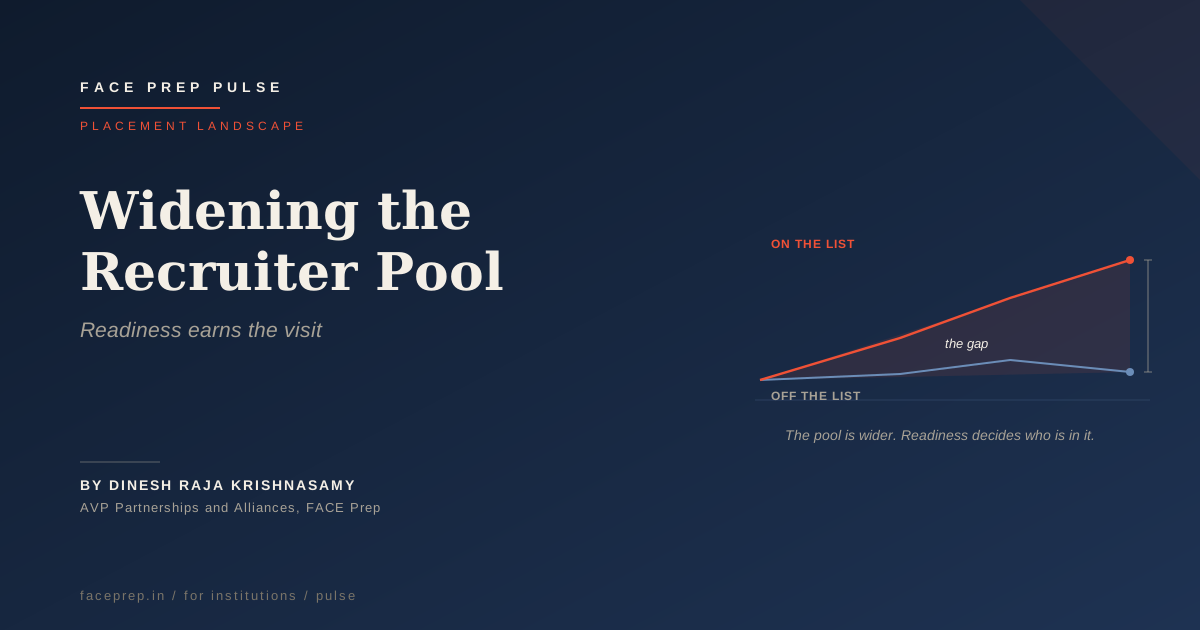
The question for a Principal or a TPO reading this is not whether the pool is widening. The documented answer is that it is. The question is whether your campus is inside it.
Why the recruiter pool is expanding
The supply arithmetic is the explanation. India graduates more than 1.5 million engineering students each year, spread across thousands of institutions. A firm that needs ten to twenty thousand freshers annually and wants each one to be technically ready for a specific role must look beyond the fifty or hundred campuses that appear most often on any shortlist.
What makes the FY26 widening different from earlier cycles is the structure of the drive. Earlier rounds of campus expansion were often pool drives or off-campus formats where students self-selected into a test and the college was a logistics point rather than a supply source. The drives being scheduled for FY26 place the company’s panel on campus, which means the company has made a specific judgment that the campus is worth the fixed cost of sending a team. That judgment is based on supply quality, not prestige.
The corollary is visible in what happens when the supply quality is poor. Rashmi Bhandary, Dean of Career Guidance and Placements at Sahyadri College of Engineering and Management in Mangaluru, noted in the Times of India in August 2025 that saturation in computer-science streams had meant a degree alone no longer carried the weight it once did, and that recruiters were looking for demonstrable skill rather than branch and CGPA as proxies. Rio D’Souza, Principal of St Joseph Engineering College in Mangaluru, observed in the same report that the visible trend was a shift away from mass recruitment and toward smaller, skill-assessed cohorts.
Both observations describe the same phenomenon from the supply side: a drive that yields few offers because the students presenting cannot clear the screen is not a brand problem for the campus. It is a readiness problem. And readiness is within a campus’s power to fix.
What the screen is testing
The formal screen at a widening-pool campus drive in FY26 typically runs four to five rounds: an online aptitude and reasoning test, a coding test in a timed environment, a technical interview, sometimes a domain or project-based round for non-CS branches, and an HR discussion. The format is built around a particular function from the first round, unlike the catch-all aptitude filter that an earlier era’s mass drives ran.
This matters for how a cell prepares. A mass-hiring drive rewarded trainable students who could clear a broad filter; role assignments followed months after joining, inside a common training pool. A role-specific drive rewards students who can demonstrate readiness for a particular function on the day of interviewing. The preparation depth needed is higher, and it must start earlier.
Vijaysekhar Chellaboina, Vice Chancellor of JK Lakshmipat University, described the institutional response to this change in a 2026 Careers360 interview. He argued that universities preparing students for specific tools or languages they might not use five years later are solving the wrong problem. The priority, in his framing, is transferable capabilities: problem formulation, critical thinking, the fundamentals of mathematics and engineering, and communication. The companies doing the selecting draw the same picture. What they call “learnability” is the same thing: can the student think through a new problem, not just reproduce a prepared answer.
For a placement cell, the practical reading is this: the screen is structured and knowable, not arbitrary. It tests skills that can be built with systematic preparation. The campuses that build them consistently across the cohort, not just for the top twenty students, are the ones that earn repeat visits from companies widening their pool.
Where two campuses in the same region diverge
The divergence I see most often is not between a college in a metro and a college in a smaller city. It is between two colleges in the same state, with similar branch mixes and similar cohort sizes, that report entirely different outcomes from the same set of companies in the same cycle.
One of them has two or three recruiters returning for a second or third year, with growing cohort sizes on each visit. The other reports that a company came once and did not come back. The colleges attribute the difference to location, to their reputation, to the economic conditions of that year. The companies, when I speak with them in the course of managing these partnerships, describe it differently. They say some campuses send a pre-screened, ready shortlist before the drive. They say some cells ensure the logistics are frictionless. They say some batches need minimal warmup time before the technical rounds begin. These are the campuses they plan the next year’s calendar around.
The companies widening their pool are not doing so randomly across every available campus. They are expanding to the campuses where the return on the drive visit (measured in good hires per campus day) has been positive. The brand of the college does not produce that return. The preparation the college has built does.
This connects to the broader argument in how campus recruitment is changing from bulk to selective: the selectivity is not just about companies taking fewer students per campus. It is about companies concentrating their visits on the campuses that reliably deliver. The widening pool and the consolidated visit list are two sides of the same calculation.
A college in Madhya Pradesh that reversed the pattern
A Tier-2 engineering college in central India, with roughly 1,800 students across CSE, ECE, and EEE branches, had seen its placement numbers tighten over three consecutive years. A major IT services company had visited once, processed sixty students in a day-long drive, made seven offers, and not returned the following year. The placement cell’s working assumption was that the company had moved to more prominent campuses.
When we worked through the picture together, a different explanation emerged. The company’s internal records showed that three of the seven students who received offers had not joined within the required window, and a fourth had a documentation gap (a missing certificate) that was not flagged until the pre-joining verification stage. The company had not left because the campus was less recognised. It had left because the return on the drive had been poor: seven offers converted to four joins, with a late documentation problem that added work for their HR team.
The college’s response involved three specific changes. First, they built a readiness baseline: all eligible students assessed eight weeks before any planned drive, using the same aptitude and coding format the company was known to run. Second, they set up a pre-drive shortlist process, sharing a readiness summary with the company contact four weeks ahead of the visit, listing the students who had cleared the baseline threshold and whose documentation was already complete. Third, they put in place an offer-tracking mechanism so that acceptance, joining intent, and document verification happened before the company arrived rather than after.
The company returned the following year. The drive processed forty students, made eighteen offers, and seventeen joined within the window. The company added the campus to its confirmed list for the year after that. The college’s name had not changed. Its infrastructure had.
What ECE, EEE, and mechanical branches mean for the eligible pool
Most placement cells I work with default to preparing the CSE cohort for company visits. This is understandable: the bulk of company drives in the IT-services expansion years targeted CSE output almost exclusively, so the preparation machine was built to serve that pipeline.
Documented eligibility criteria for widening-pool drives in FY26 include other branches explicitly. The Infosys FY26 drive listed EEE, ECE, Mechanical, Telecom, and Civil as eligible alongside CSE and IT. A college with a 600-student CSE batch and a 400-student ECE batch is, under those criteria, not a 600-student pool but a 1,000-student pool. The cell that has prepared only the CSE cohort has left 400 students outside the eligible set without a preparation plan.
The preparation for ECE and EEE students shares most of the CSE track (aptitude, reasoning, and the basic programming foundation). What differs is the domain-specific round. A student from EEE being assessed for an automation or embedded systems role will face circuit basics, control systems, and embedded coding questions that a CSE student would not see. This round is preparable. It requires the cell to know, in advance, which companies screening ECE and EEE students are likely to visit, and to run a branch-specific technical track for those students in addition to the shared aptitude and coding preparation.
The table below shows where the preparation gap tends to open up in widening-pool drives:
| Assessment area | What the drive tests | What most cells prepare |
|---|---|---|
| Aptitude and reasoning | Online test, 60-90 min, quant + verbal + logical | One-time workshop before each drive |
| Programming foundation | Live coding in a timed environment | CSE cohort; other branches often excluded |
| Domain round (ECE/EEE/Mech) | Embedded basics, circuits, control systems; or core mechanical domain | Rarely mapped for non-CS branches |
| Pre-drive readiness evidence | Companies expect a pre-screened, ready shortlist | Most cells send unfiltered eligible lists |
| Offer-to-joining readiness | Background check, document verification, timeline clarity | Tracked after offers, sometimes too late |
The gap between the second and third columns is the preparation debt that most cells are carrying. It is not the reason companies expand the pool; they do that because the talent is there. But it is the reason the number of offers from any given campus does not grow as fast as it could once the company is in the building.
For context on how this connects to readiness challenges across the cohort, the 2026 employability gap explained covers what the bar now looks like from the student preparation side.
Building the infrastructure that earns return visits
The thirty-day starting point for most placement cells is not sending outreach to more companies. It is taking an honest look at the preparation state of the current eligible cohort: how many students can clear the first round of a drive that arrives today, and what the gaps are across each branch.
A baseline assessment (aptitude, reasoning, and a coding sample for CSE and IT; a domain-skills check for ECE and EEE) gives the cell a data point it can act on. Running that assessment once as a pre-season snapshot is useful; running it continuously, so the cell has a live picture of who is ready as the season builds, is what actually closes gaps in time. Knowing where students are six to eight weeks before a drive, rather than discovering it on the day, is the practice that separates cells that deliver from those that scramble.
The second step is to identify two or three companies that have documented a widening campus approach for this cycle. Infosys is the clearest FY26 example, with public confirmation that Tier-2 and Tier-3 campuses are being added. TCS’s NQT pool is also open to students from institutions that do not receive direct on-campus visits. For each company, contact the campus relations team early, share the readiness baseline, and offer a pre-screened shortlist when the drive is confirmed. This positions the campus as a supply source the company can rely on rather than a new campus they need to evaluate from scratch.
The third step is drive logistics: all eligible student documents collected and verified before the company arrives, an offer-acceptance tracking mechanism in place, and a brief written debrief shared with the company contact within the week after the drive. Companies planning their campus calendar for the next cycle use the experience of this year’s visit. The cells that make the experience frictionless and the supply reliable find themselves on the confirmed list for the following year.
What keeps companies returning to a campus they have already visited is not brand. It is predictability: a campus that can produce a ready, pre-screened cohort, handle the logistics cleanly, and track outcomes through to joining. That is infrastructure any institution can build. It takes time, not prestige.
The recruiter pool available to a Principal or a TPO in 2026 is broader than most placement cells have yet aimed at. The constraint, on most campuses I work with, is not the number of companies willing to visit. It is the number of students the cell can put in front of those companies with documented confidence. That is a preparation problem, and preparation is something any institution can build over two or three seasons. The cells that build it now, starting with a baseline and a pre-drive readiness process, are not competing for a fixed share of a shrinking pool. They are building access to one that is expanding.
Primary sources
- Infosys plans FY26 campus drives at more than ten Tier-2 and Tier-3 engineering colleges across India; multi-branch eligibility; targets 20,000 fresher hires (Business Standard, September 2025)
- Infosys guides 20,000 fresher hires for FY26, mirrors TCS campus hiring scale (Business Standard, April 2025)
- Placements dip across Karnataka engineering colleges; Rashmi Bhandary, Dean-Placements, Sahyadri, and Rio D'Souza, Principal, SJEC, on skill readiness and shift away from mass recruitment (Times of India, August 2025)
- Vijaysekhar Chellaboina, Vice Chancellor, JK Lakshmipat University: every course and classroom must evolve; focus on transferable capabilities over specific tools (Careers360, 2026)
Frequently asked questions
Are Tier-2 and Tier-3 colleges genuinely being targeted by large recruiters in 2025-26?
Yes, with documented evidence. Infosys announced plans to conduct on-campus drives at more than ten regional and smaller engineering institutions across India for FY26, with interview panels visiting directly rather than requiring students to attend pool drives elsewhere. The company's FY26 fresher target is twenty thousand, and it cannot source that volume only from the top-ranked campuses. Other firms face the same supply math.
Does a college need to be located in a Tier-1 city to attract company visits?
No. Recruiters widening their campus pool are doing so precisely because they need to reach geographies beyond metro campuses. Infosys's FY26 drive included colleges across multiple states, not only in the four major IT cities. Location matters for which companies are within practical reach, but it does not determine whether companies visit; readiness does.
Which engineering branches apart from CSE are eligible in widening campus drives?
Infosys's FY26 eligibility criteria included ECE, EEE, Telecom, Mechanical, and Civil alongside CSE and IT. The specific branches vary by company and role, but multi-branch inclusion has become common in large-scale IT-services and GCC drives. A cell that prepares only the CSE cohort is leaving a substantial share of its eligible students without preparation.
What does a recruiter mean by readiness when deciding whether to visit a campus?
In practice, readiness means two things. First, can the students clear the company's screening rounds (aptitude, coding, and domain-specific) without requiring extensive warmup on the day of the drive. Second, can the placement cell provide a pre-screened shortlist with evidence, so the company's interview team is not spending half the drive filtering from an unscreened pool. Campuses that deliver both consistently earn return visits.
How should a placement cell make itself visible to companies that are expanding their pool?
Contact the campus relationship or talent acquisition team early in the cycle, not in the week before the drive. Share a readiness summary: eligible student count by branch, a summary of the preparation track they have completed, and the college's record on offer-to-joining for previous drives. This positions the campus as a supply source the company can plan around rather than evaluate from scratch on visit day.
Can a college build readiness infrastructure without a large training budget?
The infrastructure that matters most is a habit: a baseline assessment for all eligible students well before the drive season, a preparation track targeting the specific gaps found, and an offer-to-joining tracking mechanism. These do not require large external spend. What they require is starting earlier than most cells currently do, and making the readiness data visible to both the cell and the recruiters.
What is the single most useful thing a placement head can do in the next thirty days?
Run a baseline readiness assessment across all eligible students, covering aptitude, reasoning, and a coding sample for CS branches and a domain-skills check for ECE and EEE. The output tells you two things: how many students can currently clear the first round of a live drive, and which preparation gaps are most urgent. Without this, the cell is guessing about its own supply, which is the same information gap that stops recruiters returning.
Wondering how this applies to your college or university?
Message the FACE Prep team on WhatsApp. We work with 2,000+ institutions on placement training, academic integration, and upskilling programs. Tell us where your placements stand today, and we will share what has worked for institutions like yours.
WhatsApp the FACE Prep teamAbout the author
Dinesh Raja Krishnasamy
AVP – Strategic Partnerships & Alliances, FACE Prep
Dinesh Raja Krishnasamy is Assistant Vice President of Strategic Partnerships & Alliances at FACE Prep. A senior sales and partnerships leader with 10+ years' experience, he works with colleges and universities on building training partnerships and connecting campuses to the employers who hire from them. He holds an MBA from SRM University and a B.Tech in Information Technology.