The 2026 Employability Gap, Explained for TPOs, Principals & VCs
The employability gap is real but misframed. Students are not less capable; the skills recruiters screen for moved, and training lagged. A reframe, and how to close it.
 Karthik Raja 8 min read
 There is a number that gets quoted in almost every conversation I have with a Principal or a VC about placements: some version of how many graduates in India are not employable. It is repeated so often that it has hardened into a verdict on students, and that is where it goes wrong. The gap is real. The way it is usually framed is not, and the framing matters, because it decides whether a college reacts with despair or with a plan.
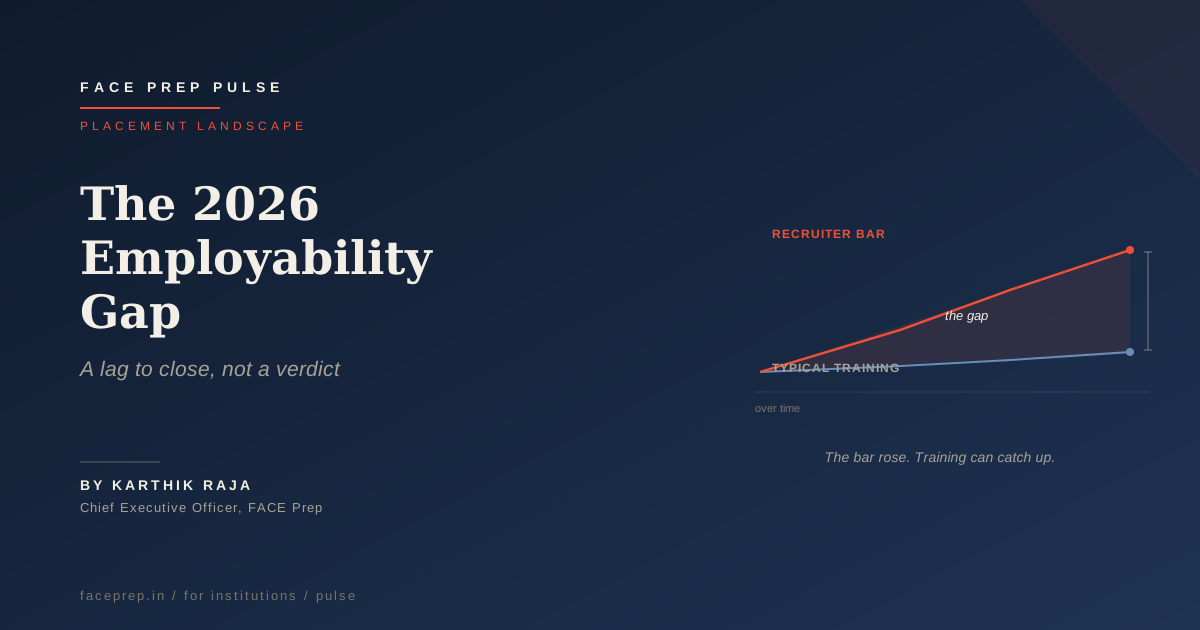
In eighteen years of doing this work across hundreds of campuses, I have not seen a generation of students that is less capable than the one before it. What I have seen is the bar move, faster in the last three years than in the decade before, while a lot of training stayed where it was. That gap between a rising bar and a static syllabus is the employability gap. Read that way, it stops being a judgement and becomes a problem with a solution.
What the employability gap number is measuring
Start with what the figure actually counts, because most of the alarm comes from misreading it. The Economic Survey for 2024-25 put a sharp number on the mismatch: only about 8 percent of graduates hold a job that matches their qualification, with a large share working in roles below their level of study. The Survey framed this as a skills-and-alignment problem in the workforce.
Notice what that figure is and is not. It is a measure of mismatch between what graduates were trained for and where they end up working. It is not a measure of whether students are intelligent, hard-working, or trainable. A student placed in a role below their qualification is not an incapable student. They are a capable student whose training did not line up with what the job market was buying. The distinction is the whole argument, because the two readings lead to opposite responses. Read as a verdict on students, the number invites resignation. Read as a mismatch, it points straight at the fixable thing, which is the alignment between training and hiring.
This is also why two colleges with similar students can post very different employability outcomes. The difference is rarely the raw talent in the room. It is whether the training has kept pace with what recruiters now ask for, and that is a choice a college makes, season after season, whether or not it realises it is making one.
The bar moved while training stood still
If students have not got worse, what changed. The bar did, in two directions at once. Recruiters moved from screening on knowledge toward screening on applied capability, and they added a new layer of AI awareness on top. Meanwhile, a great deal of campus training kept teaching the same aptitude, theory, and coding it taught years ago.
University leaders who are paying attention say this plainly. Professor Vijaysekhar Chellaboina, the Vice Chancellor of JK Lakshmipat University, told Careers360 that “we cannot continue teaching in the same way we have for the last 50 or 100 years,” and that “every course and every classroom must evolve.” He made a point I find especially useful for placements: with AI able to solve textbook problems, the skill that now matters is teaching students “how to formulate problems,” not only how to solve ones already set for them. That is a precise description of the new bar, from inside a university rather than from a vendor.
The system has acknowledged the gap in its own way. AICTE has made internships mandatory across technical programmes, with the stated aim of enhancing the employability skills of students passing out of technical institutions. That is a regulator recognising that classroom learning alone was leaving a practical-skills gap, and trying to close it with real industry exposure. The instinct is right; the point for a college is that the internship only helps if the rest of the training is aligned with it, rather than running on a separate, older track.
Three places the gap opens up
When we look closely at where a college is losing students to the gap, it almost always concentrates in three places. Naming them turns a vague worry into a work list.
The first is depth of fundamentals. A surprising number of students who clear examinations cannot apply the basics under interview conditions: they recognise a concept on paper but cannot reason with it on a live problem. This is the oldest part of the gap and the most foundational. Nothing else holds without it.
The second is applied, hands-on practice. Many students have never built something end to end, never debugged a real failure, never shipped a small working project they can talk about. Recruiters screening for applied capability read that absence immediately. This is the part AICTE’s internship push is aimed at, and the part a college can also build through projects inside its own training.
The third is AI awareness, the newest layer. Students who can put AI to work inside a genuine task, weigh whether its output is right, and field the AI-flavoured problems that have begun showing up in company assessments are meeting a bar most training does not address at all. This sits on top of the first two; it does not replace them.
A college does not need to fix all three at once for everyone. It needs to know which of the three is leaking most for its cohort, which is exactly what an honest skill-gap analysis reveals, and then to route its training there.
The cost of misreading the number
The framing is not an academic point. When a college reads the employability figure as a verdict on its students, three expensive things tend to follow, and I have watched all three play out.
The first is lowered expectations. A staffroom that believes the intake has weakened quietly stops pushing, sets easier targets, and treats poor outcomes as inevitable. The belief becomes self-fulfilling, because students rise or fall to what is expected of them. The second is misdirected effort. Convinced the problem is raw ability, the college pours its energy into the handful of visible toppers who would place anyway, and gives up on the band of students just below them, which is the very part of the cohort where the employability number is won or lost. The third is paralysis at the leadership level. If the cause is a generational decline in students, there is nothing a Principal or VC can do but wait it out, so nothing gets fixed and the gap widens for another cycle.
Each of these flows directly from the wrong reading. The accurate reading, that the gap is a lag between training and a moved bar, points to none of them. It points instead to specific, doable work on the training, which is why getting the framing right is the first practical step, not a philosophical aside.
A college in Punjab that closed the gap in two cycles
The placement head at a college in Punjab put it to me starkly the first time we met: their students were not getting worse, but their results were, and the staffroom had started to believe the two facts were the same. Morale was low, and the assumption was that the intake had declined.
We tested that assumption with a measured baseline rather than a feeling. The intake had not declined. The cohort was as capable as earlier years on raw ability. What had happened was that the college’s training had not moved while the local recruiters, including two captive centres, had quietly raised what they screened for. Fundamentals were adequate but shallow, applied project work was almost absent, and AI awareness was nil. The gap was a lag, exactly, and the staffroom’s despair was misplaced.
The fix was unglamorous and it worked. Fundamentals were deepened with applied problems rather than more theory. A strand of small, real projects was built into the pre-final year so every student had something they had made and could defend. A light, continuous AI layer was added on top for the students whose base was sound. Nothing here required a new building.
The turning point the placement head remembers was not a number; it was a single interview debrief. A student the staffroom had written off as average came back from a centre interview and described being asked to extend a small program and explain the trade-offs, and she had handled it, because she had built and defended projects all year. That one account did more to shift the staffroom’s belief than any amount of argument from me. It made the lag visible as a lag, something the college had caused and could therefore close. Over two cycles, the employability outcome rose materially, the share of students reaching the centres grew, and, as importantly, the staffroom stopped talking about a weaker generation. The students had not changed. The training had caught up to the bar.
Why this is a lag, not a verdict on students
I dwell on the framing because it changes what a college does on Monday morning. If you believe your students are fundamentally less able, there is nothing much to do but lower expectations. If you understand the gap as a lag between training and a moved bar, the path is clear and within your control: find where you have fallen behind, and close that distance.
This is also the empowering reading, and it happens to be the accurate one. Indian engineering students are not short of ability or appetite. The demand for engineers is large and growing in the destinations that are hiring. What is missing is alignment, and alignment is something a college builds, not something it is born with. I have watched lesser-known colleges with ordinary intakes post strong employability outcomes precisely because they treated the gap as a lag and went to work on it, while better-known peers waited for the problem to resolve itself.
What leadership can do this year
For a TPO, a Principal, or a VC, four moves turn the reframe into results within a cycle.
First, measure the gap instead of guessing at it. Run a baseline across fundamentals, applied skill, and AI awareness, so the conversation moves from a vague employability worry to a specific, addressable list of where students stand.
Second, update what is taught toward what is hired for. Deepen fundamentals with applied problems, build small real projects into the training, and add an AI layer for the students ready for it. The syllabus that worked five years ago is the single most common thing left unchanged, and it is left unchanged precisely because it is familiar and was once successful, which is what makes the lag so easy to miss from inside the college.
Third, use the internships you already run as real practical exposure rather than a compliance formality. AICTE requires them; the value comes from treating them as part of the readiness build, with the rest of the training aligned to reinforce what students learn on the job.
Fourth, start early. The gap closes when the work begins in the pre-final year, not in the final-year scramble. Early measurement and early training are what give a cohort time to catch up to the bar before the season opens. A gap spotted in the pre-final year is a training plan; the same gap spotted in the final-year season is a missed placement, and the only difference between the two is when the college chose to look.
None of this turns on the talent in the room, which is the part leaders find most freeing once they have seen their own baseline. The employability gap is a lag a college can close, on its own terms, in a couple of cycles. If it would help to pin down which of the three gaps is widest on your campus and what closing it would take, that is the conversation the For Colleges / Universities page opens.
Primary sources
- Economic Survey 2024-25: only about 8.25% of graduates hold jobs matching their qualifications; skills-qualification mismatch flagged (Ministry of Finance, Chapter 12, Jan 2025)
- We cannot teach the way we have for 50 or 100 years; every classroom must evolve, and we should teach students to formulate problems, not only solve them (Prof. Vijaysekhar Chellaboina, VC, JK Lakshmipat University, Careers360)
- AICTE mandatory internship policy, aimed at enhancing the employability skills of students passing out of technical institutions (All India Council for Technical Education)
Frequently asked questions
What is the employability gap, in plain terms?
It is the distance between what graduates can do when they leave college and what recruiters now need them to do on day one. The gap has widened not because students learn less, but because the bar recruiters screen against has risen toward practical, applied, and AI-aware skills, while a lot of training has stayed where it was. It is a mismatch, not a measure of student ability.
Does a low employability figure mean our students are not capable?
No, and that reading does real harm. The figure reflects a mismatch between training and current hiring requirements, not a decline in student ability. The same students who look unready against the new bar become ready when the training is updated to meet it. Treating the number as a verdict on students leads to despair; treating it as a lag leads to action.
What does the Economic Survey say about graduate employability?
The Economic Survey for 2024-25 highlighted a skills-qualification mismatch in the workforce and reported that only about 8 percent of graduates hold a job that matches their qualification, with a large share working in roles below their level of study. It frames the issue as one of skilling and alignment, which is the same gap a placement cell experiences as students who clear exams but struggle in interviews.
Is the employability gap worse for some branches than others?
The shape differs by branch. In computer science and allied streams, the gap is most often about applied and AI skills sitting on top of fundamentals. In core branches like mechanical, electrical and civil, it is often about practical, hands-on exposure and the specific tools the industry uses. The cause is the same in both: a lag between what is taught and what is currently hired for, which is why it responds to the same kind of fix.
How long does it take to close the gap for a cohort?
Plan for about two academic cycles to move the headline outcome and one to put the work in place. The colleges that close it soonest begin in the pre-final year, take an honest read of where students stand, and update training toward applied and AI-aware skills, rather than waiting for the final-year season to expose the gap when it is too late to fix.
Does closing the gap require expensive new infrastructure?
Usually not. The biggest levers are starting early, measuring honestly, and updating what is taught toward what is hired for, none of which rides on new buildings or heavy new spending. Internships and applied projects, which AICTE already requires, add practical exposure at low cost. The constraint is rarely money; it is attention and the willingness to change a settled syllabus.
How does FACE Prep help a college close the employability gap?
We start by measuring where students actually stand against what recruiters now screen for, then update the training toward the parts that have lagged: deeper fundamentals, applied practice, and AI woven in on top. It is evidence-led work we have refined across institutions over 18 years, and the aim is always to close a lag, not to label a cohort.
Wondering how this applies to your college or university?
Message the FACE Prep team on WhatsApp. We work with 2,000+ institutions on placement training, academic integration, and upskilling programs. Tell us where your placements stand today, and we will share what has worked for institutions like yours.
WhatsApp the FACE Prep teamAbout the author
Karthik Raja
Chief Executive Officer, FACE Prep
Karthik Raja is the CEO of FACE Prep, with 15+ years in education and skilling. He works with colleges and universities across India on placement strategy and outcome-based training that moves real placement numbers.