Skill-Gap Analysis for Colleges: Spot Readiness Gaps Before Drives
A baseline skill-gap analysis, including AI fluency, shows a college exactly where its students stand, so it can act before drives instead of after rejections.
 Venkataraghulan V 8 min read
 I have spent my career building products that put data in front of people who were previously working on instinct, and the same lesson keeps repeating. You cannot manage what you cannot see. Placement readiness is one of the clearest examples I know. Most colleges form a view of how their students will do based on a few visible toppers and a general sense of the batch, and then the season delivers a surprise that the data could have predicted months earlier.
A skill-gap analysis is simply the act of seeing readiness early, across the whole cohort, in the dimensions that actually decide placement outcomes. It is the cheapest high-return move available to a placement cell, and most are not yet doing it properly.
The problem it solves
The default placement cycle is reactive. A company announces a drive, the cell prepares students in the two or three weeks before, and students who were never ready are sent into interviews anyway. The rejection is the first hard signal anyone receives, and by then nothing can be done for that student or that drive.
A skill-gap analysis moves the signal forward. Instead of learning in November that a third of your final-year coders cannot clear a screening round, you learn it in the pre-final year, when there is still time to fix it.
What a good analysis measures
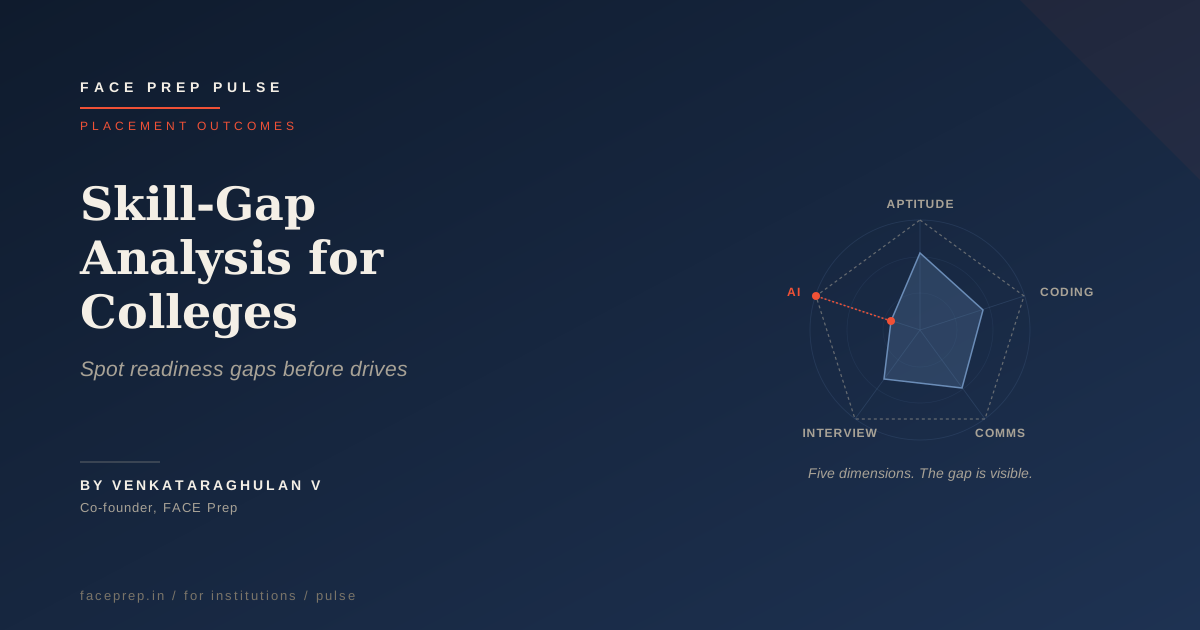
The dimensions matter, because measuring the wrong things produces confident, useless numbers. A useful analysis scores every student across five dimensions, and the fifth is new.
| Dimension | What it tells you | How to assess it |
|---|---|---|
| Aptitude | Readiness for the first screening filter most companies still use | Timed quantitative, logical, and verbal sets in the real test format |
| Coding | Whether the student can write code that compiles and solves the problem | Practical problems in a compiler environment, scored on correctness and efficiency |
| Communication | A frequent silent blocker in interviews | Structured speaking tasks, not a written grammar test |
| Interview readiness | Composure and the ability to explain one’s own work | Mock interviews scored on a rubric |
| AI fluency | Whether the student meets the new bar recruiters screen on | Tasks using AI tools in a real workflow, plus the AI-laced questions now in company tests |
That last row is not optional any more. When NASSCOM and Indeed surveyed employers in 2026, 40 percent said a demonstrable AI skill or certification now counts for more than the degree itself, and the government’s AI Curriculum Taskforce has pushed colleges to roughly double how much of an engineering course is spent on hands-on, practical work. AI has even moved inside company assessments, as we documented in our breakdown of the AI section in the TCS National Qualifier Test. An analysis that leaves AI out is measuring readiness for a market that no longer exists.
Sashi Kumar, the Managing Director of Indeed India, made the point bluntly when the NASSCOM-Indeed report came out in May 2026. “AI is no longer limited to specialist technology roles,” he said. “Employers are responding by hiring for demonstrable skills, certifications and practical capability… continuous learning, hands-on experience and the ability to work with AI will matter more in 2026.” The implication for a placement cell is direct. The thing recruiters now screen on is exactly the thing your readiness analysis has to measure, or you are showing students a passing grade on a test the market no longer gives.
From a one-time snapshot to a continuous view
A single assessment is a photograph. It tells you where the cohort stands on one day. That is useful once, but readiness changes through the year as students train, drift, or improve, and a photograph cannot show that movement.
The colleges that get real value re-measure through the year and watch the trend per student. A student who scored five on coding in July and is still at five in October is a different intervention from one who has climbed to eight. Continuous measurement turns the analysis from a report into an early-warning system.
The cadence that works in practice is three measurements through the pre-final year, four through the final year, with the last final-year measurement timed two to three weeks before the first major campus drive. Each measurement should take less than ninety minutes of student time, otherwise faculty resistance and student fatigue compound and the cadence slips. The point of frequency is not to test more. It is to spot movement, or its absence, early enough that someone can act.
When the data contradicted the staffroom
A Tier-2 university in Odisha runs three engineering schools and about 3,500 students between them. Its leadership knew the placement number was below where it should be; what they did not know was whether the cause was aptitude, coding, communication, or something else. Each school had a confident story about the others. None of those stories was built on data, and most of them turned out to be wrong.
We ran a structured baseline across the pre-final year of all three schools, scored every student on the five dimensions, and produced a single cohort view. The headline was not what anyone had predicted. Aptitude was strong across all three schools, the place faculty had assumed was weakest. Coding was patchy and clustered, two of the three schools had a healthy top quartile but a long thin middle, and the third had structural depth issues. Communication was a quiet blocker for nearly a quarter of the cohort across all three schools. AI fluency was effectively zero, except in the small AI-and-ML programme where it was, predictably, fine.
What changed after the baseline was not the training catalogue. It was the routing. The same teachers, the same materials, mostly the same hours, but allocated by gap. The Principal’s resource conversation moved from “how do we get our placement rate up” to “how do we move sixty students from a five-and-a-half on coding to a seven by November.” The latter has an answer. The former rarely does.
By November the sixty students the Principal had asked about had a documented plan and a re-measurement against it. Most of them cleared the bar, and the ones who did not were visible early enough to get extra mock drives rather than a surprise rejection. Across two cycles, the placement rate rose by about nine points, and the share of offers above seven lakhs more than doubled. The university did not add infrastructure. It simply started seeing what it had been doing all along.
That pattern, where the baseline overturns a settled staffroom assumption, is the rule rather than the exception in a first analysis. We have walked into colleges certain their problem was coding and found it was communication, and into others convinced their students were articulate and found that a third of them froze the moment a question turned technical. The value of the measurement is not that it confirms what the cell suspected. It is that it corrects what the cell suspected, before the season turns a wrong assumption into a placement gap.
How to run the first baseline
For a placement cell about to run its first structured baseline, the work breaks into five compact steps over about two weeks. None of them require new spend; they require focus and faculty time.
First, agree on what “ready” looks like at the end of the pre-final year, in concrete, measurable terms on each of the five dimensions. Second, build or borrow the actual assessment instruments, ideally short enough to fit inside a single ninety-minute slot per student per dimension. Third, run the assessment across the whole pre-final year, not a sample, because the cohort view is the deliverable, not the average. Fourth, score honestly. The temptation to soften a score because a faculty colleague will see it is the single most common reason a baseline turns into theatre. Fifth, share the cohort view with the Principal or VC alongside a routing proposal, so the assessment is paired with a decision from day one.
A baseline without a routing decision is just a report. A baseline with one is the beginning of a working system.
What to do with the data
The score is not the deliverable. The decisions are.
First, route training to the gap. If the data says forty students are weak on communication and sixty on coding, you stop running one blanket class and start running two targeted ones. Second, give management the cohort view. When a Principal or a Director can see readiness across batches at a glance, resourcing decisions get made on evidence rather than anecdote. Third, keep the records. The same data that guides training becomes your NIRF graduation-outcome and NAAC progression evidence when accreditation comes around, so the work counts twice.
A fourth use, often overlooked, is the recruiter conversation. When a placement cell can hand a hiring manager a screened shortlist with documented readiness scores against the dimensions that matter to that company’s role, the conversation changes. The recruiter is no longer being asked to take a chance on a cohort. They are being offered a curated list with evidence. Repeat companies notice, and slot allocations follow. The baseline is not only a training tool. It is the artefact that lets the placement cell speak the recruiter’s language.
What measuring AI fluency looks like
AI fluency is the newest dimension and the one most colleges are still figuring out how to assess. The right test is not whether a student can use a chat interface to generate code. Most can. The harder, more diagnostic test has three parts. The first is whether the student can read what a model produces and identify what is wrong with it, because debugging an unreliable assistant is now part of the job. The second is whether the student can integrate an AI step into a small real workflow, not just generate output in isolation. The third is whether the student can answer the kind of AI-laced reasoning questions that have started appearing inside company assessments, where the AI context is part of the problem itself. A baseline that tests all three gives you a far truer readiness picture than a single “can you use AI” tick.
A note of caution
A skill-gap analysis is a diagnosis, not a cure. I have seen institutions run a careful baseline, produce a handsome dashboard, and change nothing, because no one owned the follow-through. The measurement only pays off if it feeds action: training that shifts toward the gaps, and a second measurement that checks whether the gap closed. Data without a decision attached is just decoration.
The other failure mode is over-engineering. A first baseline does not need the perfect platform, the perfect dimensions, or the perfect rubric. It needs honest scores against a usable rubric, shared with someone who can act on them, repeated three months later. The first iteration is rough; the cadence is what makes it valuable. Cells that delay the first baseline waiting for the ideal tool usually never run one.
A related caution: do not show students only their own score. The point of the analysis is institutional, not personal. Students need to know their gaps so they can work on them, but the value of the cohort view is for the placement cell, the Principal, and the management committee. Mixing the two audiences in a single report tends to produce a sanitised version that helps no one. Keep the student-facing version short and gap-focused, and keep the management view full and honest. They are different instruments for different decisions.
A baseline is where almost every improvement we have made with a college began, because you cannot route what you cannot see. Our framework for improving placement rate and our training design across all batches both build on the baseline this analysis produces, and the For Colleges / Universities page explains how we help colleges run their first one.
Primary sources
- India's AI Talent Inflection Point: 40% of employers prefer demonstrable AI skills over degrees (NASSCOM-Indeed, May 2026)
- Sashi Kumar, MD Indeed India, on demonstrable AI skills and practical capability in 2026 (NASSCOM-Indeed report coverage, CIO&Leader)
- Government AI Curriculum Taskforce: raise hands-on share from 25-30% to 40-75% (Min. Ashwini Vaishnaw, with NASSCOM, May 2026)
- NIRF: Graduation Outcomes is one of five ranking parameters (Ministry of Education, India Rankings)
- TCS folds AI into the National Qualifier Test (our breakdown of the 2026 NQT AI section)
Frequently asked questions
What is a skill-gap analysis for a college?
It is a structured measurement of how ready your students are for placements, scored across the dimensions companies screen on: aptitude, coding, communication, interview readiness, and AI fluency. Done well, it tells you not just an average but who specifically is ready, who is nearly there, and who is still well short.
When should we run it?
Run a baseline in the pre-final year, then repeat through the year. A one-time snapshot tells you where you stand once. A repeated measure lets you catch a student who is slipping and intervene while there is still time, which is the whole point.
Why include AI fluency now?
Because recruiters have started screening for it directly, and AI now appears inside company tests. If your analysis ignores AI, it is measuring readiness for the market of a few years ago, not the one your students are walking into.
What do we do with the results?
Three things. Route training to the gap rather than running blanket classes. Give management a cohort-level view so resourcing decisions are made on data. And keep the records, because the same data becomes your NIRF graduation-outcome and NAAC progression evidence later.
How much does running a baseline cost? Do we need a separate tool?
The first baseline can run on shared assessments and a structured spreadsheet, especially for a single batch. The marginal cost is faculty time over two weeks, not new spend. A dedicated platform starts to pay back when you go from one batch to all four, when re-measurement becomes routine, and when the cohort view needs to live in front of the Principal and the management committee in real time.
What if our faculty disagree with the readiness scores for their students?
Treat the disagreement as data, not a problem. Faculty know individual students in ways the assessment cannot capture. Reconcile by flagging the conflict, looking at the student's actual outputs together, and updating the rubric if a real blind spot is exposed. The goal is one shared picture of who is ready, not a forced ranking imposed on the faculty.
Can FACE Prep run the analysis for us?
Yes. We provide baseline and continuous assessment across all five dimensions including AI readiness, with a real-time view of the cohort for your placement cell and management. It is the same system we have refined across 2,000+ institutions over 18 years.
Wondering how this applies to your college or university?
Message the FACE Prep team on WhatsApp. We work with 2,000+ institutions on placement training, academic integration, and upskilling programs. Tell us where your placements stand today, and we will share what has worked for institutions like yours.
WhatsApp the FACE Prep teamAbout the author
Venkataraghulan V
Co-founder, FACE Prep
Venkataraghulan V is a co-founder of FACE Prep. Previously at Deloitte, he has built and scaled technology products used by 5M+ learners, and leads FACE Prep's work on AI-era employability and the H.E.R.O.S. and DOJO platforms.