Designing Placement Training That Works Across All Batches
Final-year bootcamps look like action and rarely move the number. A design for placement training that runs across all four years, by gap, with AI woven in.
 Karthik Raja 8 min read
 Ask most colleges to describe their placement training and you will hear about a program that begins a few months before the final-year season. It is usually intense, well attended, and disappointing in its results. I have sat through the post-season reviews where everyone agrees the bootcamp was energetic and the placement number still did not move. The design is the problem, not the effort.
Training that moves the number is built differently. It runs across all four years, it trains students by their actual gaps rather than by their batch, and it is shaped by how companies actually screen. Here is how we design it.
Why the final-year bootcamp keeps failing
A bootcamp compresses months of skill-building into a few weeks, on top of projects, exams, and everything else a final-year student is carrying. Aptitude reasoning, clean coding, interview composure, and now AI fluency do not compress that way. They are built through spaced practice over time.
There is a second cost. When training only starts in the final year, the students who were behind in the second year are still behind, only now there is no runway left. The bootcamp sharpens the students who were already ready and barely touches the middle of the cohort, which is exactly where the placement rate is won or lost. Meanwhile the recruiters notice, and a campus that keeps sending unprepared students into interviews is part of why companies trim their slots the next year.
There is also a quieter cost the institution pays. Cognitive load on final-year students is already at its peak with capstone projects, electives, and the placement season itself. A four-week bootcamp added on top, even a well-designed one, asks students to absorb in a month what should have been built over years. The strong students manage. The middle of the cohort burns out, retains little, and underperforms in interviews they could otherwise have cleared with steady earlier preparation.
Five design principles
Start in the pre-final year, lay foundations earlier
The final-year cohort should walk into the season already prepared, which means the work happens in the years before. The government is pushing in the same direction. The AI Curriculum Taskforce it convened in May 2026 asked colleges to bring real industry use-cases into teaching from the first semester onward, while the AICTE’s national internship portal, run under NEP 2020, was built to give students real workplace exposure during the degree, not only at the end. Early exposure is becoming the norm, not the exception.
Train by gap, not by batch
A blanket class for two hundred students bores the strong and loses the weak. A baseline assessment tells you who needs coding, who needs communication, who needs aptitude work. Route students to the track they need. The same hour of training does far more when it is aimed at the right gap.
In practice this looks like three or four parallel tracks running through the year. A coding track for the students who cannot yet write a clean loop, built on the kind of daily practice our DOJO platform is designed around, a more advanced coding track for those who can but cannot yet reason about data structures, a communication track for the third of the cohort that loses interviews on spoken English rather than on technical depth, and a faster track for the top quartile that gets pushed straight to company-pattern practice. The student moves between tracks as the re-measurements come in, not stay locked in the one they started on. That mobility is what makes the design work.
Map training to how each company screens
Generic aptitude practice does not ready a student for the particular shape of a TCS National Qualifier Test, an Infosys assessment, or an Accenture round, now that AI sits inside both the questions and the screening. Build the company patterns your campus actually sees into the program so students have practised the real format before they are in the room.
The corollary is that the program changes when the campus list changes. A college that historically saw a lot of service-tier hiring needs different mock-drive content from one whose top recruiters now include analytics or product firms. A useful exercise at the end of each season is to look at the actual recruiter mix and rebalance the training catalogue for the next year, dropping formats that no longer turn up and adding ones that did. The placement cell becomes the curator of the catalogue, not just a deliverer of fixed content.
Weave AI in, on top of fundamentals
This is the part most programs still skip. TCS has reported that AI-skilled candidates made up 60 percent of its recent fresher intake, against 10 to 15 percent three years before, and the better-paid offers increasingly assume it. But AI readiness only holds on students who can already write clean code and reason through a problem. Build fundamentals first, then layer AI through the program, rather than bolting on a one-day workshop that changes nothing.
What the AI layer looks like is different at each year. In Year 2 it is light familiarity, students using AI tools to support their own coding practice, learning what the model gets right and what it does not. In Year 3 it shifts to small applied projects, where the student has to integrate an AI step into a real workflow, not just generate output. In Year 4 it is interview readiness on the AI-laced questions that now appear inside company assessments. None of this is exotic, and none of it works without the underlying coding fluency.
Space it, and keep measuring
Spread the same content across terms so it sticks, and re-measure through the year so you can catch a student who is slipping while there is still time. Spacing is not a scheduling preference. It is how skills become durable. The cadence we have found workable is a weekly two-hour slot per track through the teaching terms, with a readiness re-measurement at the midpoint and end of each year, light enough to survive a busy academic calendar and frequent enough to catch drift before it compounds.
Dr. V. S. Kanchana Bhaaskaran, the Vice-Chancellor of VIT, put it directly at the HT Future Ed Conclave in December 2025. “Every year, we should be able to change and modify the curricula based on the requirements of the industry,” she said, adding that students “should be able to spend 50 to 60 percent of their time on real tech problems.” That is the institutional version of what we are describing operationally. A program designed to move with the market needs the slack in its calendar to update, and the practical depth in its sessions to land.
What a four-year shape looks like
You do not need a heavy new program to apply this. You need the right thing in the right year.
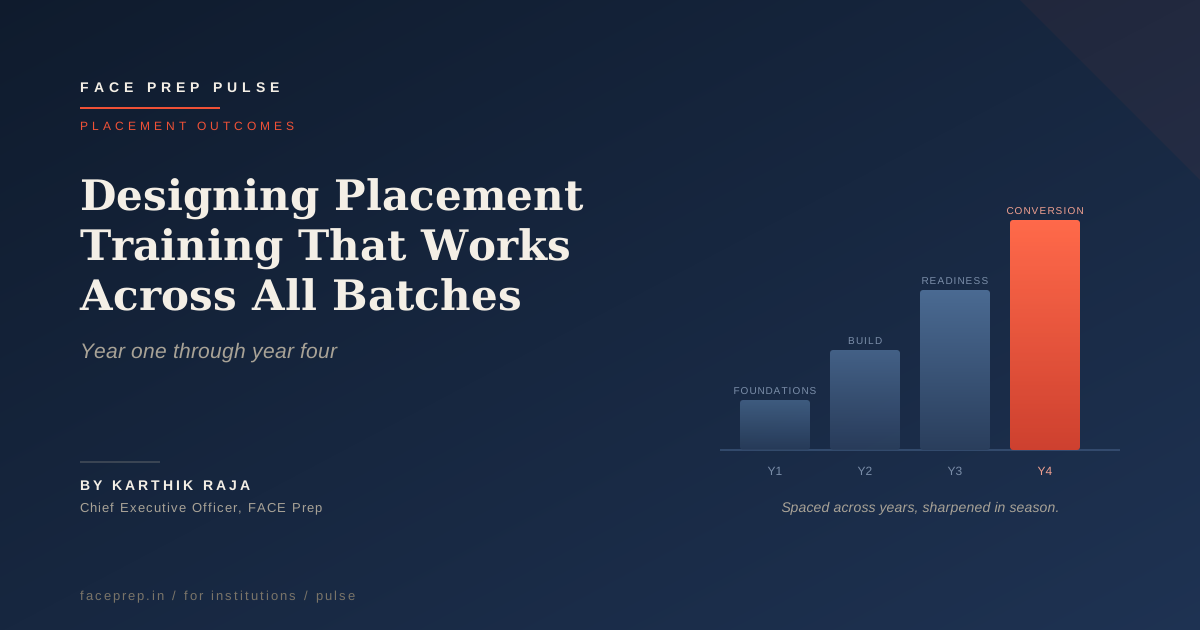
| Year | Focus | What happens | What gets measured |
|---|---|---|---|
| Year 1 | Foundations and exposure | Logic and programming fundamentals, communication basics, first exposure to how the industry works. | Whether the student can write a compilable small program and present a one-minute self-introduction. |
| Year 2 | Build | Data structures and problem-solving, continued communication, early AI familiarity layered on solid coding. | Whether the student can solve a basic data-structures problem and reason through an aptitude set under time. |
| Year 3 | Pre-final readiness | Company-pattern practice, internships, baseline readiness scoring across the cohort, AI woven into real workflows. | Readiness on all five dimensions, with at least one re-measurement to see movement. |
| Year 4 | Conversion | Company-mapped mock drives in the real, AI-laced formats, interview practice, and targeted help for students who are close. | Mock-drive conversion rate per company format, with a target of clearing the second attempt before the real drive arrives. |
What changes the placement rate is not the table. It is the discipline of measuring the listed indicator at the end of each year and refusing to push a student forward in the calendar without addressing it. That is the difference between a program that lifts a cohort and a program that has a beautiful chart.
From an August bootcamp to a four-year build
A Maharashtra engineering college with about 2,500 students across mixed branches had run the textbook bootcamp model for years: a four-week intensive every August, all hands on deck, the placement cell barely visible between January and July. The rate held in the high thirties, the higher-paid offers always went elsewhere, and the faculty ended each season exhausted.
We did not start by changing the August intensive. We started by adding a Year 2 layer, a weekly two-hour slot that built data structures on top of the first-year programming foundation. By the start of Year 3, the cohort had a six-month head start on the previous year’s cohort at the same point. The Year 3 layer added company-pattern practice and the AI weave, again as a weekly cadence rather than a separate event. The August intensive in Year 4 stayed, but it became a sharpening round, not the main act, and its content shifted toward the two or three company formats the campus actually saw.
Across two cycles the headline placement rate climbed about twelve points. The faculty hours were roughly the same; they were just distributed across the calendar rather than concentrated. The bootcamp had been doing a real job, sharpening, that it now did better because the cohort it sharpened was already prepared.
The design mistake we kept repeating
For a long time we designed each year’s training in isolation. The first-year induction was built by one set of people, the pre-final readiness push by another, and the final-year drills by a third, and nobody owned the joins between them. The result was a program that looked complete on a slide and lost students in the gaps. A cohort would finish a strong Year 2 module and arrive in Year 3 to a syllabus that assumed none of it, so the same data-structures material got taught twice while interview practice never got taught at all.
What fixed it was treating the four years as one system with explicit hand-offs. Each year now ends with a defined readiness state that the next year is built to assume, and the measurement at the year boundary is what proves the hand-off actually happened. The content barely changed. The sequencing and the joins did, and that is what moved the number.
How to switch from a bootcamp model to a spaced one
For colleges already committed to the bootcamp, the switch does not have to be all at once. The lowest-risk path is to add years backwards. Keep the existing Year 4 intensive, add a Year 3 weekly cadence first, then a Year 2 layer the following year, then Year 1 the year after that. By the third cycle the bootcamp is doing a different job, sharpening rather than building, and the faculty load has redistributed without anyone having had to give anything up. The first cycle is the most uncomfortable, because the Year 3 cohort gets the new layer late, but it is also the cycle where the placement cell starts seeing readiness data it never had before.
The discipline that holds the whole switch together is a single measurement at each year boundary, the same five dimensions scored the same way. That boundary check is what tells you whether Year 2 actually handed a stronger cohort up to Year 3, or whether the new layer is being taught into a vacuum. Without it, a spaced program quietly decays back into four disconnected modules within two cycles, which is the isolation trap all over again.
This is design work, and it is the part most colleges find hardest to do alone. If you want a second view on sequencing a four-year program for your own campus, the For Colleges / Universities page is the place to talk it through, and our framework for improving placement rate covers the levers this training design plugs into.
Primary sources
- TCS: AI-skilled graduates make up 60% of fresher hiring (CHRO Sudeep Kunnumal, Business Standard, Mar 2026)
- Government AI Curriculum Taskforce: raise hands-on share from 25-30% to 40-75% (Min. Ashwini Vaishnaw, with NASSCOM, May 2026)
- AICTE National Internship Portal, run under NEP 2020, links students to industry work (AICTE CCO Buddha Chandrasekhar, The Hindu, 2026)
- Placements dip at Tier-2/3 engineering colleges; principals report about 40% placement (Times of India, Aug 2025)
- VIT VC Dr. V. S. Kanchana Bhaaskaran on annual curriculum review and 50-60% practical time (HT Future Ed Conclave, Dec 2025)
Frequently asked questions
When should placement training start?
In the pre-final year at the latest, and ideally earlier with foundations laid from the first year. Aptitude, coding, communication, and AI fluency are built over months. A final-year-only program is the usual reason a placement rate refuses to move.
Is a final-year bootcamp useful at all?
As a final sharpening, yes. As the main strategy, no. You cannot build reasoning, clean code, interview confidence, and AI fluency in a four-week block on top of everything else a final-year student is carrying. Bootcamps feel like action but rarely change the result on their own.
How do you train a whole batch with different ability levels?
By training to the gap, not to the batch. A baseline tells you who is weak on coding, who on communication, who on aptitude. You then route students to the track they need rather than running one blanket class for everyone, which bores the strong and loses the weak.
Where does AI fit in placement training?
On top of fundamentals, woven through, not as a one-day workshop. Students need to use AI tools inside a real workflow and handle the AI-laced questions now in company tests. But AI only holds on students who can already write a clean loop, so the order is fundamentals first.
What about faculty load? We do not have spare hours to add another training program.
A spaced design usually adds less faculty load than the bootcamp it replaces, because the same content is distributed across weekly slots rather than crammed into a packed pre-season month. The bigger lift is in design and routing, which is where a partner like us is useful. Once the routes are set, faculty deliver on their normal teaching cycle.
How quickly will the placement rate move once we switch to a spaced model?
The shift typically shows up over two cycles. Year one moves the final-year cohort modestly because their runway is already short. Year two moves it more, because the pre-final year has been on the spaced model for a full year by the time they reach the season. The largest gains we have seen come from colleges that committed to the spaced model for three consecutive cycles.
Can FACE Prep deliver training across all batches?
Yes. We design and deliver year-wise programs that train by gap, map to the companies that actually hire on your campus, and build AI readiness on top of coding fundamentals, with continuous assessment and a live cohort view underneath. We have delivered this with more than 2,000 institutions over the past 18 years.
Wondering how this applies to your college or university?
Message the FACE Prep team on WhatsApp. We work with 2,000+ institutions on placement training, academic integration, and upskilling programs. Tell us where your placements stand today, and we will share what has worked for institutions like yours.
WhatsApp the FACE Prep teamAbout the author
Karthik Raja
Chief Executive Officer, FACE Prep
Karthik Raja is the CEO of FACE Prep, with 15+ years in education and skilling. He works with colleges and universities across India on placement strategy and outcome-based training that moves real placement numbers.