From Bulk to Selective: How Campus Recruitment Is Changing in India
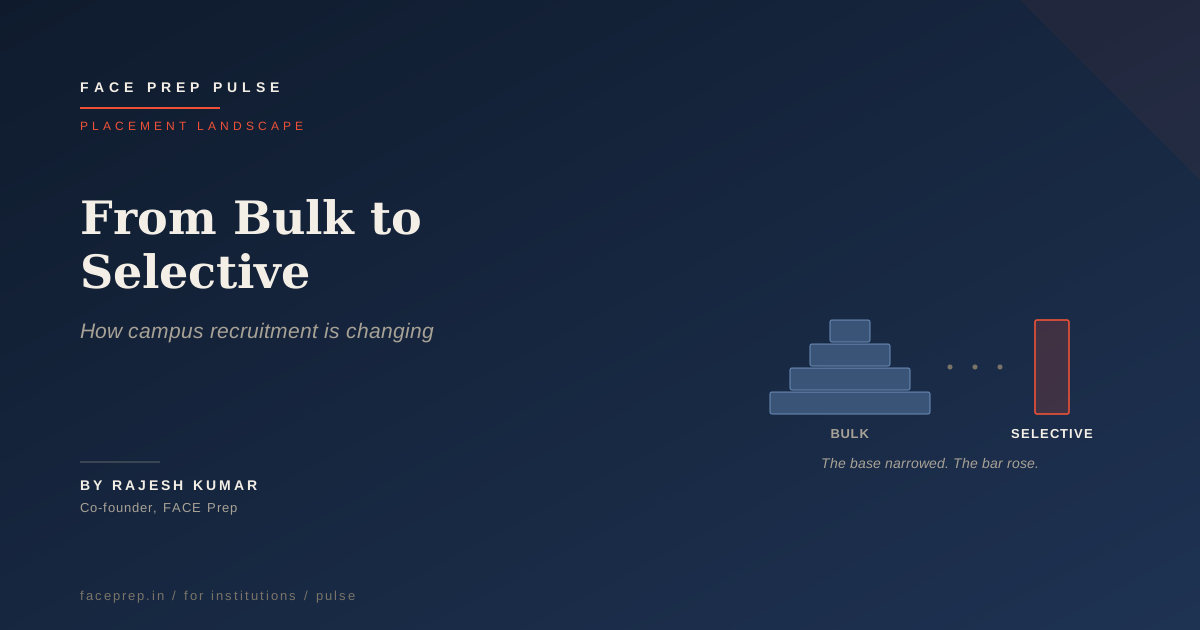
The IT services pyramid that campus hiring was built to feed is narrowing. Recruitment is now fewer, deeper, and choosier, and colleges that go deep on a segment win.
 Rajesh Kumar 8 min read
 For most of the last two decades, the Indian IT services industry hired the way a pyramid is built: a very wide base of freshers at the bottom, narrowing as people rose through the firm. Campus placements were wired to feed that base. A company would visit, run a large drive, and take a hundred or more students from a single campus into a common training pool.
I have spent eighteen years building relationships with the firms on one side of that drive and the universities on the other, and the change I see now is not that the firms have stopped coming. It is that the pyramid itself is changing shape, and the campus model built to feed the old one is the thing that feels broken.
The pyramid that campus hiring was built to feed
The pyramid logic was simple and it worked for a long time. Services revenue scaled with people. More projects meant more hands, so the firms needed a large, steady intake of freshers they could train and bill. The wide base was the business model made visible, and campuses were the supply line.
Everything about the old campus drive followed from that. The big aptitude paper made sense as a way to filter thousands quickly. The general training pool made sense because the firm would decide later where each recruit went. The volume made sense because the base genuinely needed to be wide. A college that produced a large cohort of trainable students was exactly what the model wanted.
That is the system most placement cells were built around, and it is the system that is now under strain, not because colleges did anything wrong, but because the business it served has changed underneath it.
Why headcount and revenue are coming apart
The single most important signal in the whole shift is that the firms are separating revenue growth from headcount growth. For the first time at scale, they can grow the business without growing the base in the old proportion.
Cognizant put numbers on it plainly. Its chief executive described adding around 14,000 people, about 4 percent of its workforce, while revenue grew by more than 6 percent, and said the non-linearity was showing up in the model. He framed the direction as decoupling revenue growth from headcount growth. When a services firm can do that, the economic reason for a very wide fresher base weakens, and the intake narrows with it.
The other firms describe the same direction in their own words. Wipro’s chief human resources officer said this year’s hiring had been project-based and skill-based rather than a broad campus sweep. HCLTech has kept its fresher intake selective while expanding AI-linked work. Industry commentary through late 2025 framed the whole tech hiring picture as being reshaped by AI reinvention becoming the foremost growth priority for the firms. Across the sector the language has shifted from how many we will hire to whom, for what, and at what skill level. That is the pyramid turning into a narrower shape.
It would be wrong to read this as doom. The firms are still hiring, and Cognizant for one still plans a large fresher intake this year. The point is not that the door has closed. It is that the door is narrower and the bar to walk through it is higher, and the way a college prepares students has to change to match.
What a selective filter rewards
From my side of the table, sitting with the firms that do the hiring, the change in what they want is as real as the change in how many they take. A bulk drive rewarded one thing above all: a trainable student who would clear a broad filter and slot into a common pool. The firm expected to spend months shaping that recruit, so raw trainability was enough.
A selective hire is judged differently because the firm is no longer planning to carry a long, generic training period. It wants a student who can become useful on a real project quickly. So the filter now reads for proof of work over potential alone: a project that runs and that the student can defend, code that holds up to questioning, and the judgement to reason through an unfamiliar problem rather than recite a known one. The recruiter is, in effect, asking a sharper question than the bulk drive ever did. Not can this student be trained, but can this student contribute soon.
This is why a college cannot meet selective hiring with more of the old preparation. More aptitude drilling and more memorised solutions produce a student who clears the bulk filter the firms are using less and less. The selective filter is reading for something the old training never had to build, which is demonstrable, defensible capability on real work.
There is a second thing the firms now value that the bulk drive never tested for: communication about one’s own work. A selective hire is expected to explain a decision, walk a reviewer through a piece of code, and reason aloud about a trade-off, because they will be doing exactly that on a small team from early on. In the bulk model, that polish could come later, in training. In the selective model, a student who has built something good but cannot talk about it clearly still loses the offer. So the preparation a college builds has to join the technical depth to the ability to defend it, which is a different and more demanding standard than either the aptitude paper or a coding test alone ever set.
What selective hiring asks of a college
When hiring was about volume, a college optimised for volume: prepare everyone to a common standard, send the whole cohort at the drive, and let the recruiter’s wide net do the sorting. That was the right strategy for the model that existed.
Selective hiring asks for something close to the opposite at the top end. The recruiter is now running a finer filter and taking fewer students, each tied to a specific need. A college that sends a large, evenly-prepared cohort into that filter watches most of them fall out, while the few who would have stood out get no special preparation because the effort was spread thin across everyone.
The response is depth over breadth, applied with judgement. Keep a base of readiness for the whole cohort, because the fundamentals still decide every destination. But concentrate real depth on the segment that can realistically reach the selective roles, and prepare that group for the precise way those roles screen, which leans on projects, applied problem-solving, and a specific stack far more than on a timed general test. This is not about writing off any student. It is about matching the depth of preparation to the kind of hiring each student is actually heading into.
The maths that no longer works
There is an old placement-cell arithmetic worth retiring. It went: if we send enough students at enough drives, the law of averages will place a good number, so our job is to maximise the volume going through the funnel.
That maths assumed a wide base and a recruiter taking large numbers. Both halves have weakened. Sending more unprepared students at a narrower set of selective roles does not raise placements; it lowers them, because each unprepared candidate who fails an interview also spends a slot and dents the college’s standing with that recruiter. In a selective market, the quality of who you send matters far more than the quantity, and a smaller, well-matched, well-prepared group will out-place a large, generically-prepared one almost every time.
A college in West Bengal that went deep on a segment
A college in West Bengal we worked with had a classic bulk-era setup: prepare the whole final year to one common standard, send everyone at every drive, and hope the averages delivered. As the volume drives thinned, the averages stopped delivering, and the placement number fell two years running.
Rather than push harder on volume, the cell did something it found uncomfortable at first: it segmented. It identified the roughly one in four students who, with focused work, could realistically reach the selective roles at the captive centres and product firms in the region, and built a deeper, project-led track for that group, while keeping a solid base track for everyone else aimed at the volume roles that still existed.
The first reaction from some faculty was that this was unfair to the rest of the cohort. In practice it was the opposite. The base track was stronger than the old common standard, not weaker, because it was no longer stretched to also serve the top students. And the focused segment began converting at the selective roles the college had never reached before. Within two seasons the overall placement number had recovered, the average package had risen, and, importantly, two centres that took students from the focused group came back the next year. The college had stopped competing on volume in a market that had stopped rewarding it.
What made the segmentation work was honesty in the assessment behind it. The cell did not pick the focused segment by class rank or by who the faculty liked. It picked them on a measured read of who could realistically reach the selective bar with focused work, which meant some quiet students with strong project instincts made the group and some confident toppers did not. Getting that selection right, on evidence rather than reputation, was the difference between a deeper track that paid off and one that simply concentrated effort on the usual names.
Where bulk hiring still happens
It would be a mistake to swing too far and tell a college that volume hiring is finished. It is not. Parts of the service tier still hire in real numbers, some operations-heavy functions take large cohorts, and for a great many students one of those roles is a genuine, worthwhile start to a career. A college that abandoned volume preparation entirely would fail exactly those students.
The judgement is in the mix. The bulk roles are now one part of a wider set of destinations rather than the whole game, so a placement cell should prepare for them as one track among several, not as the default that absorbs all the effort. A college that reads its own intake data honestly will usually find that the volume roles still account for a meaningful share of its placements, just no longer the overwhelming majority they once were, and the preparation should reflect that real proportion rather than yesterday’s. Hold the base for everyone, keep a real volume track for the students it suits, and build the deeper selective track on top. The error to avoid is preparing the whole cohort as if the pyramid were still wide, because that is the one shape the market has clearly left behind.
There is a partnership angle to all of this that management committees should not miss. In the bulk years, the relationship with a recruiter was largely transactional: they announced a drive, the college supplied a cohort, and the connection went quiet until the next season. Selective hiring makes the relationship matter more, not less. A firm taking a small, carefully chosen group wants to know the college understands its roles and can supply students matched to them, which is a closer, more continuous relationship than a once-a-year drive ever required. The colleges that adapt well to selective hiring tend to be the ones that treat their recruiters as ongoing partners rather than annual visitors.
For institutional leadership, the useful question is no longer how many students can we put through the drives. It is which students are heading for which kind of hiring, and are we preparing each group for the screen it will actually face. If it would help to think through how your cohort splits and where the depth should go, the For Colleges / Universities page describes how we work through that with an institution.
Primary sources
- Cognizant decoupling revenue growth from headcount: 4% workforce growth against 6%+ revenue, the non-linearity showing up in the model (CEO Ravi Kumar S, Economic Times, Feb 2026)
- Wipro: campus hiring this year is project-based and skill-based (CHRO Saurabh Govil, The Hindu, Jan 2026)
- HCLTech keeps fresher hiring selective while expanding AI-linked work (The Hindu, Oct 2025)
- India's tech hiring is being reshaped as AI reinvention becomes the foremost growth priority (industry outlook, The Hindu, Oct 2025)
Frequently asked questions
What does the shift from bulk to selective hiring mean?
It means recruiters are taking fewer freshers per campus, choosing them more carefully, and tying the hire to a specific skill or project rather than a general training pool. The total number of seats at the largest firms is smaller than in the bulk years, and each seat is harder to win. It is a change in how hiring works, not a withdrawal from campuses altogether.
Why are IT companies hiring fewer freshers in bulk?
The core reason is that they are separating revenue growth from headcount growth. As more delivery is done with AI and automation, a firm can grow revenue without adding people in the old proportion. Cognizant described adding about 4 percent to its workforce while revenue rose over 6 percent, calling it non-linearity in its model. When that link weakens, the wide fresher base the pyramid needed shrinks with it.
Are smaller and less-known colleges hit hardest by selective hiring?
It pressures the institutions that leaned hardest on bulk drives, which are often the Tier-2 and Tier-3 ones. But selective hiring rewards preparation over prestige: a recruiter choosing carefully will take a well-prepared student from a lesser-known college over an unprepared one from a famous campus. The opening for these colleges is to prepare a focused segment deeply rather than to compete on volume.
Should a college prepare fewer students more deeply, or all students the same?
Keep a base level of readiness for the whole cohort, since the fundamentals matter for every destination. But concentrate depth where it pays: identify the students who can realistically reach the selective roles and prepare that segment thoroughly for the specific way those roles screen. Spreading the same thin preparation across everyone suited the bulk era, not this one.
Is bulk hiring gone completely?
No. There are still roles and firms that hire in volume, including parts of the service tier and some operations-heavy functions, and for many students those remain a solid first job. The change is that bulk is no longer the whole market or even most of it, so a college that prepares only for volume drives is competing for a shrinking share while the selective roles go unaddressed.
What should a placement cell change first?
Start with the target list and the segmentation. Map which of your students can realistically reach selective roles and which are best served by volume drives, then prepare each group for the screen it will actually face. The single biggest waste in the old model was sending unprepared students into rounds they could not clear, which also cost the college its standing with the recruiter.
How does FACE Prep help colleges adapt to selective hiring?
We help a college read its own cohort honestly, identify the segment that can reach the selective roles, and prepare that group for the specific way those roles screen, while keeping a base of readiness for everyone. We have built relationships with universities and enterprises over 18 years, so we map preparation to what the firms are actually hiring for rather than to a generic syllabus.
Wondering how this applies to your college or university?
Message the FACE Prep team on WhatsApp. We work with 2,000+ institutions on placement training, academic integration, and upskilling programs. Tell us where your placements stand today, and we will share what has worked for institutions like yours.
WhatsApp the FACE Prep teamAbout the author
Rajesh Kumar
Co-founder, FACE Prep
Rajesh Kumar is a co-founder of FACE Prep and an IIM Kozhikode alumnus. Over 18 years he has built FACE Prep's relationships with 1,600+ universities and 500+ tech enterprises, connecting campuses to the companies that hire from them.