Off-Campus and Pooled Drives: A Pipeline Beyond Your Own Gate
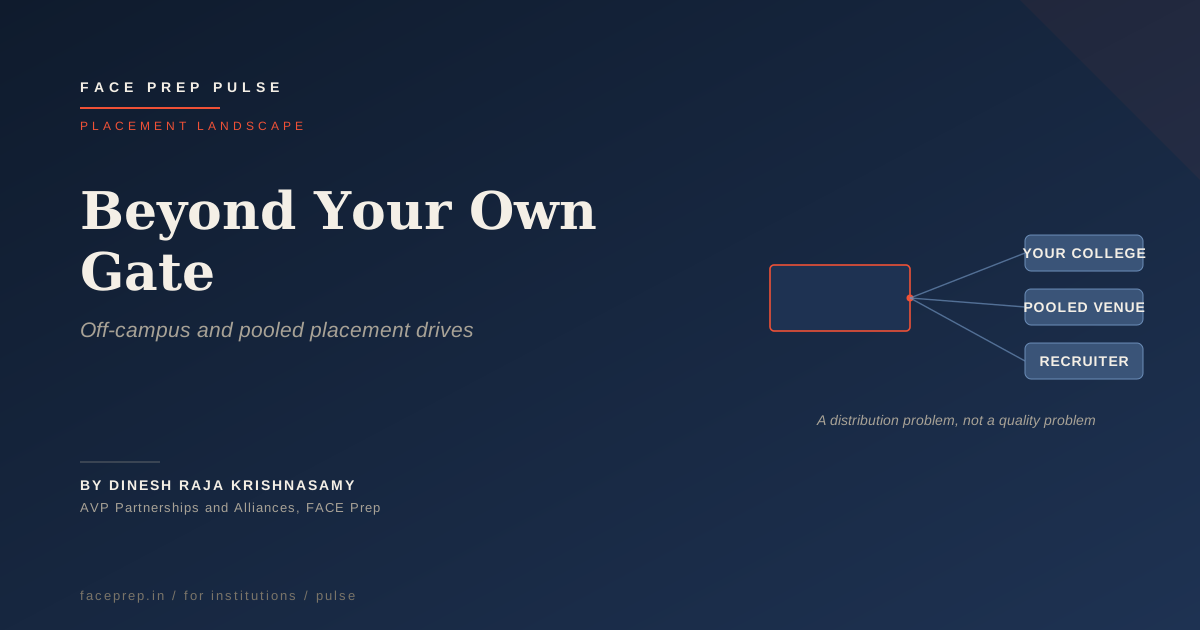
Pooled and off-campus drives solve a distribution problem, not a quality problem. How smaller colleges reach recruiters who will never visit solo.
 Dinesh Raja Krishnasamy 10 min read
 A recruiter running a solo campus drive in Tamil Nadu in 2019 could reasonably expect to interview around 400 shortlisted students in a day. The same recruiter, joining the state’s pooled statewide drive that year, could interview up to 2,400 shortlisted candidates drawn from more than 150 colleges, in roughly the same amount of time. T. Kalaiselvan, then Additional Director of Anna University’s Centre for University-Industry Collaboration, gave those figures to the Times of India as the reason IT majors and core-sector firms kept signing up for the statewide process rather than running dozens of individual visits.
That six-fold difference in reach per visit is the entire logic of a pooled drive, and it has not changed since 2019. What has changed is how many states and institutions now run some version of it, and how many colleges still treat it as a fallback rather than a channel worth building deliberately.
What “off-campus” and “pooled” mean, and why the split matters
Two different mechanisms get grouped under the same loose phrase, “beyond a single campus visit,” and it is worth separating them because a placement cell prepares for each differently.
A pooled or cluster drive brings students from several colleges together, usually at a host campus, a district skill centre, or a state-run venue, so one recruiter visit covers a combined batch instead of one college’s cohort. The college is still part of the process; it just shares the room with other institutions.
An off-campus drive removes the campus visit altogether. A company opens applications directly, most often online, and any student who meets the eligibility criteria can apply regardless of which college they attend or whether that college has ever hosted the company. TCS’s National Qualifier Test is the most familiar large-scale example: students register individually, and the college’s role is limited to informing students the window is open, not organising a visit.
Both exist to solve the same constraint. India has thousands of engineering colleges, and no recruiter, however large its fresher intake, can send a team to visit each one. A recruiter either aggregates several colleges into a single visit (pooled) or removes the visit requirement entirely (off-campus). For a placement cell, the practical question is not which format is superior. It is which one is actually available to your college this cycle, and whether you are positioned to make it count.
The distribution wall smaller colleges hit
The colleges that most need these channels are also the ones least likely to know they exist, or how to get into them. A Tier-2 or Tier-3 college with a strong, well-prepared batch of 300 students can still fail to attract a single major recruiter for a solo visit, for a reason that has nothing to do with the students: the college does not clear the volume threshold that makes a dedicated visit worth a recruiter’s fixed travel and assessment cost. A firm hiring a few hundred freshers a year cannot justify a team, a day, and an assessment setup for a campus that might yield five offers.
This is a distribution problem, not a quality problem, and the two get confused constantly. A placement cell that reads “no company visited us this year” as a verdict on its students is answering the wrong question. The real question is whether the college found a channel where its scale, combined with others, clears the threshold a recruiter needs.
That is exactly what a pooled drive fixes. A recruiter who would not travel for 300 candidates at one campus will travel for 3,000 candidates spread across fifteen campuses at a single venue, because the fixed cost of the trip is now spread across a return worth having. The colleges inside that pool are not being rescued out of charity. They are being included in a recruiter’s arithmetic that only works at aggregate scale.
What the current pooled and off-campus channels look like
Tamil Nadu’s Naan Mudhalvan programme is the largest active example of a state running this at scale. As of a Times of India report from July 2025, the state had trained 41.38 lakh students and reported more than 1.02 lakh students placed through pooled campus placements and job fairs combined. The programme runs alongside each college’s own placement activity; it is an additional channel layered on top of, not a replacement for, direct recruiter relationships a college builds itself.
Government-brokered drives are not limited to statewide, multi-sector programmes. In December 2025, Gujarat’s Directorate of Technical Education organised a four-day special placement drive at L.D. College of Engineering in Ahmedabad, bringing together students from 47 government technical institutes for a single employer, Reliance Industries. More than 3,800 students registered; after an online assessment and interviews, 225 degree-engineering students received offers, with diploma-stream interviews still underway when the results were reported. The structure is narrower than Tamil Nadu’s model, one recruiter, one state department, one venue, but the underlying logic is identical: aggregate enough eligible students from enough colleges to make a single, large, well-organised visit worth a major recruiter’s time.
A third route sits outside government programmes entirely. AICTE has, since 2023, operated a placement portal aimed specifically at rural and semi-urban engineering colleges. Then-Chairman T.G. Sitharam described its purpose to the Times of India as connecting students at colleges outside the usual recruiter circuits with companies that would not otherwise reach them. This is closer to an off-campus mechanism than a pooled drive: it widens who can be discovered, rather than aggregating colleges into a shared physical event.
None of these three routes requires a college to be large, well-ranked, or metro-located to participate. What they require is that the college is registered, that its student data is current and verified, and that its cohort shows up ready when the opportunity arrives.
What separates a pooled drive that converts from one that just adds crowd
Scale alone does not produce offers. A pooled venue with 3,000 candidates and weak preparation across most of them gives a recruiter a bigger room to sift through, not a better outcome. Recruiters know this, and the ones who run pooled or state-brokered drives well are explicit that they are looking for organised, verified pools, not just large ones.
Two things separate the colleges that convert inside a pooled drive from the ones that attend and come away with little.
The first is a readiness baseline, done ahead of the drive rather than assumed. A college that knows, before the assessment day, how many of its eligible students can clear an aptitude and coding screen at the level the recruiter typically sets is a college that can send its strongest shortlist forward with confidence, and use the remaining weeks to close specific gaps for the rest. A college that has not measured this is gambling on the day itself.
The second is an honest, verified shortlist the college can stand behind. In a pooled setting, a recruiter is often relying on each participating college to vouch for its own students’ eligibility and documentation. A college whose list is accurate, current, and free of last-minute surprises, backlog issues, missing certificates, incorrect batch years, becomes a source the recruiter trusts on the next pooled drive too. A college whose list creates friction gets quietly deprioritised the following cycle, even inside a state-run programme where attendance itself is not the bottleneck.
The table below sets out what tends to separate the two outcomes at the same pooled event.
| What happens at the drive | College that converts | College that adds crowd only |
|---|---|---|
| Readiness before arrival | Baseline assessed 6-8 weeks ahead; targeted prep for identified gaps | No baseline; students attend without a diagnostic |
| Shortlist accuracy | Verified branch, CGPA, backlog, and documentation before the day | Errors surface during on-site verification, costing time |
| Assessment-format familiarity | Students have practised the recruiter’s typical test structure | Students meet the format cold |
| Follow-up after the drive | Offer-to-joining tracked; debrief shared with the organiser | No tracking; college does not know its own conversion rate |
| Standing for the next cycle | Recruiter or state programme treats the college as dependable supply | College is one of many undifferentiated entries in the pool |
This is the same discipline that decides which campuses keep earning solo visits in a consolidating recruiter market. A pooled channel does not exempt a college from that work; it just changes the venue where the work gets tested.
A cluster drive in Odisha that built a track record instead of a lucky break
A group of four engineering colleges in a district cluster in Odisha, none with more than 250 students in their eligible final-year batch, had spent three consecutive years failing to attract a single dedicated recruiter visit. Individually, none of them came close to the scale that made a company’s travel and assessment cost worthwhile, and the colleges had drawn the conclusion that their students simply were not competitive enough for the companies they were chasing.
The first change was not a marketing push. It was an honest audit of what each college could bring to a combined pool: roughly 850 eligible students across the four colleges, spanning CSE, ECE, and mechanical branches, once verified rosters replaced each college’s informal estimate. That number, aggregated, sat well inside the range that made a mid-sized recruiter’s visit plan viable, where any single college’s number did not.
The second change was preparation, run jointly rather than duplicated four times. The colleges agreed on a shared baseline assessment, administered on the same day across all four campuses, using the assessment format the target recruiters were known to run. The result told them which students, out of 850, could currently clear a first-round screen, and which needed specific work before the drive was set. Roughly 40 percent cleared the baseline on the first attempt; the remaining weeks went into closing that gap for as many of the rest as possible, rather than treating the whole 850 as drive-ready by default.
The third change was the shortlist itself. Rather than each college submitting its own list to the host coordinator, the cluster agreed on one shared, verified format: branch, CGPA, backlog status, and documentation completeness, checked before submission, not discovered on the day. When the recruiter arrived, the coordinating college could hand over a single, accurate list rather than four inconsistent ones that would need reconciling on-site.
The drive produced offers at a rate the individual colleges had not managed on their own in three prior years, and the recruiter, whose feedback afterward focused specifically on how little time was lost to verification issues, returned for the cluster’s drive the following cycle without needing to be re-convinced. What changed was not the students’ underlying ability. It was whether the cluster showed up as an aggregated number with no organisation behind it, or as a combined pool that had done the readiness work a solo campus would have had to do anyway.
A 30-60-90 day plan for a cell weighing this route
For a placement cell deciding whether to pursue a pooled or off-campus channel this cycle, the sequence matters more than any single tactic.
In the first thirty days, the priority is information and measurement, not outreach. Confirm which state, university, or AICTE-linked programmes your college is already registered for, and which it is eligible for but has not joined. Run a baseline readiness assessment across the eligible cohort, covering aptitude and reasoning for every branch and a timed programming exercise for CSE and IT students, so the cell knows its real numbers rather than an estimate.
In the next thirty days, close the gap between the baseline and drive-readiness for as many students as the timeline allows, and build the verified shortlist infrastructure, a single, accurate, continuously updated record of branch, CGPA, backlog status, and documentation, so it exists before a drive is confirmed rather than being assembled under deadline pressure. If a nearby cluster of colleges is a realistic option and no state programme is imminent, this is also the window to approach two or three neighbouring institutions about a shared drive.
In the final thirty days, focus on the specific drive: confirm eligibility criteria for the recruiters attending, run at least one full mock assessment in the format the recruiter typically uses, and agree with any pooled partners on a single point of coordination so the recruiter deals with one organised process. After the drive, track offer-to-joining through to completion and share a short debrief with the organiser, whether that is a state department, a host college, or the recruiter directly. That follow-through is what turns a one-time pooled visit into a standing invitation for the next cycle.
Where this fits alongside the rest of the recruitment picture
Pooled and off-campus drives are one channel among several a college should be building, not a substitute for the direct recruiter relationships covered in the economics behind which campuses recruiters keep visiting, or the widening of company-initiated visit lists described in why recruiters are reaching Tier-2 and Tier-3 colleges directly. GCC hiring, covered separately in why GCCs are becoming the new campus recruiters, runs through its own set of channels again. A placement cell that treats these as one undifferentiated pursuit of “more companies” will under-invest in each. One that understands which channel it is building, direct visits, state or consortium pooling, or open off-campus applications, and prepares its cohort specifically for each, gets more out of all three.
None of this requires a college to wait its turn or hope a recruiter eventually notices it. Registering for the state programmes your college is eligible for, measuring your own cohort’s readiness honestly, and, where no programme exists yet, approaching three or four nearby colleges about building a shared drive are all things a placement cell can start this term. Scale was always going to decide who gets an economical visit. What a college decides is whether it builds that scale deliberately or keeps waiting for a solo invitation that the arithmetic was never going to send. I talk to placement teams building exactly this kind of cluster most weeks, and our page for colleges and universities has a way to reach us directly.
Primary sources
- Naan Mudhalvan: more than 1.02 lakh students placed through pooled campus placements and job fairs, 41.38 lakh students trained (Times of India, Jul 2025)
- Gujarat DTE-Reliance special placement drive: 47 government technical institutes, 225 degree-engineering students selected (The Indian Express, Dec 2025)
- T. Kalaiselvan, Additional Director, CUIC, Anna University, on the statewide drive reaching 2,400 candidates from 150+ colleges versus roughly 400 on a solo visit (Times of India, Dec 2019)
- T.G. Sitharam, Chairman, AICTE, on the placement portal for rural and semi-urban engineering colleges (Times of India, Mar 2023)
Frequently asked questions
What is the difference between a pooled campus drive and an off-campus drive?
A pooled or cluster drive brings students from several colleges to one venue, usually a host campus or a state-run centre, so a recruiter interviews a larger, combined batch in a single visit. An off-campus drive skips the campus visit altogether. The company opens applications directly, often online, and any eligible student can apply regardless of which college they attend or whether that college has any placement relationship with the company. Both exist for the same underlying reason: a recruiter cannot visit every one of the thousands of engineering colleges in India, so it either aggregates several colleges into one visit or removes the visit from the process entirely.
Do students lose anything by being part of a shared, multi-college drive instead of a solo campus visit?
The trade-off is real but manageable. A pooled drive means more competition in the room, since students from several colleges are chasing the same set of openings, and a college loses some control over how its cohort is presented compared to running its own drive. What it gains is access: a recruiter who would never justify a solo visit to a smaller campus will attend a pooled event because the combined numbers make the trip worthwhile. For most Tier-2 and Tier-3 colleges, the honest comparison is not a pooled drive against a guaranteed solo visit. It is a pooled drive against no visit at all.
How does a college get invited into, or start, a pooled placement drive?
Three routes are active in India today. State-run programmes, such as Tamil Nadu's Naan Mudhalvan, register colleges into a state placement network and schedule pooled drives centrally. Departmental or university-brokered drives, such as Gujarat's Directorate of Technical Education organising a multi-institute drive with a single large recruiter, are arranged top-down by the technical education authority. And college-to-college consortiums, where a group of nearby institutions agree on a host campus, shared eligibility rules, and a common shortlist, can be set up without waiting for a government programme, provided the colleges are willing to align on eligibility criteria and data-sharing before approaching a recruiter.
Does a pooled drive work for core branches like mechanical, civil, and EEE, or only CSE and IT?
It works across branches, and several documented drives are core-branch specific. Gujarat's DTE-Reliance drive processed both degree and diploma engineering candidates across streams, and mechanical and mechatronics students have been part of pooled hiring events run through state and industry channels. The branch mix a recruiter accepts depends on the roles they are hiring for that cycle, not on the pooled format itself. A college should confirm eligible branches for each specific drive rather than assume it is a CSE-only channel.
What makes a recruiter keep returning to a pooled or consortium drive, instead of attending once and not coming back?
The same thing that keeps a recruiter coming back to a solo campus: a good return on the day. In a pooled setting that means an organised, verified candidate list, students who are prepared for the assessment format rather than showing up cold, and logistics that let the recruiter get through the whole shortlist without repeated interruptions for missing paperwork. A pooled drive with weak preparation across the combined cohort gives a recruiter a bigger room of underprepared candidates, which is a worse outcome for them than a small, well-prepared solo visit. Scale only helps if the colleges behind it have done the readiness work first.
Can a small or newer college start its own cluster drive without government backing?
Yes, and several do. The requirements are an agreement among a handful of nearby colleges on a host venue and coordinator, a shared, verified student database with consistent eligibility fields (branch, CGPA, backlog status, graduation year), and a single point of contact for the recruiter so the company deals with one organised process rather than several inconsistent ones. What a government programme adds is scale and a recruiter's pre-existing trust in a state-branded process. A self-organised consortium has to earn that trust directly, which is harder in year one but is a durable asset once a recruiter has had one good experience with it.
Where does FACE Prep fit into a college's pooled or off-campus placement strategy?
Our work sits before the drive, not during it. Across 2,000-plus institutions and 18-plus years, the consistent pattern is that colleges which enter a pooled or off-campus channel with a readiness baseline and a verified, honest shortlist convert at a meaningfully higher rate than colleges that simply add their numbers to the pool. We help placement cells build that baseline, prepare students for the specific assessment format the drive uses, and put together a shortlist a recruiter can trust without re-checking it. If your cell is weighing a state programme or building its own consortium, that is exactly the kind of conversation worth having.
Wondering how this applies to your college or university?
Message the FACE Prep team on WhatsApp. We work with 2,000+ institutions on placement training, academic integration, and upskilling programs. Tell us where your placements stand today, and we will share what has worked for institutions like yours.
WhatsApp the FACE Prep teamAbout the author
Dinesh Raja Krishnasamy
AVP – Strategic Partnerships & Alliances, FACE Prep
Dinesh Raja Krishnasamy is Assistant Vice President of Strategic Partnerships & Alliances at FACE Prep. A senior sales and partnerships leader with 10+ years' experience, he works with colleges and universities on building training partnerships and connecting campuses to the employers who hire from them. He holds an MBA from SRM University and a B.Tech in Information Technology.