The Apprenticeship-Linked Hiring Path Most Colleges Underuse
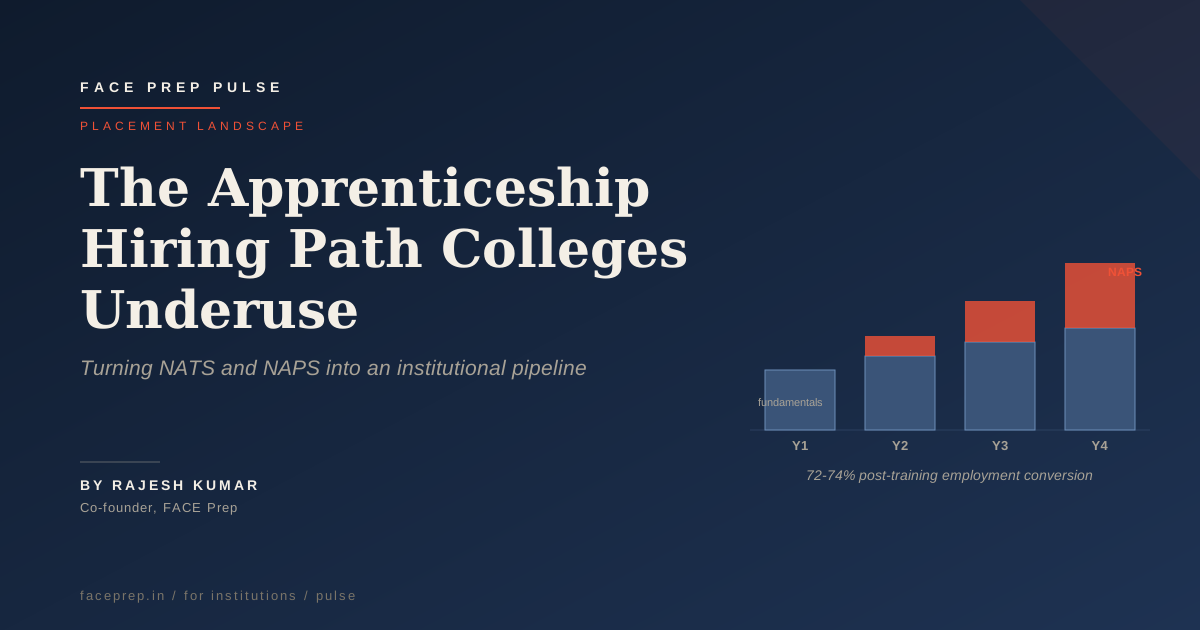
India's NAPS and NATS show 72-74% post-training employment. Most colleges treat both as student-led options, not institutional pipelines. Here is how to change that.
 Rajesh Kumar 10 min read
 Nine point eight five lakh. That is how many apprentices were engaged under India’s National Apprenticeship Promotion Scheme in FY 2024-25, according to the Ministry of Skill Development and Entrepreneurship. The number had nearly tripled from 3.08 lakh in FY 2020-21. And yet, most of the placement cells I have spoken with across India’s engineering colleges could not tell me whether a single student from their last batch had entered a NAPS or NATS apprenticeship.
That gap is not about awareness. TPOs know the schemes exist. What they have not built is an institutional process around them: a way of routing eligible students, tracking their cohort, and counting the outcomes. The result is a hiring track with a documented 72-74% post-training employment conversion rate that most colleges leave to individual student initiative.
This article is about what a placement cell actually needs to do to change that.
A conversion rate most placement cells have not priced in
Third-party impact assessments cited by the Ministry of Skill Development and Entrepreneurship in a 2025 PIB press release show that approximately 72% of NAPS apprentices and 74% of NATS apprentices move into paid employment after completion. A separate impact study for NATS finds 74% of ex-trainees in wage employment, self-employment, or family enterprise within months of finishing.
For a placement cell that typically counts only offers from campus drives it organised, this conversion rate represents an untapped count. If a college sends 40 students into NATS or NAPS in a given cycle and roughly 72-74% of them move into employment, that is 28-30 students who belong in the placement report but often do not appear there, because the cell never tracked them.
The Economic Survey 2025-26 makes the policy case alongside the institutional one: a 12-percentage-point rise in the share of formally skilled workers could generate more than a 13% increase in employment in labour-intensive sectors by 2030. Apprenticeship is the operational lever the survey points to. Combined NAPS and NATS onboarding in 2025 was approximately 17 lakh apprentices across more than 51,000 registered establishments.
The question for a placement cell is how to make that lever institutional rather than individual.
Two tracks, one outcome: what NAPS and NATS are
Both schemes run under the Apprentices Act, 1961, but they operate through different ministries and suit different student profiles.
| NAPS | NATS | |
|---|---|---|
| Administered by | Ministry of Skill Development and Entrepreneurship | Ministry of Education (through BOATs) |
| Primary target | Wide qualification range; trade and non-trade | Engineering graduates and diploma holders |
| Duration | Typically one year | Six months to one year |
| Minimum stipend (graduate, 2025 rules) | Rs 12,300/month | Rs 12,300/month |
| Government reimbursement to employer | 25% of stipend (up to Rs 1,500/month via DBT) | 50% of prescribed minimum |
| Registration portal | apprenticeshipindia.gov.in | nats.education.gov.in |
For a CSE or IT branch with students targeting software engineering, data, or cloud roles, NATS is the more relevant track: it is specifically designed for engineering graduates and the major IT services companies register their apprenticeship openings there. For ECE, EEE, and mechanical branches, both tracks are active, with NAPS carrying the larger listings in electronics, electrical, and manufacturing sectors.
IT-ITeS is the second-largest sector by apprentice engagement under the current NAPS phase, with cumulative engagement running into several lakh, behind only the automotive sector. Large IT services companies use the scheme because the government reimbursement lowers their cost of evaluating new graduates before committing to a full-time hire. The apprenticeship period becomes, in effect, a paid and structured pre-employment assessment.
What the Apprenticeship Amendment Rules 2025 changed for colleges
In September 2025, the Ministry of Skill Development and Entrepreneurship notified the Apprenticeship Amendment Rules 2025, which introduced a formal definition of “degree apprenticeship”: a course having apprenticeship as an integrated component of the curriculum.
This is more than a definitional addition. It creates a regulatory basis for institutions to build the apprenticeship period into their degree structure, treat it within the academic credit framework, and execute tripartite contracts between the institution, the employer, and the student. Previously, colleges could facilitate NATS registration as a student-level option; now the rules explicitly contemplate it as a course-integrated element.
The 2025 rules also revised the minimum stipend for graduate and degree apprentices to approximately Rs 12,300 per month, with future revisions linked to the consumer price index. For students from Tier-2 and Tier-3 institutions, this is not a trivial amount during the final year; the financial clarity makes the pathway more attractive to a wider share of the cohort.
The rules further require establishments to engage between 2.5% and 15% of their total workforce as apprentices. That obligation creates sustained demand for students from colleges whose placement cells register on the NATS portal and actively map students to company listings.
The AICTE six-month window most placement cells have not connected to hiring
AICTE’s 2024-27 Approval Process Handbook mandates that internship “shall be made compulsory for all final year students of AICTE approved Institutes/Universities.” The 2024 model curriculum, visible in the civil engineering version and being replicated across other engineering branches aligned to NEP 2020, places a credited six-month internship in Semester VII, valued at 12 credits, running through the second half of the final year.
Many placement cells handle this by advising students to find their own internship and submit a completion certificate. That satisfies the AICTE requirement, but the outcome is private, untracked, and does not appear in the placement cell’s count.
A placement cell that operates differently routes the Semester VII window into NATS registration. Under the Apprenticeship Amendment Rules 2025, the period of practical training undertaken as part of a degree course is explicitly treated as the apprenticeship training period, provided the employer is a registered NATS establishment and the contract is executed through the BOAT. The same six months can fulfil the AICTE requirement and register as a government apprenticeship contract, without duplication.
The AICTE requirement is already there, creating the time window. The placement cell’s decision is whether to manage what goes into that window or leave it unmanaged.
Where the institutional handoff usually fails
The most common failure I have seen is straightforward: the placement cell knows both schemes but leaves the registration entirely to the student. The student creates an account on the NATS portal, applies for listings, and either receives an offer or does not. The placement cell has no view into who registered, which companies shortlisted them, who completed an apprenticeship, and who moved into employment afterwards.
In the eighteenth year of working alongside placement teams at more than 2,000 partner institutions, I have seen the same gap repeat across states and institution sizes: a student completes a year at a registered IT company under NATS and is absorbed as a junior engineer, but the college counts that outcome as zero, because its tracking system covers only the drives it coordinated. The student does not always report back. The employer does not notify the college. The outcome is invisible.
This is a data and process gap, not a strategic one. Two things close it: the placement cell takes ownership of the NATS and NAPS registration for eligible students rather than leaving it to individuals, and it sets up a tracking sheet that follows each student from portal application to post-training employment confirmation. Neither requires new budget. Both require the cell to expand its definition of the outcomes it manages.
A TPO in Odisha who made this a tracked track
An engineering college in eastern Odisha, with roughly 2,000 students and a batch weighted toward ECE and EEE branches, reached a decision point in 2023. Campus drives in those branches concentrated on a few manufacturing companies and PSU recruiters, and the yield was uneven across the batch. The TPO’s observation was that ECE students were individually registering on NAPS listings with electronics sector employers, completing their apprenticeships, and in some cases moving into paid roles, but the college had no record of any of it.
The decision was to stop treating it as a student initiative and to build it as a tracked, institutional process. The placement cell registered the college on the NATS portal and identified three electronics-sector establishments with active listings in the region. An MoU was signed with two of them. The cell held a single two-hour orientation for the eligible cohort covering what NATS is, how the apprenticeship contract works, how the stipend is paid, and how the outcome would be tracked alongside campus drive results.
The adjustment that mattered most was timing. The placement cell negotiated start dates with both employer establishments that aligned with the AICTE Semester VII window. Students who had not received a campus offer by a defined date enrolled in the NATS track for Semester VII. That sequencing avoided students withdrawing from campus drives midway through an apprenticeship contract.
Within two cycles, roughly 15% of the ECE and EEE batch had entered a documented apprenticeship through the institutional process. Approximately two-thirds of those converted to confirmed employment within six months of completion. Those numbers began appearing in the college’s NIRF reporting once the placement cell established a process for collecting conversion documentation from the employer establishments.
The lesson is not that the apprenticeship track replaces campus drives. It runs alongside them, catching students the drives would not have reached.
The first ninety days: building the process from scratch
For a placement cell starting from scratch, the work is concentrated in the first semester and the ongoing effort is light once the pipeline is running.
Days 1 to 30: Map the eligible cohort. Pull the final-year batch list and identify students who will complete their degree in the next six months, meet NATS eligibility criteria (a government-recognised programme, within five years of passing, no relevant full-time employment history), and have not yet received a confirmed campus placement. Register the institution on nats.education.gov.in and on apprenticeshipindia.gov.in.
Contact the regional BOAT office. The four Boards of Apprenticeship Training in Chennai, Kanpur, Kolkata, and Mumbai run orientation sessions for institutions new to the scheme. The BOAT office will also show which companies hold active listings in the college’s state and sector, which narrows the outreach effort considerably.
Days 31 to 60: Shortlist three to five establishments on the NATS portal with active listings that match the college’s branch mix. Approach each for an MoU or a batch-registration agreement. The conversation with a company already using NATS is practical: the placement cell manages the registration, tracks progress, and reduces the company’s sourcing burden. Most NATS-registered companies respond positively to this.
Brief the eligible cohort in a single session of about 90 minutes. Cover what NATS is, how the BOAT contract works, how the Rs 12,300 minimum stipend is paid, how the training period satisfies the AICTE Semester VII requirement, and what the placement cell’s role will be through to outcome confirmation.
Days 61 to 90: Run the Aadhaar-based e-KYC process as a group workshop. Each student completes this on the NATS portal before applying; a placement coordinator can facilitate 30-40 students in an afternoon session. Help students build their portal profiles with education details, branch, and year of passing. Submit applications to the shortlisted companies as a cohort, not as scattered individual applications.
Set up a tracking sheet: student name, company applied, interview date, offer status, apprenticeship start date, expected end date, and a follow-up date to confirm the employment outcome. Update the sheet at the end of each student’s training period and collect a confirmation or absorption letter from the employer. That letter is both the NIRF evidence and the placement cell’s count.
No additional budget is required. NATS registration is free for institutions and students. The government stipend reimbursement flows to the employer. The placement cell’s cost is coordination time, concentrated in the first 90 days.
Beyond CSE: ECE, EEE, and mech are in scope
The common assumption is that NATS and NAPS primarily serve IT branches. The data does not support that reading. NAPS has sustained sector engagement in electronics (over 4 lakh apprentices cumulatively under NAPS-2), automotive, and manufacturing, which cover the core placement domains for ECE, EEE, and mechanical branches.
For ECE branches, electronics manufacturers, telecom companies, and semiconductor firms registered on the NATS portal offer roles in embedded systems, testing, and network operations. For EEE and electrical branches, power sector PSUs and renewable energy companies hold active NAPS listings. Mechanical branches can access listings with automotive OEMs, capital goods producers, and industrial engineering firms.
The institutional process is the same across all branches; only the company targets differ. An ECE-focused placement coordinator manages the electronics listings, and a mechanical coordinator handles the manufacturing ones. The mapping exercise in the first thirty days, with the regional BOAT office showing what is active in the college’s state, will surface which of these branch-specific pipelines is worth building first.
When both lanes run together
A college that runs the apprenticeship pipeline alongside its campus drives does not have to choose between the two. Campus drives and NATS/NAPS serve different student segments and different company needs. Drives serve companies hiring at scale in a fixed window; apprenticeship tracks serve companies that want a structured evaluation period and students whose profile has not yet cleared the campus-drive threshold. Both lanes contribute to the same final count.
Over eighteen years and more than 2,000 partnerships, the placement cells that have moved their numbers most consistently have done something similar: they found structured, trackable pathways for students who would otherwise fall out of the count, and they built institutional processes around those pathways. The government apprenticeship schemes are one such pathway. The Apprenticeship Amendment Rules 2025 have made them easier to build into the degree structure than at any point since the schemes were established.
For a TPO or a placement head considering where to start, the regional BOAT office is the first call. The portal shows the demand. The tracking sheet defines the outcome. The placement cell that builds this process is the one whose full count gets reported.
More context on how the campus hiring environment sits around this track is in why companies now visit fewer campuses and in how the mix of selective and volume hiring has redistributed across Indian engineering colleges. The apprenticeship pipeline adds a counted lane for students who fall outside the drives, and it gets more reliable each cycle once the BOAT registration and employer MoUs are in place.
Primary sources
- PIB / MSDE — NAPS engagement data FY 2024-25 including women apprentices (March 2026)
- PIB / MSDE — NAPS + NATS 2025 engagement and post-training employment rates
- Economic Survey 2025-26 Chapter 12 — Skilling and apprenticeship
- India Employer Forum — Apprenticeship Amendment Rules 2025
- NATS official portal (Ministry of Education, GoI)
- AICTE Model Syllabus and Curriculum 2024 — mandatory internship
- Economic Times — Enrolments under NAPS up 50% in 2025-26
Frequently asked questions
What is the difference between NAPS and NATS for an engineering college student?
NAPS (National Apprenticeship Promotion Scheme) is administered by the Ministry of Skill Development and Entrepreneurship, covers a wide range of sectors including IT-ITeS and manufacturing, and is open to candidates with varying educational qualifications. NATS (National Apprenticeship Training Scheme) is administered by the Ministry of Education through the Boards of Apprenticeship Training and is designed specifically for engineering graduates and diploma holders, typically running for six months to one year. Both pay a stipend and carry government reimbursement to the employer. For a B.Tech or B.E. graduate targeting a technical role in software, cloud, or data, NATS is the more focused track.
Does a student's NATS training period count as work experience with IT recruiters?
NATS completion carries a Certificate of Proficiency recognised nationally. Many IT companies that participate in NATS as registered establishments treat the apprenticeship period as a pre-hire evaluation, and a meaningful share of successful NATS apprentices receive full-time offers from the same company on completion. Whether it counts as formal work experience for another recruiter's eligibility criteria depends on that recruiter's policy, but the structured nature of NATS and the government certificate generally position it as relevant experience.
Can ECE, EEE, or mechanical engineering students participate in NATS or NAPS?
Yes. NATS covers all B.Tech and B.E. branches, including ECE, EEE, and mechanical engineering, not only CSE and IT. NATS listings include roles in electronics, electrical systems, and industrial engineering. NAPS, which spans 45-plus sectors, has active listings in electronics (over 4 lakh apprentices engaged in that sector cumulatively under NAPS-2), automotive, and manufacturing, all of which suit EEE, mechanical, and civil branches well.
Does NATS or NAPS participation count toward NIRF placement data?
NIRF asks institutions to report the percentage of students who secured employment or enrolled in higher studies. A student who moves into full-time paid employment after completing an apprenticeship period is counted in that metric; the apprenticeship stipend period itself is not counted unless it converts to a confirmed employment offer. Institutions should track apprenticeship-to-employment conversions separately and include documented conversions in NIRF reporting. An MoU with the employer establishment and a written conversion or absorption letter both support this.
How does AICTE's six-month mandatory internship connect to government apprenticeship schemes?
AICTE's 2024-27 Approval Process Handbook mandates a six-month internship for all final-year students at AICTE-approved institutions. The Apprenticeship Amendment Rules 2025 state that the period of practical training undertaken as part of a degree course is treated as the apprenticeship training period. A placement cell that registers its final-year cohort under NATS for their mandatory Semester VII window can fulfil the AICTE internship requirement and execute a formal government apprenticeship contract within the same six months, avoiding duplication.
What does a placement cell need to do to register with the NATS scheme?
The institution creates an account on nats.education.gov.in. It identifies companies already registered as NATS establishments on the portal and initiates contact for an MoU or a batch-registration agreement. Students must complete Aadhaar-based e-KYC on the portal before applying. The regional Boards of Apprenticeship Training (BOAT offices in Chennai, Kanpur, Kolkata, and Mumbai) run institutional coordination sessions and can guide placement cells through the first registration cycle.
What is the government-prescribed stipend for a graduate degree apprentice in 2025?
Under the Apprenticeship Amendment Rules 2025, the revised minimum stipend for a graduate or degree apprentice is approximately Rs 12,300 per month. The government reimburses a share of this to the employer (25-50% depending on the scheme and establishment type). Many large IT services companies registered on NATS pay above this minimum, with reported stipend ranges in software engineering, cloud, and data roles running from Rs 15,000 to Rs 24,000 per month.
Wondering how this applies to your college or university?
Message the FACE Prep team on WhatsApp. We work with 2,000+ institutions on placement training, academic integration, and upskilling programs. Tell us where your placements stand today, and we will share what has worked for institutions like yours.
WhatsApp the FACE Prep teamAbout the author
Rajesh Kumar
Co-founder, FACE Prep
Rajesh Kumar is a co-founder of FACE Prep and an IIM Kozhikode alumnus. Over 18 years he has built FACE Prep's relationships with 1,600+ universities and 500+ tech enterprises, connecting campuses to the companies that hire from them.