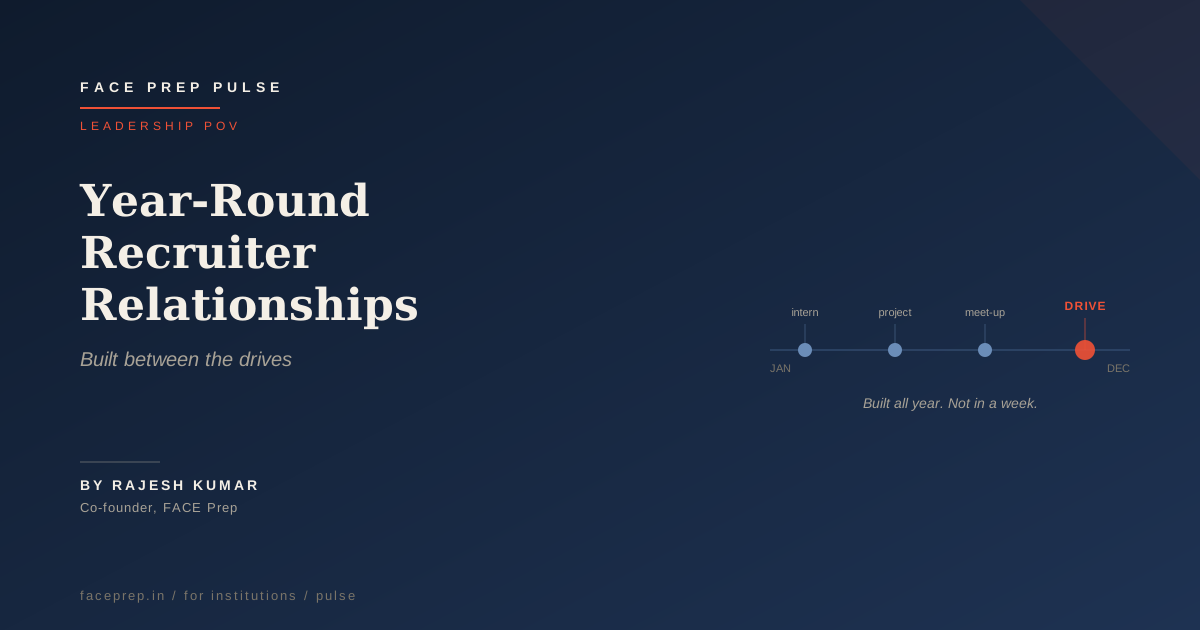
Year-Round Recruiter Relationships, Not One-Time Drives
The recruiters who hire best now engage all year, not just in placement season. Why a college should run recruiter relationships as a continuous, managed asset.
 Rajesh Kumar 8 min read
 The recruiters who hire best from campuses do not appear in placement season and vanish the rest of the year. They are present all year, through internships, projects, mentoring, and quiet contact, and the colleges they hire from most are present all year too. The one-time drive, where a company arrives, interviews, and leaves until next year, still happens, but it is increasingly the weakest form of a relationship, not the whole of it, and the colleges that rely on it alone are quietly slipping behind those that do not.
In eighteen years of connecting campuses and employers, the single clearest pattern I can offer a placement cell is this: treat recruiter relationships as a year-round asset to be managed, not a seasonal transaction to be repeated. The colleges that do this place better, and the gap is widening every year as the best employers move further toward continuous engagement and away from the seasonal model.
The best recruiters already engage year-round
This is not an aspiration I am projecting onto recruiters; it is how the most active ones already behave. The employers building the strongest fresher pipelines have moved decisively away from seasonal mass hiring toward continuous engagement.
NASSCOM’s reporting on the sector describes captive centres and startups building their talent pipelines through year-round activity: internships used to assess candidates over real work, hackathons, capstone-project mentorship, tech meetups, and competitive early offers, increasingly at Tier-2 colleges rather than only the famous ones. Coverage of how these centres operate shows them engaging the graduating class early and continuously, building familiarity with campuses long before any formal drive. These employers are not waiting for placement season to discover a college; they are cultivating the campuses they will hire from across the whole year, and they hire most readily from the ones that have engaged them back.
The implication is direct. If the recruiters worth winning engage continuously, then a college that engages only seasonally is, to those recruiters, hard to see. The relationship they value has no counterpart on the college’s side, and so the college is passed over for one that engaged.
Why the placement-season-only model fails now
The season-only model made sense when hiring was seasonal and bulk. A company would announce a drive, the college would prepare, the drive would happen, and both sides would go quiet until the next cycle. When that was how everyone worked, a college lost nothing by matching the rhythm.
It loses a great deal now, for two reasons. First, the best employers no longer work that way, so a season-only college is simply absent from the continuous engagement where pipelines are actually built. By the time the season arrives, the recruiter has already been cultivating other campuses for months, and a relationship cannot be conjured in the fortnight before a drive. Second, a cold drive is a worse drive. A company arriving at a campus it has had no contact with all year knows little about the students, has no basis to trust the shortlist, and treats the visit as a gamble. A company that has run internships, set projects, and stayed in contact arrives already knowing the campus, and the drive is the confident last step of a relationship rather than a first, uncertain meeting. The season-only college gets the cold version of every drive, even the ones it does land.
What a year-round relationship looks like
A year-round relationship is not a vague intention to stay in touch; it is a set of concrete, recurring touchpoints that keep a college and a recruiter genuinely connected between seasons.
The richest touchpoint is the internship, because it lets a recruiter assess a student over weeks of real work and lets the student prove themselves, and it often converts directly into an offer. Around it sit live projects set by the company and worked on by students, which give the recruiter a window into the campus’s capability. Then there are guest sessions and mentoring, where the company’s engineers spend time with students and faculty, building familiarity in both directions. Hackathons and competitions bring a recruiter onto campus in a low-stakes setting where they see students perform. And underneath all of it is regular, human contact between the placement cell, the relevant faculty, and the recruiter, so the relationship is maintained by people who know each other rather than by an annual form. None of these is large alone. Together they mean that when a hiring decision comes, the recruiter is choosing from a campus it knows well, which is exactly the position a college wants to be in.
Why internships are the keystone touchpoint
Of all the touchpoints, the internship deserves singling out, because it does more work than any other and anchors the rest. It is the touchpoint a college should build first if it builds only one.
An internship solves the recruiter’s hardest problem, which is judging a fresher from a short interview, by replacing minutes of conversation with weeks of real work. A recruiter who has watched a student work through an internship knows things no interview could tell them, and that knowledge converts: a large share of the strongest year-round relationships run through internships that turn into offers. For the student, it is a chance to prove themselves on the recruiter’s own ground. For the college, it is the touchpoint that most reliably deepens a relationship, because it gives the recruiter a real stake in the campus and a reason to return. This is also why the captive centres and startups building pipelines lean so heavily on internships: they have understood that an intern who works out is a far safer hire than a candidate who merely interviews well. A college that treats internships as a serious strategic instrument, rather than a compliance requirement to be signed off, holds the single most powerful tool for building recruiter relationships that exist.
Start with five, not fifty
The most common objection I hear is that a placement cell is too small to manage relationships with all its recruiters all year. That objection is right, and it points at the answer rather than against it: do not try to do it with all of them. Depth on a focused set beats thin contact with everyone.
The practical move is to pick a small number of priority recruiters, perhaps five to a dozen, chosen for how much a deeper relationship is worth, and concentrate the year-round effort there. Give each one an owner in the cell and a light, regular cadence, and let the rest remain seasonal for now. A cell that keeps five recruiter relationships genuinely warm, with internships, projects, and real contact, will out-place one that runs cold drives with fifty acquaintances. As the cell builds the muscle, it can widen the set. But it should start narrow and deep, because a handful of strong relationships delivers more placements than a long list of faint ones, and it is achievable for even a small, stretched placement cell. The discipline is choosing the few and tending them, not attempting everyone at once and tending none.
Run it like a relationship, not a transaction
The shift that makes all this work is to manage recruiter relationships the way a good sales team manages its accounts: deliberately, continuously, and with ownership. A transaction is something you repeat; a relationship is something you tend.
In practice this means a few disciplines. Keep a clear list of your priority recruiters, the ones most worth a deeper relationship, rather than treating all employers identically. Give each priority recruiter an owner in the placement cell, a named person responsible for that relationship through the year. Maintain a simple calendar of touchpoints, so contact and activity happen on a rhythm rather than only when something is needed. And keep a record of each relationship, what was discussed, who was hired, what the recruiter wants next, so institutional memory does not reset every time a coordinator changes. This is, in effect, a recruiter relationship management system, and it need not be elaborate; a shared sheet and an owner per account will do. The discipline matters more than the tool. What it produces is a placement function that is building toward every season all year, rather than sprinting to assemble one at the last minute.
A college in Delhi NCR that stopped starting cold
A college in the Delhi NCR region had decent placements but felt it was always starting from zero. Each season its cell would reach out to recruiters it had hosted the previous year, re-establish contact, and try to secure drives, and each year the recruiters treated the college as a faint acquaintance rather than a known partner. The relationships never compounded, because they were rebuilt annually from cold.
The change we helped them make was not dramatic; it was a matter of continuity and ownership. The cell picked its dozen most valuable recruiters, assigned each to a member of the cell, and committed to a light, regular cadence with them through the year: an internship cohort here, a project there, a guest session, a check-in, a hackathon invitation. Nothing in any single month was large. But by the time the next season arrived, those dozen recruiters were no longer faint acquaintances; they were partners who knew the college, had seen its students at work through internships and projects, and trusted its shortlist.
The drives that season were different in kind, not just degree. The recruiters arrived already familiar, the conversions were higher because students had been assessed through real work over months, and several recruiters expanded their intake because the relationship had earned their confidence. The college had not found new recruiters; it had stopped letting its existing relationships go cold, and that alone changed its season.
The cost of the change was almost entirely attention, not money. The internships and projects used the college’s existing programmes; the guest sessions cost a recruiter an afternoon; the check-ins cost a phone call. What had been missing was not budget but the decision to treat these dozen relationships as standing assets worth tending, and to give someone responsibility for each. Once that decision was made, the activities that built the relationships were ones the college could largely already do. The barrier had been a way of thinking, not a lack of resources, which is the case more often than placement cells expect.
Where colleges go wrong
A few failure modes are worth naming, because they are common and avoidable. The first is letting relationships lapse between seasons, which forces the cold restart the Delhi NCR college escaped. The second is over-concentrating on one or two large recruiters and neglecting the wider set, which feels efficient until one of them cuts back and the college has nothing else warm. The third is treating engagement as a junior administrative task rather than a managed relationship with senior attention, so it never gets the continuity or the seniority that real relationships need.
All three come from seeing recruiter engagement as a seasonal chore rather than a year-round asset. There is a fourth, subtler one: failing to record the relationship, so that when a coordinator moves on, the history and the rapport leave with them and the next person starts cold with recruiters the college has known for years. A relationship held only in one person’s memory is fragile, and the fix is a simple shared record of who each recruiter is, what was discussed, and what they want next.
For a Principal, a Director, or a management committee, the reframe is the valuable part: the placement cell’s most important work happens between the drives, not during them, and resourcing it that way is one of the highest-return decisions a college can make. If it would help to set up recruiter relationships as a managed, year-round function, drawing where useful on relationships we have already built, that is a conversation we welcome through the For Colleges / Universities page.
Primary sources
- GCCs and startups are building fresher talent pipelines through year-round campus engagement, internships, mentorship and competitive packages, increasingly at Tier-2 colleges (NASSCOM report, The Hindu BusinessLine, 2025)
- GCCs engage the graduating class early and continuously to build their tech talent pipelines rather than hiring only at season (Economic Times, 2024)
Frequently asked questions
Why are year-round recruiter relationships better than one-time drives?
Because the recruiters worth winning now engage year-round themselves. The best employers, including the growing set of captive centres and strong startups, build talent pipelines continuously through internships, projects, and engagement, and they hire from the campuses they already know. A college that only opens its doors for the placement season is invisible to that continuous engagement, and it walks into each drive cold rather than building on a relationship that has been warming all year.
What goes into a year-round recruiter relationship?
A series of continuous touchpoints rather than a single annual ask. These include internships that let a recruiter assess students before the season, live projects set by the company, guest sessions and mentorship, hackathons, and regular contact between the placement cell, faculty, and the recruiter. None of these is large on its own; together they keep the college on the recruiter's radar and make the eventual hiring decision low-risk and familiar.
Our placement cell is small. How can it manage relationships all year?
Start with a few priority recruiters rather than all of them. Pick the handful of employers most worth a deeper relationship, assign each an owner in the cell, and maintain a light, regular cadence of contact and activity with those few. A small cell that keeps five recruiter relationships genuinely warm will out-place one that runs cold drives with fifty. Depth on a focused set beats thin contact with everyone, especially when resources are limited.
How do internships fit into year-round recruiter relationships?
Internships are one of the most powerful touchpoints, because they let a recruiter assess a student over weeks of real work rather than minutes of interview, and they let the student prove themselves. Many of the best year-round relationships run through internships that convert into offers, and the engagement around them, the projects, the mentoring, keeps the company connected to the campus between seasons. A college that treats internships as a serious part of its recruiter strategy, not a compliance box, builds relationships through them.
Do year-round relationships help with GCCs and startups specifically?
Especially with them. NASSCOM reporting shows GCCs and startups building their fresher pipelines through continuous engagement rather than seasonal mass hiring, and they are increasingly active at Tier-2 colleges. These are exactly the employers a continuous relationship reaches and a season-only model misses. For a college trying to diversify beyond the shrinking bulk-services drives, year-round engagement with these employers is one of the most direct routes in.
What is the most common mistake with recruiter relationships?
Letting them lapse between seasons and starting cold each year. A college builds a good relationship during a drive, then goes silent for eleven months, and has to rebuild rapport the next season as if from scratch. The other common mistake is depending on one or two large recruiters and neglecting the wider set, which leaves the college exposed when one of them cuts back. Continuity and breadth, kept up deliberately, are what a managed relationship provides and an ad-hoc one does not.
How does FACE Prep help colleges build year-round recruiter relationships?
We help a college set up recruiter engagement as a managed, year-round function: identifying priority employers, designing the touchpoints from internships to projects to drives, and bringing our own long-standing enterprise relationships to open doors a single college might not reach alone. The aim is a continuous pipeline rather than an annual scramble. Over 18 years we have built our own deep relationships with employers, and we help colleges build and keep theirs.
Wondering how this applies to your college or university?
Message the FACE Prep team on WhatsApp. We work with 2,000+ institutions on placement training, academic integration, and upskilling programs. Tell us where your placements stand today, and we will share what has worked for institutions like yours.
WhatsApp the FACE Prep teamAbout the author
Rajesh Kumar
Co-founder, FACE Prep
Rajesh Kumar is a co-founder of FACE Prep and an IIM Kozhikode alumnus. Over 18 years he has built FACE Prep's relationships with 1,600+ universities and 500+ tech enterprises, connecting campuses to the companies that hire from them.