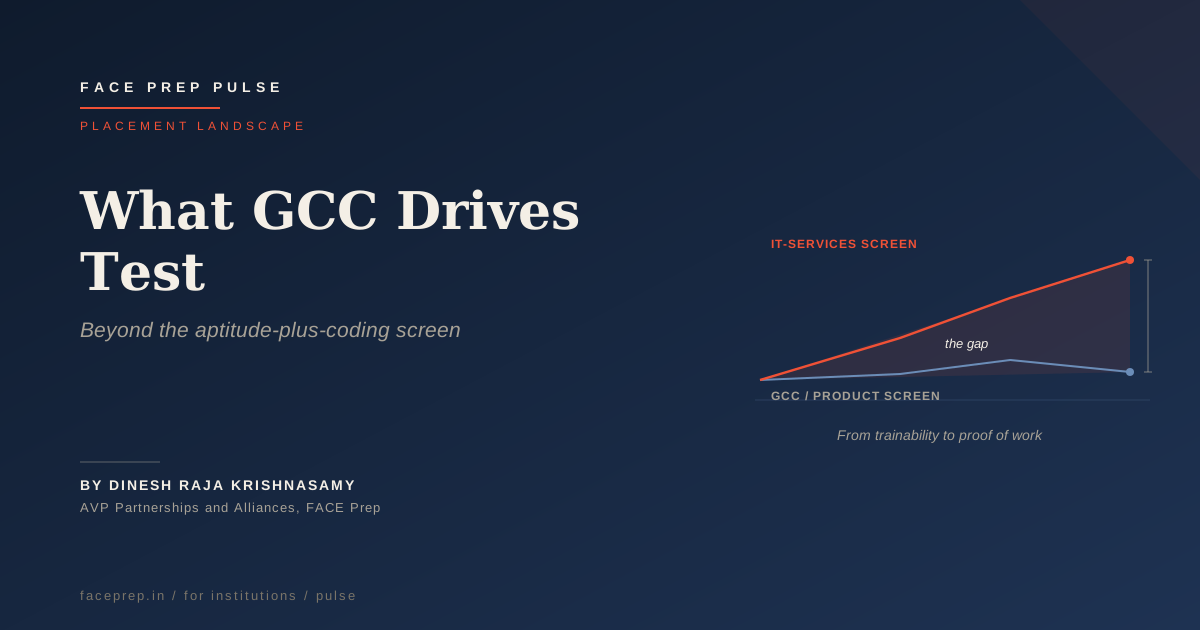
What GCC and Product Drives Screen For That IT-Services Never Did
GCC and product company campus drives test proof of work, systems thinking, and machine-coding. A guide for colleges on what the screen asks and how to build readiness.
 Dinesh Raja Krishnasamy 9 min read
 In a debrief after the 2025-26 campus drive season, a recruiter from a Global Capability Centre told me something I have since repeated to almost every placement head I speak with. Their team had run drives across fourteen campuses. On every campus, the students cleared the online aptitude round. On most campuses, the technical round produced two or three offers, sometimes none at all. The bottleneck was not reasoning speed or numerical ability. Students were clearing those sections. The bottleneck was a sixty-minute machine-coding task: given a problem statement, build a working system from scratch, write the class design, and explain the thinking as the code takes shape. Most students had never done that in a test room. Several had never done it anywhere.
That recruiter’s debrief describes a structural mismatch that most college placement programs have not yet addressed. The preparation that gets students through IT-services drives does not reliably get them through GCC and product company drives. The gap lives in a category of technical assessment that most placement training was never designed to reach.
What the IT-services trainability screen was built to do
The campus drive format that shaped Indian placement training for two decades was calibrated to IT-services hiring logic. A large services company needed to hire several thousand freshers every year, route them into a shared onboarding and induction track, then deploy them into client projects as work arrived. The campus screen was not designed to find engineers who could already do a specific job. It was designed to find people who could learn one quickly.
The TCS NQT reflects this logic clearly. The Foundation section runs seventy-five minutes across Numerical Ability, Verbal Ability, and Reasoning Ability. The Advanced section adds a ninety-minute coding component. Together they answer one question: is this person sharp enough and disciplined enough to be shaped into a productive delivery team member after six to twelve months of training? The company does not need to know whether the student can already build a working software system. That is the training program’s job.
This is a reasonable screen for that model of hiring. The preparation it calls for is also reasonable: timed aptitude drills, a grounding in data structures and sorting algorithms, enough coding confidence to solve structured problems in a constrained window. Colleges across India have spent two decades building this preparation, and most have gotten good at it.
The challenge arrives when the same preparation is measured against a drive type that does not run on trainability logic at all.
The screen that GCC and product drives run on
A Global Capability Centre is the parent company’s own engineering team, building the company’s own systems in India. A fresher who joins a GCC data team or a GCC platform team is expected to contribute to live work within weeks of joining. There is no common training pool that absorbs a large batch and sorts them into projects later. Before an offer is made, the company must have evidence that this specific student can deliver this specific role.
Times of India reporting from the 2026 drive season named the criteria GCC interviewers evaluate: depth in the relevant technology domain, problem-framing ability, ownership after delivery, and practical use of AI tools in real work. One candidate who joined a Bank of America technology GCC spoke about how his entire technical interview turned on an AI-powered exam preparation tool he had built for his college. The interviewer probed the architecture choices, the edge cases he had discovered and handled, and how he had measured whether the tool actually worked. The degree, the certifications, and the course completions were not what drove that conversation. The project was.
This is the screen that GCC and product company drives are built to run: can this student show us something they built, explain every meaningful decision in it, and discuss what they learned from building it? Infosys, which hired over 20,000 college graduates in FY26 and has framed its fresher hiring explicitly as a strategic bet on GenAI-native talent, has moved its assessment toward applied AI problem-solving alongside code quality. The direction from the largest IT-services recruiters matches the direction from GCCs: proof of what you can build is becoming the primary filter in technical rounds across company types.
NASSCOM and Zinnov’s 2026 GCC ecosystem research documents that India’s GCC sector has grown 32 percent since FY21, with the workforce profile oriented toward building and operating complex engineering systems rather than delivering against a specification handed down by a client project manager. That shift in the nature of GCC work is why the screen has moved in the direction it has.
What the machine-coding round tests
The machine-coding round is the single most consistent point of failure for students who have prepared only for IT-services drives, and it is worth understanding in concrete terms.
A machine-coding task gives the candidate a problem statement and sixty to ninety minutes to build a working small system from scratch. A common version: implement a library management system with defined operations, handle the edge cases, and write the class structure cleanly. Another version: build a rate limiter with a specified API, explain the data structure choice, and describe how your design handles concurrent requests. Some GCC companies now include a task where the candidate is given an AI-generated code block with a bug, and must read it, identify the failure, fix it, and explain the change.
The assessor watches how the candidate interprets a requirement that is not fully specified, how they break the problem into logical units, how they name variables and methods, and how they handle the cases the problem statement does not mention. They also ask questions while the candidate is working, because explaining a design choice under time pressure is part of the evaluation.
The machine-coding round asks one question: can you build a coherent small system from a problem statement and explain every meaningful decision you made while building it? A student who has solved five hundred practice problems on a coding platform and drilled aptitude for months is genuinely prepared for the IT-services screen. That same preparation does not build the skill this round measures.
The problem-framing round
Beyond machine-coding, GCC and product company drives include a problem-framing round that has no direct equivalent in the IT-services format. This round asks a candidate to explain, clearly and logically, how they would approach a business or engineering problem they have not seen before, without necessarily producing a working solution.
A BFSI GCC might present a scenario: customer complaint volumes at a bank’s retail network have risen 40 percent in one quarter, concentrated in three cities. What would you want to know, what data would you look for first, and how would you structure the investigation? A technology GCC might present a production system with unexplained latency spikes and ask the candidate to walk through their diagnostic reasoning.
The interviewer is not looking for the correct answer to the business problem. They are evaluating whether the candidate can handle an unclear problem without freezing, ask useful questions, identify what information would change the approach, and communicate the reasoning structure clearly in English. This lives closer to analytical communication than to technical knowledge, and most campus preparation programs have no structured track for it. Interview preparation that focuses on technical correctness builds something useful and necessary, but it does not build this skill on its own.
Where service-track preparation carries over and where it stops
The aptitude foundation that every IT-services drive tests is the same foundation that GCC and product drives assume is in place before the technical rounds begin. A student who cannot clear a quantitative reasoning filter will not reach the machine-coding stage at any company type. The communications baseline that most college programs now include as part of IT-services preparation carries directly into GCC behavioural and communication rounds. None of that work is wasted.
What requires a separate track is the ceiling. A student who has cleared TCS NQT simulations repeatedly is ready for the IT-services screen. The machine-coding round and the problem-framing conversation sit above that preparation, and they do not improve from aptitude drilling or additional DSA problem sets alone. Building them requires building things.
An engineering college near Pune that closed the machine-coding gap
An engineering college in the Pune region with approximately 2,500 students across CSE, ECE, and IT branches had a well-structured placement program going into FY25. Their aptitude preparation was solid. Their coding fundamentals training consistently moved the cohort above average by the pre-drive baseline they ran every year. They were placing students steadily in IT-services roles.
Their GCC conversion rate was near zero.
When we worked through the data together, the picture was clear. In the two prior years, every student who had attempted a GCC technical round had cleared the aptitude stage and stalled in the technical assessment. The preparation had built the right floor. It had not built the ceiling the GCC screen was looking for.
We designed a two-month addition to their existing CSE preparation, running alongside the aptitude calendar. Weekly machine-coding sessions of ninety minutes each: a problem statement, a blank file, and a time limit. No scaffolding. The session output was assessed on three things: does the solution run, is the class design coherent, and can the student explain one design choice when asked by the observer. The first session was difficult across the board. By the fourth session, a segment of the cohort had stabilised into a consistent working pattern.
Of the approximately 240 students in the CSE batch, around 65 could produce a defensible small system under test conditions by the end of the two months. The placement cell built its GCC shortlist from that group, matched by sector against the companies they had mapped.
Three GCCs ran drives from the shortlist. Twelve offers came through at packages significantly above what the same batch had received from IT-services drives. The students who converted were not the highest scorers on aptitude or on the DSA problem-set tests. They were the ones who had spent eight weeks building things under time pressure and could talk about what they had built.
What a placement cell needs to add to its existing program
Every placement cell that already runs a solid IT-services preparation program has the floor. What it needs to add is a project-and-build track that sits above the existing technical calendar, without replacing any of it.
In practice, this means three additions.
Weekly or fortnightly machine-coding sessions from the third semester onward, where students are given a problem statement and a time limit and asked to produce a working, explainable small system. The output is scored on design quality and the student’s ability to explain one or two choices, not on algorithmic speed. The sessions run alongside the existing coding and aptitude schedule.
A problem-framing practice block, separate from mock-interview preparation, where students handle open-ended business or engineering scenarios and practise communicating their reasoning structure. Three or four such sessions per semester is enough to move a segment of students from freezing on an open question to handling it fluently.
A portfolio checkpoint at the end of each academic year, so that every student in the selective-drive track has at least one documented project they built themselves and can discuss in detail. The checkpoint is a conversation, not a form, and the standard is whether a student can sustain forty minutes of technical questions about the project they claim to have built.
None of this dismantles the existing preparation. The aptitude calendar stays. The company-specific mock drives stay. The coding fundamentals track stays. What changes is the ceiling: students who go through the services preparation plus the build track come to the drive season ready for more doors, not just the ones the IT-services format opens.
Where the preparation gap matters most
For colleges outside the most selective tier, this matters for a concrete reason. GCC campus participation has grown substantially in the 2025-26 drive season, and the companies running those drives are not choosing between famous and less-famous campuses. They are choosing between prepared and unprepared cohorts. A shortlist from a lesser-known college that shows machine-coding-ready students assessed against the company’s specific criteria is often more actionable for a GCC recruiter than a general invitation from a college with a stronger name.
The preparation investment that lifts a cohort from IT-services-ready to GCC-ready is a defined, bounded addition to an existing program. Across the more than 2,000 partnerships we have built over 18 years, the lever that opens the GCC door is almost always the same: a build track above the aptitude floor, a project that a student owns completely, and a way to assess and report readiness before the outreach begins.
The students who cleared GCC rounds from that Pune-area cohort were not the ones with the highest aptitude scores from the prior year’s baseline. They were the ones who had spent eight consecutive weeks building things under test conditions and had something to show for it. For a placement head reading the same pattern in their own debrief data, the question becomes concrete: which students in your batch have something to show? That question has a preparation answer, and preparation is within the placement cell’s control.
Primary sources
- TCS All India NQT: Foundation section (75 min, Numerical + Verbal + Reasoning Ability) and Advanced section (90 min coding); official pattern for 2025-26 (TCS Careers, current)
- GCCs are hiring: engineers must unlearn old rules. Criteria evaluated: depth, problem-framing ability, ownership after delivery, practical AI tool use; a Bank of America GCC interviewee's AI project drove the entire interview rather than credentials (Times of India, Apr 2026)
- GCCs boost campus placements with higher packages for freshers; GCC recruiters prioritise problem-solving ability and interdisciplinary knowledge (Times of India, Jan 2026)
- Infosys recruited over 20,000 college graduates in FY2026 and set a similar target for FY27; management framed fresher hiring as a strategic bet on GenAI-native talent (Infosys Integrated Annual Report FY2026)
- NASSCOM-Zinnov India GCC 2026 ecosystem report: GCC sector has grown 32 percent since FY21; workforce profile oriented toward building and operating complex engineering systems
Frequently asked questions
What is a machine-coding round in campus placements?
A machine-coding round gives a candidate a problem statement and sixty to ninety minutes to build a working small system from scratch. A common task asks the candidate to implement a library management system, a rate limiter, or an expense splitter with a defined API, write clean class design, handle edge cases, and explain trade-off choices when asked. The assessor is not measuring algorithmic speed. They are measuring whether the candidate can translate an ambiguous requirement into a coherent system, name things clearly, and communicate design decisions under pressure. This format is common at GCC and product company campus drives and has no direct equivalent in the IT-services aptitude-plus-coding screen.
Does TCS NQT preparation carry over into GCC and product company screens?
It carries at the floor level. The quantitative aptitude, logical reasoning, and verbal ability work that students do for the TCS NQT Foundation section is the same foundation every GCC and product drive assumes is already in place. Students who cannot clear the initial aptitude filter at a GCC do not reach the technical rounds. What does not carry over automatically is the ceiling: the machine-coding round, the problem-framing conversation, and the depth of project discussion that characterise the later rounds of most GCC drives. Preparing for the NQT builds the floor; reaching the GCC ceiling requires a project-and-build track on top of it.
What does proof of work mean in a campus placement context?
Proof of work, in campus placement terms, means a student can show something they built, explain every important design decision in it, describe what failed and how they fixed it, and answer technical questions about it for an extended conversation. It is not a certification or a course completion record. A student who built an AI-powered exam tool for their college, deployed it, measured whether it worked, and improved it has proof of work. A student who completed a one-week online module in the same technology does not. GCC and product company interviewers distinguish between the two quickly, because they ask follow-up questions that only the builder can answer.
How much of IT-services placement preparation transfers to GCC company screens?
The aptitude foundation and the communications baseline transfer directly. GCC drives still begin with a quantitative reasoning or aptitude filter, and the behavioural and communication rounds at GCC companies reward the same clarity and structure that IT-services HR rounds require. What does not transfer is project depth. The machine-coding round requires students to have built things, not just studied algorithms. The problem-framing round requires them to handle ambiguous scenarios, not just answer structured technical questions. These are learnable skills, but they are not built by aptitude drilling or DSA problem sets alone.
How long does it take to build proof-of-work readiness across a college cohort?
Meaningful readiness across a defined segment of a cohort takes six to eight months of consistent practice, starting from the third semester rather than the final year. Weekly or fortnightly machine-coding sessions, a problem-framing practice block, and a portfolio checkpoint at the end of each academic year are the three elements. The students who tend to clear GCC machine-coding rounds are not the ones with the most months of preparation but the ones who have spent the most time building things under test conditions rather than watching solutions. A college that starts this track in the third semester graduates students who are demonstrably ready by the time the drive season opens.
Do ECE and EEE students face the same GCC screening criteria as CSE students?
The screen varies by sector. ECE and EEE students targeting manufacturing and engineering GCCs face domain fundamentals alongside problem decomposition and logical reasoning, rather than software design depth. BFSI GCCs are often more branch-neutral for entry-level data and operations roles, assessing quantitative aptitude, SQL, and data interpretation. The machine-coding round in its full form is more common at technology GCCs hiring for software development roles, where most of the demand for CSE and IT students concentrates. ECE students who develop Python fundamentals and data skills are competitive for data engineering roles at BFSI and manufacturing GCCs.
How should a college measure whether its students are ready for GCC drives before the season opens?
A useful pre-drive readiness check runs three assessments in parallel: an aptitude baseline against the quantitative and logical standards the targeted GCC sector uses, a machine-coding trial under test conditions where the output is scored on design quality and explainability rather than algorithmic correctness, and a problem-framing exercise where students handle an ambiguous business scenario and communicate their reasoning structure. The third assessment is the one most colleges have not run before. Students who perform poorly on it are not yet ready for the later rounds at most GCC companies, regardless of their aptitude or DSA scores.
Wondering how this applies to your college or university?
Message the FACE Prep team on WhatsApp. We work with 2,000+ institutions on placement training, academic integration, and upskilling programs. Tell us where your placements stand today, and we will share what has worked for institutions like yours.
WhatsApp the FACE Prep teamAbout the author
Dinesh Raja Krishnasamy
AVP – Strategic Partnerships & Alliances, FACE Prep
Dinesh Raja Krishnasamy is Assistant Vice President of Strategic Partnerships & Alliances at FACE Prep. A senior sales and partnerships leader with 10+ years' experience, he works with colleges and universities on building training partnerships and connecting campuses to the employers who hire from them. He holds an MBA from SRM University and a B.Tech in Information Technology.