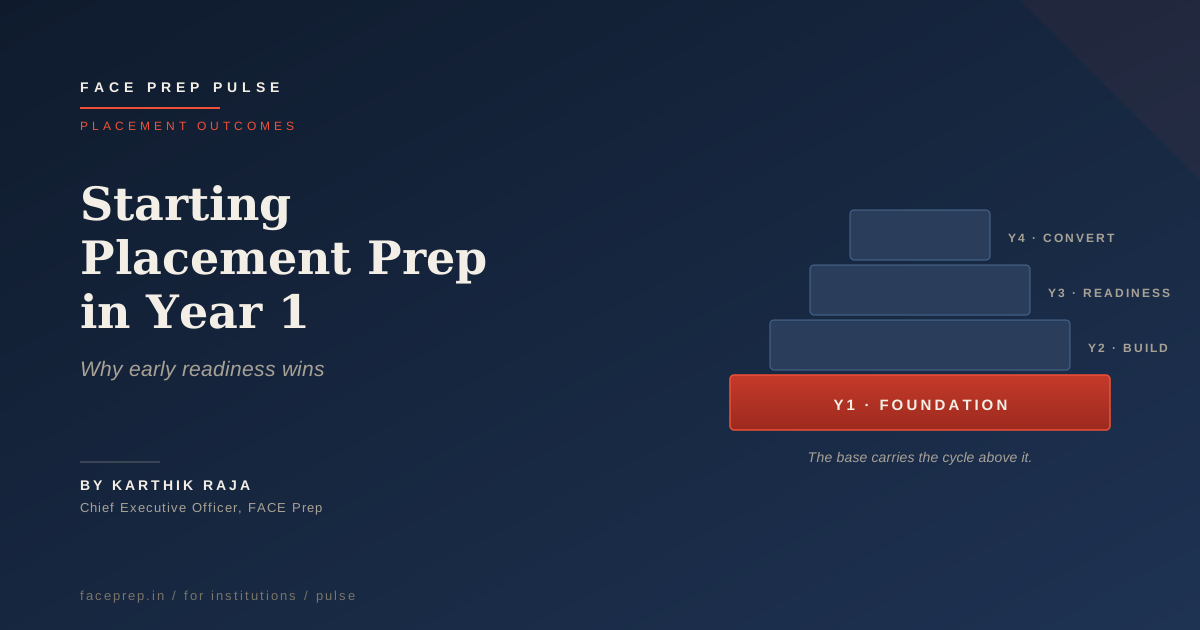
Starting Placement Prep in Year 1: Why Early Readiness Wins
A college's placement rate is mostly decided before final year. Why early readiness wins, what the government now expects, and what year-one prep looks like in practice.
 Karthik Raja 8 min read
 The placement season feels like the decisive moment. Companies arrive, students interview, offers are made, and the number is set. But by the time the season opens, most of the outcome is already determined. The students who convert are, with few exceptions, the ones who were made ready over the previous three years. The season does not create readiness. It reveals it.
This is why the colleges with the strongest numbers start placement preparation long before the final year, and why a late start, more than anything else, keeps a placement number flat. Across eighteen years and more than two thousand institutions, I have not seen a college lift its number durably with a final-year push alone.
The season is won before it starts
Consider what a final-year program is actually being asked to do. In a few months, it must take a student who may be shaky on aptitude, unsure on coding, nervous in interviews, and unfamiliar with how companies now use AI, and make that student competitive against peers who have been building those skills for years. It rarely works, and it cannot work at the scale of a whole batch.
The cost shows up on both sides. The students in the middle of the cohort, the ones who would convert with enough runway, run out of time. And the recruiters notice the unprepared candidates. A campus that is ready early earns more visits. A campus that scrambles late loses them.
There is also a quieter compounding effect at work. A student who reaches Year 4 with three years of compounded skill-building behind them does not just have more knowledge. They have habits, a sense of pace under time pressure, and the confidence that comes from having seen the format more than once. None of that can be built in a final-year push, however intense. The students who clear the better-paid offers are almost always students who had been quietly preparing since Year 1 or Year 2, often on their own. The early-readiness program simply makes that path institutional rather than self-organised, so the middle of the cohort gets there too.
Policy is now pointing the same way
Early readiness used to be a matter of judgement. It is becoming an expectation. The government’s AI Curriculum Taskforce, set up in May 2026, called for replacing lecture-heavy teaching with real industry use-cases from the first semester. The AICTE, under the Ministry of Education, runs a national internship portal as part of the NEP 2020 mandate, built specifically to put students into workplaces during their course rather than only at the end. Its chief coordinating officer was candid that the system makes students employable while employment itself sits outside the council’s remit, which is precisely where a college’s own early-readiness program comes in.
AICTE Chairman Prof. T. G. Sitharam has made the same point repeatedly. In his commentary around the council’s curriculum reforms he has said the goal is to equip students with skills that are “not only industry-relevant but also in line with global standards,” adding that the revised curricula deliberately build in “industry exposure, field visits, and internships” to make students industry-ready before they graduate. The council’s own model curricula now include a structured first-year induction programme and link engineering reform to mandatory internships across the four years.
The direction is clear. Industry exposure and practical skill-building are moving toward the start of the degree, not the end of it. Colleges that move with this are simply early to where the system is going.
What early readiness looks like, year by year
Early does not mean placement drills for first-years. It means the right work in the right year, building a base that later years can stand on.
In the first year, the work is foundations and exposure. Logic and programming basics, communication practice, and a genuine first look at how the industry works and what it values. The aim is a base and a sense of direction. The students who arrive in Year 2 having done this look very different from those who did not, and the difference compounds. A structured first-year induction, of the kind AICTE has formalised, can carry a lot of this load.
In the middle years, it is skills and familiarity. Data structures and real problem-solving, continued communication, internships through the kind of platforms the AICTE now runs, and early familiarity with AI tools layered on top of solid coding. With recruiters now screening freshers for demonstrable AI skill, not just a degree, this familiarity is no longer a nice extra, though it only takes hold when it sits on real coding ability rather than standing in for it. Year 2 is where most colleges still leave the heaviest gap, because the season feels far away and the cohort feels unfocused. The colleges that lift their placement rate are the ones that hold the line on Year 2.
In the final year, it is conversion. Company-mapped practice in the real assessment formats, interview readiness, and targeted help for the students who are close. By this point the heavy lifting is done, and the final year is about sharpening and matching, not building from scratch.
The cost of waiting until Year 3 or 4
The most common objection to Year 1 prep is that the calendar is already full. First-year students are settling into a new institution, adjusting to the engineering coursework, and often still figuring out the basics. Adding another structured layer feels like asking too much.
The data does not support that worry. A well-designed Year 1 layer is light: two to three hours a week, plus a structured first-week induction. The cost is real but small. The cost of not running it shows up at the other end of the degree, when the placement cell is trying to convert a cohort that never had a foundation to build on. By Year 3, even a strong placement training programme has to do double duty: it has to teach the fundamentals that were never taught and the company-specific skills that should be the focus at that stage. Almost no programme manages both. The numbers reflect that.
Final-year-only placement training has been the dominant model in Indian engineering for two decades, and the average placement rate at Tier-2 and Tier-3 colleges has not budged from the high thirties. The model is not working. A student who first meets aptitude, communication, and a real coding problem in the seventh semester is already behind the one who began building those habits in Year 1. Continuing it because the calendar feels full is not a calendar problem. It is a design choice.
A college that moved its start line to Year 1
An autonomous engineering college in Rajasthan with about 1,400 students decided two cycles ago to introduce structured Year 1 placement prep for the first time. The starting point was modest: a six-day induction for the incoming batch focused on logic, basic Python, communication practice, and a guided look at what the IT services industry actually does, what product companies look like, and what core-engineering hiring involves. Nothing about CV writing or company drills, because none of it would have been useful yet.
The shift showed up first in Year 2. The cohort that had been through the Year 1 induction came into Year 2 with materially stronger fundamentals and, more importantly, with a sense of what they were preparing for. The Year 2 layer that the college added next, a weekly slot on data structures and problem-solving, was easier to teach because the base was there. The Year 3 readiness scores, when the college first measured them, were several percentage points higher across the cohort than the previous year’s cohort had been at the same point.
The Year 4 season for that cohort, two years later, was the first in which the placement cell was not scrambling. The headline placement rate rose about eleven points across the two cycles, and the share of higher-paid offers grew faster than the headline. The college did not change its recruiter list. It changed when it started preparing. This account is anonymised per our partner-naming rule, and the point is not the specific college: early work in Year 1 made every later year easier, and the season stopped being the moment when the cell discovered it had run out of time.
There is a number behind this worth making explicit. A student who starts structured preparation in Year 1 gets roughly six semesters of spaced practice before the season. A student who starts in the final year gets one, fragmented across projects and exams. The difference is not effort, it is runway, and runway is the one input a final-year program cannot manufacture. This is why the colleges that lift their weakest cohort, not just their toppers, are almost always the ones that started early. The toppers would have found the runway on their own. The middle of the batch only gets it if the institution builds it in. And building it in is cheaper in Year 1 than anywhere else, because an hour spent on fundamentals early saves several final-year hours spent trying to retrofit them under deadline.
A starting point for the first thirty days of Year 1
For a Principal or Director who wants a concrete starting point, the first thirty days of a Year 1 readiness layer can look very simple. Run a structured induction in the first week, modelled on the AICTE three-week first-year induction programme template, focused on programming foundations and communication. Add a single weekly slot through the rest of the term, two hours, that covers logic and applied problem-solving. Schedule three short industry guest sessions across the semester, one each on IT services, on product companies, and on core engineering, so students get a real picture of what the options are. None of this is heavy. It is what a college can run in its existing calendar, with its existing faculty, and it sets the base on which every later year stands.
The colleges that delay this work tend to do so because Year 1 feels too early. The colleges that do it consistently find that Year 1 is the cheapest place to add capacity to the system.
One more practical note. A Year 1 induction works better when it includes a structured measurement at the end of the first semester, even a light one. The point is not to score the students but to set a baseline that the rest of the four-year program can build on. A college that knows where its incoming cohort actually stands at the end of Year 1 can plan Year 2 honestly, rather than starting Year 2 with the same fresh-slate assumption every cohort gets, and then being surprised in Year 3.
What the final-year-only model taught us
Our own early programs made the same bet most colleges make: concentrate the effort in the final year. We ran strong individual sessions and watched them produce weak cohort results, because the students who did well were mostly the ones who had arrived ready. A final-year program, we came to see, is a multiplier on readiness that already exists. When there is little to multiply, even an excellent program returns very little.
Once we moved the work earlier, beginning with induction for incoming batches and building through the middle years, the season changed character. It stopped being the point at which the cell discovered who was unprepared, and became the point at which prepared students were matched to offers.
A placement rate is not set in the season. It is set in the quiet years before it, in a hundred small decisions about what students practise and when. The institutions that move their number treat Year 1 as part of the placement system, not as a separate, earlier conversation. Our training design across all batches and our placement-rate framework both build on this early readiness, and if you want to think through where a first-year layer would fit on your own calendar, the For Colleges / Universities page is a good first stop.
Primary sources
- Government AI Curriculum Taskforce: bring real industry use-cases from the first semester (Min. Ashwini Vaishnaw, with NASSCOM, May 2026)
- AICTE National Internship Portal, run under NEP 2020, links students to industry work (AICTE CCO Buddha Chandrasekhar, The Hindu, 2026)
- AICTE Chairman Prof. T. G. Sitharam on industry-relevant curriculum, field visits and internships (Times of India)
- Placements dip at Tier-2/3 engineering colleges; principals report about 40% placement (Times of India, Aug 2025)
- India's AI Talent Inflection Point: 40% of employers prefer demonstrable AI skills over degrees (NASSCOM-Indeed, May 2026)
Frequently asked questions
Isn't year one too early for placement preparation?
Year one is too early for interviews, not for readiness. Aptitude, programming fundamentals, communication, and curiosity about how the industry works are all built slowly. Starting them in the first year means the final-year season is a checkpoint, not a cliff. It also matches where policy is heading, with industry exposure now expected from the first semester.
What does early prep actually involve in the first year?
Foundations and exposure, not placement drills. Logic and programming basics, communication practice, and a first real look at how companies work and what they value. The goal is to build a base and a sense of direction, so the heavier skill-building in later years has something to stand on.
Does the government expect early industry exposure?
Increasingly, yes. In 2026 the AI Curriculum Taskforce called for real industry use-cases in teaching from the very first semester, and the AICTE runs a national internship portal under NEP 2020 that connects students with workplaces during the course, not only at the end.
We start in the final year and place reasonably. Why change?
Because the students you place are usually the ones who were ready anyway, and the placement rate moves when the students in the middle of the batch improve. Final-year-only preparation cannot reach that middle in time. Starting earlier is how a 40 percent rate becomes a 60 percent one.
Won't first-year placement prep confuse students who haven't even chosen a career path yet?
Not if it is framed correctly. First-year work is foundations and exposure, not company-specific drills. Logic, programming basics, communication, and a first look at what the industry actually does are useful to a student whether they end up at a service-tier IT company, a product company, a core engineering role, or higher studies. The base is general; the direction comes later.
How do we get faculty buy-in for moving placement prep into year one?
Show them, do not tell them. Run a baseline of the current pre-final-year cohort and share the picture honestly. Most faculty already suspect what the data shows, that the strong students are strong because they have been preparing since first year on their own, and the middle of the cohort has had no structured help. The data turns a values argument into a problem statement, and most faculty respond to problem statements.
How does FACE Prep support early-year readiness?
We run structured programs from the first year through to placement, including our Launchpad induction for incoming batches, foundational skill-building in the middle years, and company-mapped readiness in the final year, all supported by assessment and a real-time readiness view. It is the model we have run with 2,000+ institutions across 18 years.
Wondering how this applies to your college or university?
Message the FACE Prep team on WhatsApp. We work with 2,000+ institutions on placement training, academic integration, and upskilling programs. Tell us where your placements stand today, and we will share what has worked for institutions like yours.
WhatsApp the FACE Prep teamAbout the author
Karthik Raja
Chief Executive Officer, FACE Prep
Karthik Raja is the CEO of FACE Prep, with 15+ years in education and skilling. He works with colleges and universities across India on placement strategy and outcome-based training that moves real placement numbers.