Reading Recruiter Demand a Year Early: From Signals to a Training Plan
Recruiter demand shows up in public disclosures months before it shows up in a campus JD. A practical calendar for reading it, and a plan for training against it.
 Rajesh Kumar 8 min read
 On 24 February 2026, NASSCOM published its Annual Strategic Review, projecting the Indian technology sector to add roughly 135,000 net jobs in FY26 and cross $315 billion in revenue. Most placement cells did not read it that week. By the time the same signal showed up as a company’s campus notice in September, seven months had passed, and a placement cell that had started training in March had a head start most competitors never noticed they were behind on.
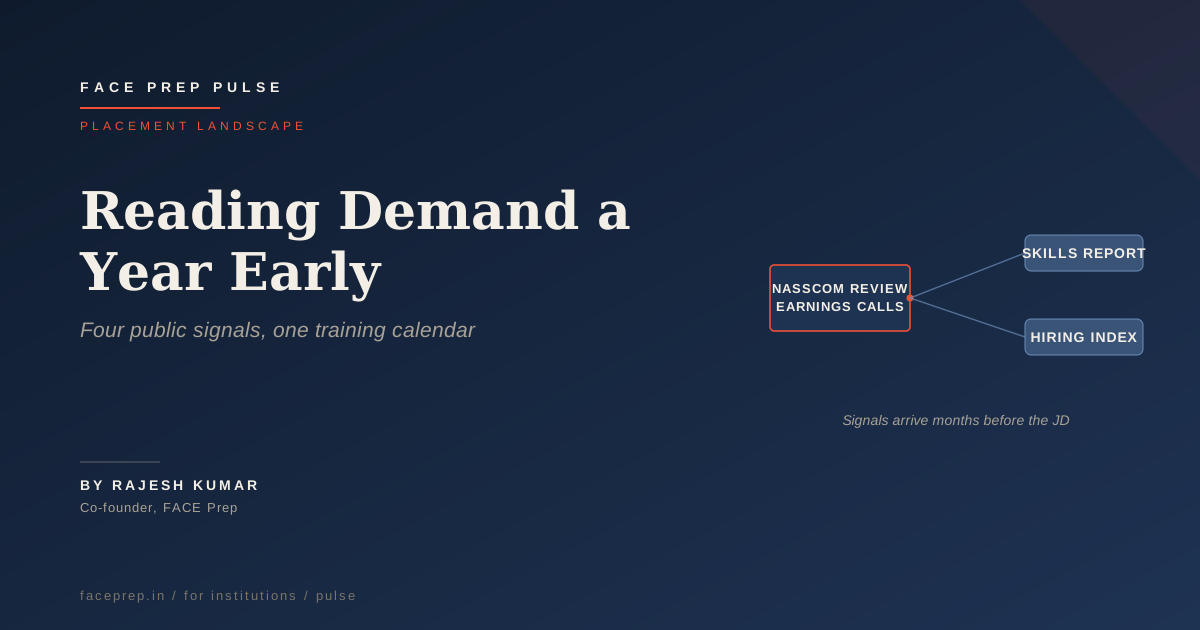
That is the pattern this article is about. Recruiter demand does not appear out of nowhere with the JD. It is disclosed, in public, well before the campus visit, on a calendar that repeats every year: a sector-wide review in February, company earnings calls in April and July, a skills-mix report around May, and a monthly hiring index in between. None of these dates is a campus visit. All of them tell you, months in advance, roughly what to expect and what to train for. I run enterprise partnerships for FACE Prep, which means I read this calendar every year across several hundred recruiting companies, and the placement heads I talk to who use it consistently start their training cycle earlier and calmer than the ones who wait for the notice.
What the February number tells a placement cell
NASSCOM’s Annual Strategic Review, published every February at its technology leadership forum, is the earliest sector-wide signal in the calendar. The 2026 edition projected direct technology-sector employment climbing to roughly 5.95 to 6 million people, a net addition of about 135,000 jobs, even as the industry’s dollar revenue kept expanding faster than its headcount. Net addition is the number that matters for a placement cell to read correctly: it is hiring after attrition, not gross recruitment, and 135,000 was only marginally ahead of the roughly 133,000 net additions the sector recorded the year before.
Read as a headline, a marginal year-on-year increase sounds like a plateau. Read as a training signal, it says something more specific: the sector is still a net employer, but the growth is coming from a narrower set of higher-value roles rather than a broad hiring expansion. A placement cell that treats “135,000 jobs added” as “roughly the same number of freshers as last year” is misreading the number. The report itself pairs the employment figure with a shift toward AI-led services, platform work, and specialised engineering roles, which means the jobs being added skew toward candidates who can show more than a clean resume and a cleared aptitude test.
For a TPO, the practical use of the February number is a planning baseline, not a headcount forecast. It tells you whether the coming year is a growth year, a flat year, or a contraction year for the sector overall, roughly seven months before your own campus season opens. That is enough lead time to decide whether next year’s training plan needs to lean harder into differentiation, or whether volume-friendly fundamentals will carry most of the cohort through on their own.
What a quarterly earnings call reveals that a campus visit does not
The next reliable signal lands in April and July, when the largest IT recruiters report quarterly results and take analyst questions on hiring. Four companies, four earnings calls, four different postures in the same season, is a more useful data set than any single company’s eventual campus notice.
| Company | FY27 hiring posture (April 2026 calls) | What it tells a placement cell |
|---|---|---|
| TCS | 25,000 fresher offers made for FY27; more hiring “linked to demand clarity” | A stated plan with a condition attached. Read as a floor, not a ceiling; the number can move either way through the year. |
| Infosys | ~20,000 freshers planned, level with FY26 | The clearest continuity signal among the four. Historically one of the more dependable large-campus recruiters. |
| HCLTech | No fixed annual figure; FY27 expected “broadly similar” to FY26’s 11,744 additions, allocated quarter by quarter | Hiring will track project and revenue visibility through the year rather than a single headline number. Expect uneven quarters. |
| Wipro | No FY27 target stated; “completely on demand, very volatile environment” | The least predictable of the four on paper. Does not mean no hiring, but the timing and volume are genuinely unclear this early. |
By July, the picture sharpens further. TCS had onboarded 14,000 campus graduates in Q1 FY27 against its 25,000-offer plan, a pace that confirmed the earlier number was active rather than aspirational. That second data point, four months after the first, is what turns a stated plan into a credible signal.
None of this replaces the eventual campus conversation with a TPO. What it does is let a placement cell walk into that conversation already knowing which of the four postures its target recruiter is likely to hold, and prepare the cohort accordingly, months before the recruiter’s own campus team has finalised a visit schedule.
The posture itself is useful even before it is confirmed by a campus notice. A recruiter closer to the Infosys pattern, a stated number held broadly steady year on year, is worth building sustained, early-start preparation against, because the odds favour that recruiter returning at roughly the scale it named. A recruiter closer to the Wipro pattern is worth keeping on the outreach list without over-committing training capacity to it months ahead, because the volume and timing genuinely are not fixed yet. Sorting your recruiter list into these two postures each April is a small piece of work that changes how a placement cell allocates its scarcest resource, which is not budget but the weeks of training time before a drive.
Reading the skill mix before the JD names it
Volume is only half of what the calendar discloses. The other half is composition: what skills are actually showing up in the roles being advertised. NASSCOM’s report with Indeed, released in May 2026 and drawing on Indeed’s own postings data, tracked the AI-related share of Indian job postings rising from 8.9 percent in January 2025 to 14 percent by January 2026. Put differently, roughly one in eleven postings mentioned AI a year earlier; by the start of 2026 it was closer to one in seven.
That trajectory matters more to a placement cell than the single-point figure, because it shows direction and pace, not just a snapshot. A skill that appears in one in seven postings and rising is not yet universal, but it is no longer niche either. It is moving from “a differentiator for the strongest students” toward “a baseline expectation in a meaningful share of technical roles,” and a training calendar built a year ahead can shift the mix gradually rather than bolt on a crash module the month before recruiters arrive.
The practical read for a college is not “teach AI instead of the fundamentals.” It is “build the demonstrable AI or data layer on top of the fundamentals, at a pace the postings data justifies, rather than reacting to it the first time a recruiter’s screening round names it directly.” A student walking into a technical round having built one project that touches AI or data, on top of solid programming fundamentals, is prepared for both the roles that ask for it and the roles that still don’t.
A month-to-month pulse, not just an annual one
The February review and the April and July earnings calls are the four biggest disclosures, but they leave long gaps. Naukri’s JobSpeak index, published monthly and tracking new job postings and recruiter searches on India’s largest résumé database, is the closest thing to a live gauge in between. The index opened 2026 at 2,637 points, up 3 percent from January 2025, using July 2008 as its base of 1,000.
The honest caveat matters here: JobSpeak measures postings and recruiter search activity across white-collar hiring generally. It does not measure campus placements directly, and it excludes gig and hyperlocal hiring. Treat it as a monthly weather check, not a forecast in itself. Its real value is confirming or complicating the annual and quarterly signals as the year plays out. If a month’s reading contradicts what an earnings call implied a quarter earlier, that is worth a second look before a placement cell commits training capacity to an assumption the more recent data no longer supports.
Where this method runs out
Not every corner of campus recruitment gives a signal this clean, and it is worth being specific about where the method is weaker rather than presenting it as universal.
The four largest IT services firms disclose fresher numbers because headcount is material to how investors read their business, and analysts ask about it directly on every call. Most product companies, mid-sized firms, and many GCCs do not carry that same disclosure obligation, and rarely give a comparable public figure. For that segment, the sector-level signals, the AI-postings share and the monthly index, do more of the work, because a single-company number often does not exist to read in the first place.
The method also does not shrink the value of aptitude and core coding fundamentals. Service-tier roles, which still make up a substantial share of total campus offers at most colleges, continue to screen heavily on the same fundamentals they always have. A stated hiring figure from an earnings call is a plan, subject to revision, not a guarantee; TCS said as much about its own number. Reading the calendar well means holding the number as a planning range and building flexibility into the training sequence, not treating any single disclosure as fixed.
A university in Goa that built its calendar around four dates
A university in Goa with a little over 3,000 engineering students across CSE, ECE, and mechanical branches had, for several years, run its placement training in a single intensive block starting in July, timed to whichever companies had already confirmed a visit. The placement head’s frustration was specific: by the time she had a confirmed company list, she had eight weeks to prepare a cohort that needed considerably more than eight weeks.
The change she made in early 2026 did not touch the training content in the first instance. It touched the calendar. In March, after the NASSCOM review, her team built a working assumption for the year: a modestly growing but selective sector, with AI and data skills carrying more weight than the previous cycle. In April and May, after the earnings calls and the NASSCOM-Indeed report landed, she mapped which of her historical recruiters had signalled continuity (closer to the Infosys posture) and which had signalled volatility (closer to Wipro’s), and adjusted her outreach priority accordingly. Of the eleven recruiters her college had hosted the previous year, six read closer to the steady posture and were prioritised for early, sustained preparation; the remaining five, read as more volatile, stayed on the outreach list without a matching training commitment that far ahead.
The training calendar for the incoming final-year batch started in June, two and a half months earlier than the previous year, built around fundamentals plus a scaled AI-and-data layer sized to what the postings data suggested, not a guess. Mechanical and electronics students, who had historically received a lighter version of the technical track, got the same early start as CSE and ECE this cycle, because nothing in the signal read suggested the demand shift was CSE-specific.
By the time company visits began that September, her cohort had five months of preparation behind it instead of eight weeks. The recruiter mix she reached did not change dramatically. What changed was how ready her students were when those recruiters arrived, because the training plan had started when the signal appeared rather than when the invitation did.
What eighteen years of watching this calendar has taught us
We work with more than 500 enterprise partners and 2,000-plus colleges and universities, and one advantage of that scale is a wide-angle view of the same calendar every institution can read on its own: the same NASSCOM review, the same earnings calls, the same skills report, the same monthly index. What eighteen years of watching it has taught us is not that any single disclosure is precise. It is that reading four public dates together, every year, consistently buys a placement cell three to six months of extra runway compared with waiting for the campus notice, and that runway is what turns a rushed training block into a sequenced one. If your cell is planning next year’s calendar and wants a second set of eyes on how the signals read for your recruiter mix, that is a conversation worth having.
Primary sources
- NASSCOM Annual Strategic Review 2026 projects $315bn FY26 tech revenue (+6.1%) and ~135,000 net direct-employment additions, workforce nearing 6 million (CNBC-TV18, 24 Feb 2026)
- TCS made 25,000 fresher offers for FY27, hired 44,000+ freshers in FY26; further hiring linked to demand clarity, per K. Krithivasan, CEO & MD (Business Today, 13 Apr 2026)
- TCS onboarded 14,000 campus graduates in Q1 FY27 against the 25,000-offer plan (Moneycontrol, 9 Jul 2026)
- Infosys plans to hire ~20,000 freshers in FY27, level with FY26, per Jayesh Sanghrajka, CFO (Moneycontrol, 23 Apr 2026)
- Wipro states no FY27 fresher hiring target, calls the environment demand-led and volatile, per Saurabh Govil, CHRO (Moneycontrol, 16 Apr 2026)
- NASSCOM-Indeed 'India's AI Talent Inflection Point': AI-related share of job postings rose from 8.9% (Jan 2025) to 14% (Jan 2026)
- Naukri JobSpeak white-collar hiring index opened 2026 at 2,637 points, up 3% year on year
Frequently asked questions
Which public sources should a placement cell actually track for hiring demand?
Four, tracked once a year and refreshed monthly. NASSCOM's Annual Strategic Review, published every February, gives the sector-wide direction. The April and July earnings calls of the largest recruiters give company-specific hiring postures. The NASSCOM-Indeed AI Talent report, published around May, tracks what skills are showing up in job postings. Naukri's JobSpeak index, published monthly, gives a rough pulse between the bigger disclosures. None require a subscription or an insider contact.
Does a company's earnings-call hiring number mean that many students will actually get offers?
No, and treating it that way is the most common misread. TCS's 25,000 fresher offers for FY27 is a stated plan with an explicit condition attached: more hiring depends on demand clarity. A hiring number from an earnings call is a planning range set by the company's own leadership, not a guaranteed offer count for any particular campus. The value of the number is directional, not a headcount a placement cell can bank on.
How far ahead of a campus drive should training start, based on these signals?
Most of the signal is available nine to twelve months before a drive. NASSCOM's review lands in February for a hiring year that mostly runs August through the following July. Earnings-call postures land in April, five to six months before autumn campus season opens. A college that waits for the campus notice in September is starting training with roughly a quarter of the runway a college that reads the February and April signals has.
Do smaller or niche recruiters give the same kind of advance signal as the largest IT firms?
Not to the same degree. The four largest IT services firms disclose fresher hiring numbers on investor calls because headcount is material to their business model and their shareholders ask about it directly. Product companies, GCCs, and mid-sized firms rarely give a comparable public number. For that segment, sector-level signals such as the AI-postings share and the monthly hiring index matter more than any single company statement, because a single-company number often does not exist to read.
What does a rising AI-postings share actually change about what to teach?
It changes the composition of the technical track, not the whole curriculum. The NASSCOM-Indeed data shows AI-related mentions in Indian job postings moving from under one in eleven postings to one in seven inside a year. That is a training-mix signal: a placement cell reads it as a reason to add a demonstrable AI or data component to the existing coding and aptitude track, not as a reason to replace core computer science fundamentals with AI content.
Should a college stop preparing students for the traditional aptitude and coding rounds?
No. Nothing in the disclosure calendar points that way. Service-tier hiring, which still accounts for a large share of campus offers, continues to screen substantially on aptitude and core coding ability. The AI and skill-mix signals sit on top of that base; they do not replace it. A placement cell that drops fundamentals to chase a skill-mix headline will lose students to the roles that still test the fundamentals first.
How does FACE Prep use these signals across the colleges it works with?
We read the same four-date calendar every year across the 500-plus enterprise partners and 2,000-plus institutions we work with, and we build the training sequence for the next cycle against it rather than against the JD that arrives with the campus notice. The pattern across eighteen years is consistent: the colleges that start their training plan when the signal appears, not when the recruiter visits, get a longer, calmer runway to build readiness instead of compressing it into the weeks before a drive.
Wondering how this applies to your college or university?
Message the FACE Prep team on WhatsApp. We work with 2,000+ institutions on placement training, academic integration, and upskilling programs. Tell us where your placements stand today, and we will share what has worked for institutions like yours.
WhatsApp the FACE Prep teamAbout the author
Rajesh Kumar
Co-founder, FACE Prep
Rajesh Kumar is a co-founder of FACE Prep and an IIM Kozhikode alumnus. Over 18 years he has built FACE Prep's relationships with 1,600+ universities and 500+ tech enterprises, connecting campuses to the companies that hire from them.