What 18 Years of Placement Training Taught Us About Employability
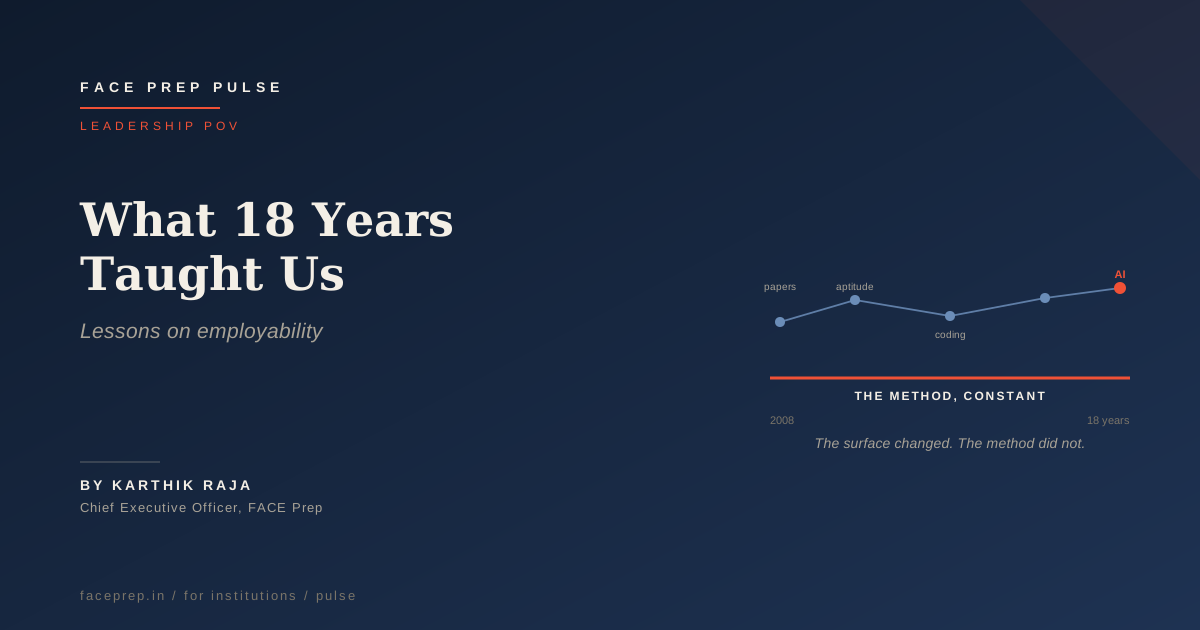
Across 18 years and 2,000+ institutions, the surface of placement training changed completely while the method that builds employability stayed the same. The lessons.
 Karthik Raja 8 min read
 Eighteen years is long enough to watch a field change its vocabulary completely and keep its fundamentals intact. When we started, the conversation was about placement papers and company-specific question banks. It moved to aptitude, then to coding and data structures, and now to artificial intelligence, each shift arriving with the confidence that everything before it was obsolete. Across more than 2,000 institutions and over 7 million students, I have watched that surface change again and again. What I want to set down here is the part that did not change, because it is the more useful half of what eighteen years teaches, and the half that gets the least attention precisely because it does not change.
The surface is loud and the method is quiet, which is why most of the attention, and most of the marketing, goes to the surface. But the colleges that build employable graduates, year after year, through every change in the headline skill, are doing the same small number of things they were doing a decade ago. Those things are worth naming plainly.
What kept changing
It is worth being honest about how completely the surface has turned over, because it is what makes the constancy underneath so striking. Each era had its defining skill, and each felt permanent while it lasted.
There was the era of placement papers, when preparation meant drilling the specific questions companies were known to ask. There was the long era of aptitude, when quantitative and logical reasoning were the gatekeepers to almost every drive. There was the coding era, when data structures and algorithms became the bar. And now there is the AI era, when the ability to work with and judge AI is the rising requirement. Every one of these shifts was real, and a college that ignored the new skill paid for it. The mistake was never in taking the new skill seriously; it was in believing that the new skill replaced everything underneath it, which it never did.
Each era also had its own certainty that this time was different, that the new skill was not just another layer but a break from everything before. That certainty was wrong every time, and recognising the pattern is part of what eighteen years buys you. When the next defining skill arrives, and it will, it will come with the same conviction that the past no longer applies, and it will be the same kind of layer on the same foundation.
So if you measured our work only by the content of the training, it would look like four different businesses across eighteen years. Measured by the method, it has been one.
What never changed: the method
Underneath every era, the same method produced employable graduates, and its parts are unglamorous enough that they are easy to overlook in the rush toward the latest skill.
Employability is built, not selected. It is the middle band of a cohort that moves a college’s placement number, not the handful at the top, and that band shifts only with deliberate work applied to everyone. It starts early; the colleges that begin in the pre-final year consistently outperform those that wait for the season, because their students arrive ready rather than scrambling. It is measured, not guessed; the colleges that know where their students actually stand, across the dimensions that decide placement, make far better decisions than those running on the staffroom’s impressions. And it covers the whole cohort, because a method that only serves the strong leaves most of the placement rate on the table. Early, measured, whole-cohort, built rather than selected: that is the method, and it has held through placement papers, aptitude, coding, and AI alike.
I find this reassuring rather than deflating, and I think institutions should too. It means the thing that works is knowable and stable, and does not have to be reinvented every time the headline skill turns over. A college does not have to guess at what will work next year, or chase every trend in fear of being left behind. It has to do a small number of known things well and keep doing them, which is a far calmer and more achievable mandate than the anxious reinvention many placement cells feel pushed toward.
Why the method is hard to hold
If the method is so stable and so effective, a fair question is why every college does not simply follow it. The answer, learned across eighteen years, is that the method is simple to state and genuinely hard to hold, and the difficulty is what separates colleges more than knowledge does.
Three pulls work against it constantly. The first is the pull of the shiny new skill, which makes it tempting to lead with the latest thing and let the unglamorous fundamentals slide, because the new skill is what everyone is talking about. The second is the pull toward the top students, who are visible, gratifying to teach, and who reflect well on the college, while the middle band that actually moves the number is harder, less rewarding work. The third is the pull away from honest measurement, because measuring readiness produces uncomfortable truths about where students actually stand, and it is easier to run on the staffroom’s optimism. Each pull is natural, and each quietly degrades the method. The colleges that sustain results are not the ones that know the method better; almost everyone knows it. They are the ones disciplined enough to resist these three pulls, season after season, when it would be easier not to. That discipline, more than any insight, is the real scarce ingredient.
The lesson that took longest: fundamentals before adaptation
The hardest lesson to learn, and the one we relearned a few times before it stuck, is one of sequence. The durable skills come first, and the current skill is layered on top, never the other way around.
Every time a new skill arrived, the temptation was to lead with it, to make the exciting new thing the foundation. It never worked. A student weak on fundamentals could not be rescued by the latest skill; the new layer needs something to attach to. The colleges that built strong reasoning, communication, and coding first, and then added the current skill on top, produced graduates who could absorb whatever came next. That capacity to keep absorbing the new is, in the end, the real product. Professor Suman Chakraborty, the director of IIT Kharagpur, put the destination of this well when he said the future will reward adaptive intelligence over static degrees. Adaptive intelligence is exactly what a strong foundation plus the habit of layering on the current skill produces. It is not built by chasing each new skill in isolation; it is built by getting the sequence right, over and over.
The quiet decider: the human skills
Across every era, one set of skills decided outcomes more than any technology, and it was the set least talked about in any given year’s excitement: the human skills. Communication and the ability to learn have separated the hired from the unhired through placement papers, aptitude, coding, and AI alike.
The reason is simple and unchanging. Every employer, whatever the technology of the moment, ultimately needs people who can explain their thinking, work with others, and absorb what is new, because the specific skill they are hired for will change and the human capabilities will still be needed. Chakraborty captured this when he said the world does not need more technocrats, but people who can combine emotional intelligence with technical intelligence. Eighteen years says he is right, and that this has been true in every era, not only the AI one. It is also the part of employability that institutions most often underinvest in, precisely because it is hard to make flashy: a workshop on the latest tool photographs better than the patient work of helping a quiet student learn to speak about their work with confidence. Yet it is the second of these, far more than the first, that decides whether that student walks out of an interview with an offer. A college that builds strong communication and learnability into its students is investing in the part of employability that never depreciates, whatever the headline skill happens to be.
A college that proved the method, twice
I think of a college we worked with early and then again years later, a useful natural experiment in the method. The first time, in the aptitude era, it lifted its placements by getting the basics right: starting earlier, measuring its cohort, and training the middle rather than the top. Years later, in the coding and early-AI era, the same college faced an entirely new set of required skills, and the leadership wondered whether the old approach still applied.
It applied unchanged. The content was different, coding and AI where there had once been aptitude, but the method that worked was identical: start early, measure honestly, train the whole cohort, build fundamentals before the current skill. The college lifted its placements a second time using the same approach on completely different content, which is as clean a demonstration as I have seen that the method, not the content, is the durable asset. The students were different, the skills were different, the recruiters were different. The method was the same, and it worked the same.
What struck me most, returning years later, was how easily the college could have concluded the opposite. Faced with coding and AI where there had once been aptitude, its first instinct had been that the new era needed a new approach, and it nearly discarded what had worked before. Many colleges do exactly that at each turn, throwing out a sound method because the content around it changed, and starting over from scratch with every shift. The ones that endure learn to separate the two: to update the content without abandoning the method, treating each new skill as a change of cargo rather than a change of vehicle. That separation is subtle and it is everything, because the cost of relearning the method from zero every few years is enormous and entirely avoidable.
What this means as AI reshapes the surface
It would be easy, in a moment as loud as the current one, to conclude that AI changes everything and that eighteen years of method no longer applies. The evidence says the opposite. AI is a genuine and important new layer, the largest in some time, and a college that ignores it will pay for that as surely as one that ignored coding a decade ago. But it is a layer, and it sits on the same foundation every previous layer did.
So the guidance I would give an institution now is the same I would have given in any earlier era, with the content updated. Build the fundamentals and the human skills, start early, measure honestly, train the whole cohort, and weave the current skill, today AI, on top. Hold the method and adapt the content. The colleges that do this will keep producing employable graduates through the AI era and whatever follows it, because they are building the one thing that has always mattered most, the capacity to keep adapting, on the one foundation that has always supported it.
Eighteen years, more than 2,000 institutions, over 7 million students, and a 97 percent promoter score from the colleges we serve have taught us that employability is not a mystery and not a moving target in the way it appears to be. It is the predictable result of a stable method applied with discipline, era after era. That is the most useful thing I know about this work, and it is what we bring to every institution we partner with. If you would like to apply it to your own students, we would be glad to talk it through. To begin, reach us via the For Colleges / Universities page.
Primary sources
- The future will reward adaptive intelligence over static degrees; education is moving from a discipline-centric to a problem-centric model (Prof. Suman Chakraborty, Director, IIT Kharagpur, APAC News Network, 2026)
- The world does not need more technocrats, but people who combine emotional intelligence with technical intelligence (Prof. Suman Chakraborty, Director, IIT Kharagpur, convocation, The Hindu, Jul 2025)
Frequently asked questions
What is the single most important thing 18 years taught FACE Prep about employability?
That employability is built, not selected. The instinct everywhere is to find and polish the students who were always going to do well. The lesson that held across 2,000-plus institutions is that a college's placement number is decided by whether the middle band of the cohort moves, and that band shifts only with deliberate, early, measured work. Employability is the result of a method applied to everyone, not a quality a few students happen to have.
Has the AI era changed the fundamentals of employability?
It has changed the surface, not the foundation. Every few years the headline skill changes, from aptitude to coding to AI, and each shift feels like a revolution. Underneath, the method that produces employable graduates has been constant: build fundamentals early, measure honestly, train the whole cohort, and layer the current skill on top. AI is the newest layer, and it matters, but it sits on the same foundation everything else did.
Why do you emphasise starting early so strongly?
Because eighteen years of evidence is unambiguous on it. The skills that decide employability, reasoning, communication, coding, and now AI fluency, take months of steady building, not a pre-season burst. The colleges that start in the pre-final year consistently outperform those that wait, because their students walk into the season already prepared. Intensity before the season has never matched the quiet compounding of starting early; we learned that the hard way before we learned it well.
What role do human skills play in employability?
A decisive and durable one. Through every shift in technology, communication and the ability to learn have separated the students who get hired from those who do not, because every employer ultimately needs people who can explain their thinking and absorb what is new. As the IIT Kharagpur director put it, the world does not need more technocrats but people who combine human and technical intelligence. That has been true across all eighteen years and shows no sign of changing.
How should institutions think about employability as AI accelerates?
Hold the method, adapt the content. The temptation in a fast-moving moment is to chase the newest skill and abandon the fundamentals, which is exactly the mistake to avoid. The durable approach is to keep building fundamentals and human skills, measure readiness honestly, start early, and weave the current skill, today AI, on top. Adaptive intelligence, the ability to keep learning, matters more than any single skill, and it is built on a foundation, not instead of one.
Does this apply equally to Tier-2 and Tier-3 colleges?
Yes, and that is one of the most encouraging lessons. Across eighteen years, the method has worked at colleges of every tier and location, because it depends on discipline rather than on prestige or budget. A lesser-known college that starts early, measures, trains its whole cohort, and keeps the fundamentals strong consistently outperforms a better-known one that does none of those things. Employability is earned through method, which puts it within reach of any institution willing to apply it.
How does FACE Prep apply these lessons today?
The same way we have refined across 2,000-plus institutions and more than 7 million students over 18 years: start early, measure readiness, train the whole cohort on strong fundamentals, weave in the current skills the market rewards, and never neglect the human ones. The tools we use have changed many times; the method has held. It is what we bring to every institution we work with.
Wondering how this applies to your college or university?
Message the FACE Prep team on WhatsApp. We work with 2,000+ institutions on placement training, academic integration, and upskilling programs. Tell us where your placements stand today, and we will share what has worked for institutions like yours.
WhatsApp the FACE Prep teamAbout the author
Karthik Raja
Chief Executive Officer, FACE Prep
Karthik Raja is the CEO of FACE Prep, with 15+ years in education and skilling. He works with colleges and universities across India on placement strategy and outcome-based training that moves real placement numbers.