The Skills Recruiters Expect from Freshers in 2026: A Checklist
A practical checklist of what recruiters actually screen freshers for in 2026, grouped into a durable core and a current technical layer, with the realistic bar for each.
When a placement head asks me what their students should be trained on, they usually expect a long, technology-heavy list. I tend to disappoint them, because the most useful answer is shorter and more stable than they assume, and it starts with skills that have nothing to do with any particular tool.
What follows is the checklist I actually give them. It has two parts: a durable core that recruiters have screened for as long as I have been in this work and will keep screening for long after 2026, and a current technical layer that changes every few years. A college needs both, but it should understand which is which, because the two ask for very different things from a training programme.
The list, and how to read it
A good skills checklist is not a wish list of every technology in the news. It is a short, honest account of what a recruiter is actually trying to find out when they screen a fresher, organised so a college can act on it.
The mistake I see most often is a college chasing the technical layer alone, adding a course every time a new tool appears, while the durable core goes untaught and untested. That produces students who can name technologies but cannot reason, communicate, or learn quickly, which is exactly the combination a recruiter screens out. So read this checklist top down: the core first, because it is the foundation, then the technical layer as the current expression of it.
The durable core every recruiter screens for
The durable core is the set of skills that decide whether a fresher will be useful in any role, in any year, on any technology. Recruiters have always valued it, and in 2026 they are explicit about it.
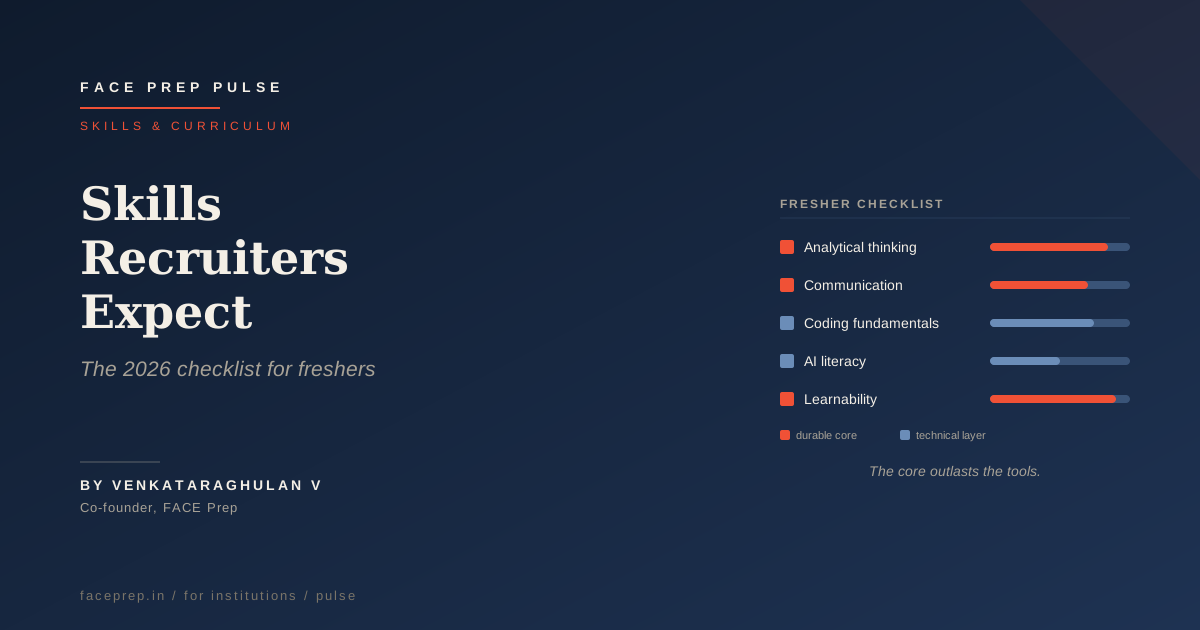
The first is analytical thinking, the ability to break a problem down and reason toward a solution. The World Economic Forum’s Future of Jobs Report 2025 puts this at the very top of what employers want, calling it essential by 7 in 10 companies, ahead of every specific technology. The second is problem-solving under unfamiliar conditions, which is analytical thinking applied to a problem the student has not seen before, the situation every interview tries to create. The third is communication, the ability to explain one’s own reasoning and work clearly, which is the quiet decider of a great many interviews. The fourth, and the one that has risen most in importance, is the ability to learn quickly. Recruiters have become explicit that they hire for this, because the specific tool a fresher knows today will be replaced, and what a company is really buying is how fast the student can absorb the next one. A candidate who can show they have taught themselves something recent is signalling exactly the trait that survives every turn in technology.
None of these four is new, and that is the point. They are the part of the checklist a college should be most confident investing in, because they will not be made obsolete by the next tool.
It is worth dwelling on why recruiters weight the core so heavily, because it explains the whole checklist. A recruiter hiring a fresher is not buying what the student knows today; the technologies will have moved by the time the student is productive. They are buying what the student can become, and the core is the best available predictor of that. A student strong on reasoning, communication, and learning will absorb whatever tool the team uses next; a student who has only memorised today’s tool will be stranded when it changes. That is why an experienced interviewer spends so much of a technical interview probing how a candidate thinks rather than what they have memorised.
The current technical layer
On top of the durable core sits the technical layer, the skills a recruiter needs a fresher to have right now. This part of the list does change, and a college should revisit it each year.
In 2026 the technical layer has four items. Coding fundamentals come first: the ability to write correct, clean code and reason about it, which underpins everything above it. Data literacy comes next, the ability to work with data, read it, and draw sound conclusions, now expected well beyond data-specific roles. AI literacy is the newest item, the ability to use AI tools in a real task and judge what they produce, layered on the coding base rather than floating free of it. Cloud and security basics round it out, the foundational awareness of how modern systems are built and kept safe.
The WEF report tracks exactly this movement, naming AI and big data the fastest-growing skills employers want, followed by networks and cybersecurity and by technological literacy. A NASSCOM survey of colleges found the same priority order from the hiring side: employers lead with core programming, then look for AI, machine learning, data analytics, and cybersecurity. The technical layer, in other words, is well understood; the discipline is in teaching it on top of the core rather than instead of it. Notice too that the order within the technical layer is itself a sequence: coding fundamentals come before data literacy, which comes before AI literacy, because each rests on the one before it. A college that teaches these out of order, reaching for AI before the coding base is sound, builds on sand and finds out at interview time.
The checklist, by what recruiters test
A skill a college cannot measure is a skill it cannot train. So the most useful form of this checklist pairs each item with how a recruiter tests it and the realistic bar a fresher needs to clear.
| Skill | How recruiters test it | The realistic bar |
|---|---|---|
| Analytical thinking | Aptitude and reasoning, timed | Consistent accuracy under time pressure, not perfection |
| Problem-solving | Unseen problems in interview | A structured approach to a problem they have not met before |
| Communication | Structured speaking, interview | Explains their own reasoning clearly, without freezing |
| Learnability | Behavioural and follow-up questions | Evidence of having picked up something new on their own |
| Coding fundamentals | Practical problems in a compiler | Correct, readable code they can defend under questioning |
| Data literacy | Case or data-handling tasks | Reads data correctly and draws a sound, simple conclusion |
| AI literacy | Use-and-correct an AI tool | Uses AI usefully and catches where its output is wrong |
| Cloud and security basics | Awareness questions | Understands the shape of modern systems, not deep expertise |
The bar column matters as much as the skill column. Recruiters are not looking for mastery from a fresher; they are looking for a sound, defensible level on each item and strength on the core. A college that aims for the realistic bar across the whole list places more students than one that chases depth on a single fashionable skill.
What is changing, and what is not
It is worth being clear about which parts of this checklist will move and which will not, because that decides where a college should put its lasting effort.
The technical layer will change, and the WEF report quantifies how much: it expects 39 percent of the skills workers use today to be transformed or outdated by 2030. The specific tools, languages, and platforms on the technical layer in 2026 will look different in a few years, which is why a college that defines its whole training programme around today’s tools is signing up to rebuild it constantly. The durable core, by contrast, will not move. Analytical thinking, problem-solving, communication, and learnability were on this checklist a decade ago and will be on it a decade from now.
The practical implication is a ratio. A college should put the larger share of its training effort into the durable core, which compounds and never expires, and a smaller, regularly-refreshed share into the current technical layer. Programmes that invert this ratio, all tools and no core, are the ones that have to start over every time the technology turns.
A college in Andhra Pradesh that trained the core first
A college in Andhra Pradesh came to us frustrated that its students, who had completed a string of technical certifications, were still struggling in interviews. The leadership assumed they needed even more technical courses, perhaps in whatever was newest.
When we measured the cohort against the full checklist, the picture was clear and a little uncomfortable. The technical layer was reasonable; the students had the certifications to prove it. The durable core was where they were losing offers. Analytical reasoning under time pressure was shaky, communication was a real blocker for many, and almost none could explain the work behind their own certifications. They had collected the technical layer and skipped the foundation beneath it.
The college reversed its emphasis. It kept the technical training but put the larger share of its effort into the core: structured reasoning practice, regular speaking tasks, and an insistence that students be able to explain and defend any project or certification they listed. Within two cycles the interview results improved markedly, not because the students knew more technologies, but because they could finally do the thinking and talking the technologies were supposed to sit on. The lesson generalises: the technical layer gets a student shortlisted, and the durable core gets them hired.
Two ways a college misreads the checklist
Before the practical steps, it helps to name the two errors I see most often, because avoiding them is most of the work.
The first is collecting the technical layer as a stack of certificates while the core goes unbuilt. A student can accumulate an impressive list of completed courses and still fail every interview, because a certificate records exposure, not capability, and certainly not reasoning or communication. Recruiters have learned to look straight past the list to the thinking behind it, so a college that measures its own success by certificate counts is optimising for the wrong number. The certificates are not worthless; they simply do not substitute for the core they are meant to sit on.
The second is testing a skill in a form the recruiter never uses, which produces confident, misleading scores. The clearest example is communication: a college that assesses it with a written grammar test will pass students who then freeze the moment they have to explain their work aloud, because spoken explanation under mild pressure is a different skill from written correctness. The same applies to coding tested only as multiple-choice theory rather than live problem-solving, and to AI literacy tested as a definition rather than a task. If the assessment does not match the recruiter’s format, the score is measuring the wrong thing, and the gap will only surface in the interview, too late to fix.
How a college uses this checklist
The checklist is only useful if it becomes a working instrument rather than a wall poster. Three steps turn it into one.
First, measure students against both layers, honestly, and find where each student actually stands rather than where the syllabus says they should. Second, route training to the gaps the measurement reveals, weighting the durable core, because that is where the largest and most lasting returns sit. Third, refresh the technical layer once a year against what recruiters on your own campus are screening for, while leaving the core constant. A college that runs this loop every year places more students with less churn than one that rewrites its whole programme around each new technology.
For a TPO, an HOD, or a Dean, the reassuring part is that most of this checklist does not change. The durable core is stable, knowable, and entirely within a college’s power to build, and it rewards patient effort more than fashionable spending. If it would help to measure your students against the full checklist and see where the gaps actually sit, the For Colleges / Universities page walks through how we do exactly that.
Primary sources
- Analytical thinking is the top core skill, essential for 7 in 10 employers; AI and big data, cybersecurity and technological literacy are the fastest-growing skills; 39% of skills will be transformed by 2030 (World Economic Forum, Future of Jobs Report 2025, Jan 2025)
- 85% of colleges report a shift from credentials to capabilities; top technical skills in demand are software programming/coding, AI/ML, analytics and cybersecurity (NASSCOM, Building the Next Generation of Tech Professionals, July 2025)
Frequently asked questions
What skills do recruiters actually screen freshers for in 2026?
Two layers at once. A durable core of analytical thinking, problem-solving, communication, and the ability to learn quickly, which every recruiter values regardless of role. And a current technical layer of coding fundamentals, data literacy, AI literacy, and cloud and security basics, which is what the role needs right now. A strong candidate shows both; a college that trains only the technical layer leaves the more durable half untested.
Which matters more, the durable core or the technical skills?
The durable core matters more over a career, and recruiters know it, which is why analytical thinking and learnability now sit at the top of what they screen for. The technical layer is the entry ticket, but it changes every few years, while the core endures. A college should treat the core as the foundation and the technical layer as the current expression of it, not the other way around.
Is AI literacy now a required skill for freshers?
It is moving from a differentiator to a baseline expectation for technical roles, but it is not a replacement for the fundamentals it sits on. AI literacy means being able to use AI tools sensibly and judge their output, which only works when a student already understands the underlying problem. So it belongs on the checklist, layered on top of coding and reasoning, not in place of them.
How should a college test these skills before drives?
Test each skill the way recruiters do. Analytical thinking and aptitude through timed reasoning sets, coding through practical problems in a compiler, communication through structured speaking tasks rather than written grammar, and AI literacy through tasks that ask a student to use and then correct an AI tool. The point is to measure the skill in the form the recruiter will measure it, so there are no surprises in the interview.
Do non-CS branches need the same checklist?
The durable core is identical across every branch, and so are communication and learnability. The technical layer adapts: a mechanical or electrical student needs the data and AI literacy relevant to their field and the core tools of their discipline, rather than full software-stack depth. The structure of the checklist holds; the specific technical items shift with the branch.
How often does this checklist change?
The durable core barely changes; it has been the same for decades and will outlast 2026. The technical layer shifts every few years as tools evolve, which is exactly why the WEF finds a large share of skills will be transformed by 2030. A college should revisit the technical layer each year against what recruiters on its campus are screening for, while keeping the core constant.
How does FACE Prep train students against this checklist?
We measure students against both layers, the durable core and the current technical layer, then route training to the gaps each student actually has. The checklist becomes a working assessment rather than a poster, and the training follows the evidence. We have run this kind of measurement-led training with institutions for 18 years, and we refresh the technical layer each year as recruiters' priorities move.
Wondering how this applies to your college or university?
Message the FACE Prep team on WhatsApp. We work with 2,000+ institutions on placement training, academic integration, and upskilling programs. Tell us where your placements stand today, and we will share what has worked for institutions like yours.
WhatsApp the FACE Prep teamAbout the author

Venkataraghulan V
Co-founder, FACE Prep
Venkataraghulan V is a co-founder of FACE Prep. Previously at Deloitte, he has built and scaled technology products used by 5M+ learners, and leads FACE Prep's work on AI-era employability and the H.E.R.O.S. and DOJO platforms.