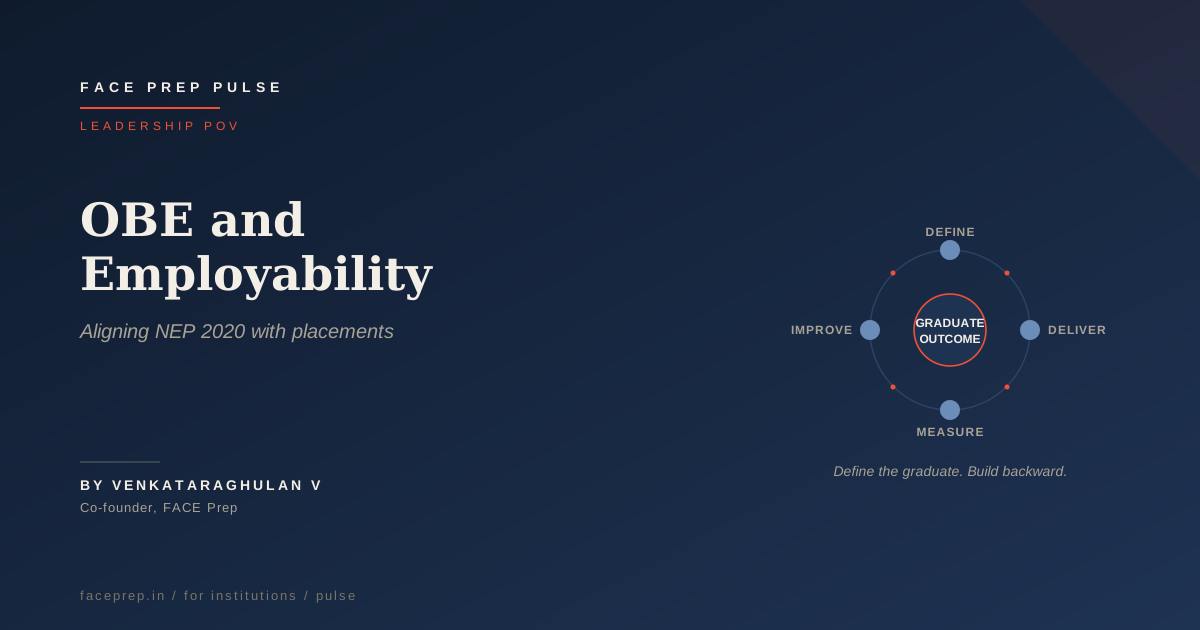
Outcome-Based Education & Employability: Aligning NEP 2020 with Placements
Outcome-based education and employability are the same goal described twice: define the graduate you want, then design and measure backward. How to align the two.
 Venkataraghulan V 8 min read
 Outcome-based education and employability get talked about in different rooms, by different people, as though they were different goals. The accreditation team owns outcome-based education; the placement cell owns employability; and the two rarely meet except at a deadline. This separation is the quiet source of an enormous amount of wasted effort across the institution, because the two are not different goals at all. They are the same goal, described twice.
Once a college sees that, a great deal that felt like competing priorities resolves into one. The outcome-based education the accreditation framework asks for and the employability the college wants for its students are the same project, and running them as one is both less work and far more effective than running them as two separate efforts that never quite line up.
OBE and employability are the same idea
Strip outcome-based education back to its core and it is a simple instruction: decide what a graduate should be able to do, then design the curriculum, the teaching, and the assessment backward from that. Start from the outcome, not the syllabus.
Now ask what should be on the list of things a graduate can do. Somewhere on that list, prominently, is being able to get and hold a good job, which is to say, being employable. Employability is not a separate aim that competes with academic outcomes; it is one of the outcomes, and arguably the one students and parents care about most. So when a college works on outcome-based education properly, employability is part of what it is working on, and when it works on employability seriously, it is doing outcome-based education. The two are one activity seen from two angles, and the only reason they feel separate is that most colleges have split them across two teams, with two vocabularies, two sets of meetings, and two reporting lines that almost never cross.
The practical consequence is large. A college that unifies them runs one system: define the graduate, including their employability, measure where students stand against that definition, and improve where they fall short. A college that keeps them separate runs two systems that duplicate effort and, worse, can pull in different directions.
What NEP 2020 asks for, and why it fits
This unified view is not a reinterpretation of policy; it is what the policy already asks for. NEP 2020 places learning outcomes and real graduate capability at the centre of how education should be organised, and it emphasises the multidisciplinary, practical, twenty-first-century skills that make graduates employable. The policy does not treat employability as an afterthought or a separate stream; it builds graduate capability into the core of what education is for.
So a college aligning its placements with its academic mission is not bolting an industry demand onto an academic structure that resists it. It is delivering on something the national policy already requires. That matters for how leadership frames the work internally. The placement cell asking the academic side to take employability seriously is not making a commercial request that sits outside the academic remit; it is asking the institution to deliver on the outcome focus NEP already mandates. Framed that way, the academic resistance that often greets placement-driven change tends to soften, because the two sides discover they were asked for the same thing.
The trap: OBE as paperwork
There is a failure mode that swallows all of this, and it is the most common state I find OBE in. Outcome-based education gets reduced to documentation: course outcomes and programme outcomes written down, mapped to each other in a file, and produced for an audit, with no connection to what happens in a classroom or to whether graduates get jobs.
When OBE is paperwork, the outcomes on paper are usually academic and generic, phrased to satisfy a format rather than to describe a capable graduate. Employability does not appear, because the document is built for an accreditation reviewer, not for a student’s career. The college can have a complete, compliant OBE file and a poor placement record at the same time, and see no contradiction, because the two live in different worlds. This is outcome-based education in name with none of its substance, and it is worse than useless, because it creates the impression that the outcome work is being done while the actual outcomes go unmeasured and unimproved.
This state is easy to fall into and hard to see from the inside, which is why it is so common. The documents are real, the mappings are complete, the accreditation passes, and every external signal says the outcome work is in good order. Only one signal says otherwise, the placement record, and because that signal is owned by a different team, it is rarely read as a verdict on the OBE. A college can sit in this state for years, doing the paperwork diligently and wondering separately why its graduates struggle, never connecting the two. Naming the trap is the first step out of it: if your OBE file is healthy and your placements are not, the file is almost certainly describing the wrong outcomes.
The cure is not more documentation. It is to make the outcomes real, and to put employability among them.
Making employability a real outcome
Turning employability from a vague aspiration into a genuine, measured outcome uses exactly the machinery OBE already provides, pointed at the right target.
It starts with definition. Specify what an employable graduate of your programme can actually do, in concrete, assessable terms: the reasoning, communication, coding or domain skills, and the applied capability that the roles your students target require. Vague outcomes produce vague training; precise ones produce a work list. Then measure where students stand against that definition, through the year, not once at the end, so the gap is visible while it can still be closed. Then direct teaching and training at the gaps the measurement exposes, and measure again to see whether they closed. That loop, define, measure, attain, improve, is precisely the outcome-attainment cycle OBE describes. The only change is that employability is now one of the outcomes running through it, with the same rigour the academic outcomes get. Done this way, the OBE file stops being a separate document and becomes a true description of a system that is actually producing employable graduates.
NBA, the Washington Accord, and why this is already required
For engineering programmes, the outcome framework is not optional, which is the part colleges can use to their advantage. NBA accreditation is built on outcome-based education and requires programmes to define Graduate Attributes and demonstrate that students attain them. This is in line with the Washington Accord, the international agreement on engineering-education equivalence that India joined as a full member in 2014, which is what gives an NBA-accredited Indian degree its international standing.
The significance for this argument is that outcome-thinking is already mandated for engineering. A college does not have to adopt a new philosophy; it has to use the one it is already required to operate, and put real content into it. The Graduate Attributes NBA asks for, problem analysis, design, communication, the ability to function professionally, are, read honestly, a description of an employable engineer. The framework already points at employability; most colleges have simply filled it with generic academic language instead. Aligning OBE with employability, then, is less an addition than a correction: making the mandated outcome framework say what it was always meant to say.
A university in Telangana that unified the two
A university in Telangana had a strong, compliant OBE system and a separate, struggling placement effort, and it did not connect the two facts. Its outcome documents were complete and its accreditation was in order, yet its graduates were not converting in interviews, and leadership treated this as a placement-cell problem rather than an outcome problem.
When we looked with them, the disconnect was stark. The defined programme outcomes were academic and generic, and not one of them described the applied, communicative, job-ready capability that recruiters were screening for. The OBE system was measuring attainment of outcomes that had little to do with employability, and reporting healthy numbers, while the actual employability outcome went undefined and unmeasured. The paperwork was sound and the substance was missing.
The university rewrote its programme outcomes to include concrete employability capabilities, then used its existing outcome-attainment machinery to measure students against them through the year and route training accordingly. Crucially, this was not a new system; it was the OBE system it already ran, pointed at outcomes that actually mattered for careers. Within two cycles the placement results improved, and the accreditation submission was stronger rather than weaker, because the outcomes it now reported were real and attained rather than generic and assumed. The university had not added a second effort; it had made its existing one mean something.
Where to start the alignment
Leadership hearing this can reasonably ask where to begin, since rewriting every programme’s outcomes at once is neither wise nor necessary. The alignment is best started small and proven before it is scaled.
A good first move is to take a single programme, ideally one whose placement record leadership is unhappy with, and do three things with it. Rewrite its programme outcomes so that at least some of them describe genuine, assessable employability, not generic academic attributes. Measure the current cohort against those rewritten outcomes, honestly, to see where students actually stand. And use the result to direct that programme’s teaching and training for the year. That is the whole loop, run once, on one programme, at low risk.
What that pilot produces is not just a better programme; it is proof for the rest of the institution. When the academic and placement sides see one programme where the outcome framework genuinely describes an employable graduate, and where measuring against it improved both the placements and the accreditation evidence, the argument for unifying the two stops being theoretical. Other departments adopt it because they have seen it work next door, which is a far easier path than mandating a whole-institution change from the top. One honest programme, done well, is the most persuasive case a college can make to itself.
The integration leadership should drive
For a VC, a Registrar, a Dean, or a Principal, the move is one of integration rather than addition.
The leadership’s particular job here is structural, because the split between OBE and employability is structural, baked into the org chart. No amount of exhortation closes a gap that the institution’s own design holds open. What closes it is leadership deciding that the academic and placement functions answer to one outcome, share one record, and are reviewed together, and then setting up the institution so that is simply how it runs.
First, put the academic and placement leadership in the same room and treat outcome-based education and employability as one mandate. They are working on the same goal; the org chart has simply hidden that from them. Second, audit the defined outcomes for honesty: do the programme outcomes describe a genuinely employable graduate, or generic academic attributes. Where they are generic, rewrite them to include real, assessable employability. Third, run one outcome-attainment loop that includes employability, measured through the year, and use it for both the academic mission and the placement effort. One definition, one measurement, two purposes served.
This does not ask a college to choose between academic rigour and employability, which is the false choice that keeps the two apart. It asks the college to recognise that its outcome framework and its employability goal were always the same thing, and to run them as one. That is lighter than running two systems and far better for students. If it would help to make employability a genuine, measured outcome inside your existing OBE framework, we are glad to walk an institution through how it is done. The For Colleges / Universities page has the detail.
Primary sources
- NEP 2020 emphasises learning outcomes, multidisciplinary education and 21st-century skills to improve graduate employability (Ministry of Education, National Education Policy 2020)
- NBA mandates outcome-based education and the definition and attainment of Graduate Attributes for engineering programmes, in line with the Washington Accord India joined in 2014 (National Board of Accreditation, UG Engineering manual)
Frequently asked questions
What is the relationship between outcome-based education and employability?
They are the same idea described twice. Outcome-based education means deciding what a graduate should be able to do, then designing the curriculum, teaching, and assessment backward from that. Employability is simply one of the outcomes that should be on that list: a graduate who can get and hold a good job. Treated properly, working on OBE and working on employability are the same work, not two competing priorities.
Does NEP 2020 require a focus on employability?
NEP 2020 strongly emphasises learning outcomes, multidisciplinary learning, and the practical, 21st-century skills that make graduates employable, and it pushes institutions to organise education around what students can actually do. It does not treat employability as a side effect; it places graduate capability at the centre. So a college aligning its placements with NEP is not adding a new demand, it is delivering on one the policy already makes.
Is outcome-based education just accreditation paperwork?
It becomes that when a college reduces it to documents, course outcomes and programme outcomes mapped in a file that satisfies an audit and changes nothing in the classroom. That is the trap. Done genuinely, OBE is a way of running the whole programme backward from the graduate you want to produce, and employability is one of the outcomes it measures and improves. The paperwork is a by-product of doing it, not the point of it.
How do you make employability a real outcome rather than a vague aim?
Define it concretely, measure it, and feed the result back. Specify what an employable graduate in your programme can do, in terms you can assess, then measure where students actually stand against it through the year, and adjust teaching and training where they fall short. That is exactly the outcome-attainment loop OBE already describes, applied to employability rather than only to academic outcomes. The discipline is the same; the outcome being tracked is the job-readiness one.
Does NBA accreditation already require this kind of outcome thinking?
Yes. NBA is built on outcome-based education and requires engineering programmes to define Graduate Attributes and demonstrate that students attain them, in line with the Washington Accord India joined in 2014. So the outcome-thinking framework is already mandated. The gap in most colleges is not the framework but its content: the defined outcomes are often academic and generic, and making them genuinely include employability is where the real alignment happens.
Will aligning OBE and employability mean more work for faculty?
Less, over time, not more, because it removes duplication. Most colleges currently run OBE documentation and placement preparation as two separate efforts that do not talk to each other. Aligning them means one outcome framework that includes employability, measured once and used for both. There is effort in setting it up, but the steady state is lighter than maintaining two disconnected systems, and it produces better graduates.
How does FACE Prep help align OBE with employability?
We help a college define employability as a concrete, measurable outcome within its existing OBE framework, then measure attainment through the year and route training to close the gaps, so the academic outcome system and the placement effort become one. It is the same evidence-led, outcome-attainment discipline NBA already asks for, with employability made a genuine part of it. We have done this across institutions over 18 years.
Wondering how this applies to your college or university?
Message the FACE Prep team on WhatsApp. We work with 2,000+ institutions on placement training, academic integration, and upskilling programs. Tell us where your placements stand today, and we will share what has worked for institutions like yours.
WhatsApp the FACE Prep teamAbout the author
Venkataraghulan V
Co-founder, FACE Prep
Venkataraghulan V is a co-founder of FACE Prep. Previously at Deloitte, he has built and scaled technology products used by 5M+ learners, and leads FACE Prep's work on AI-era employability and the H.E.R.O.S. and DOJO platforms.