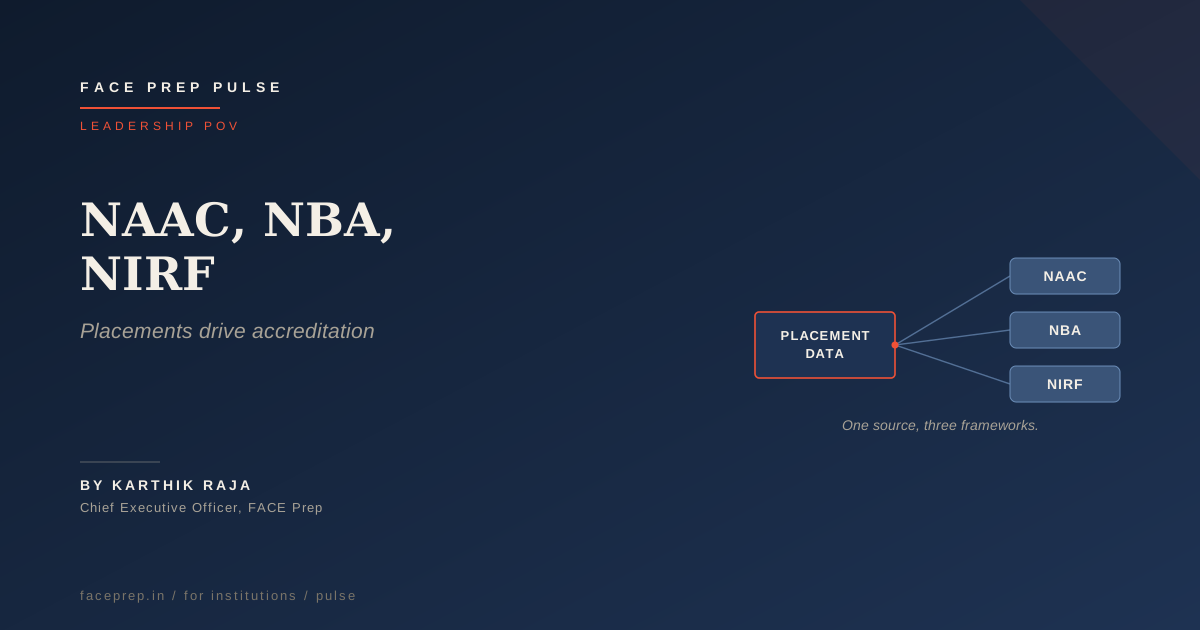
NAAC, NBA, NIRF: How Placement Outcomes Drive Accreditation Scores
Under the 2025 reforms, placements and accreditation have become one job: the same outcome data feeds NAAC, NBA, and NIRF, and is now cross-verified across all three.
 Karthik Raja 8 min read
 Most colleges I work with run placements and accreditation as two entirely separate jobs, handled by different people, on different timelines, with different spreadsheets. For years that made sense. After the 2025 reforms, it no longer does, because the two have quietly become the same job, and the colleges that still treat them as separate are doing twice the work and carrying a new risk for no reason.
The change is worth understanding clearly, because it turns a compliance burden into an opportunity. The data a college builds to run its placements well is now, almost exactly, the data the accreditation frameworks ask for. Build it once, build it cleanly, and it serves both, instead of consuming two separate teams and two separate efforts across the year.
Placement outcomes now feed all three frameworks
Start with how placements enter each framework, because the overlap is larger than most colleges realise. All three of the systems that judge institutional quality now weigh what happens to a college’s graduates.
NAAC assesses student progression and placement directly, under its student-support and progression criterion. NIRF, the national ranking, draws partly on graduate outcomes, which include where students are placed and how many go on to further study. NBA, the engineering accreditation built on outcome-based education, treats placement and career progression as evidence that the graduate attributes it requires were actually attained. Three different frameworks, three different vocabularies, but the same underlying question sits beneath all of them: what happened to your students after they graduated, and can you prove it with evidence that holds up.
This means a college’s placement record is not a separate achievement that sits alongside its accreditation. It is a direct input into all three accreditation and ranking outcomes, which is a very different way to think about the placement cell’s data.
It is worth being concrete about which figures matter, because vague awareness does not survive an audit. The frameworks look for the share of eligible students placed, the spread of employers and roles, the package distribution, the number progressing to higher study, and increasingly the readiness and skill development that led to those outcomes. These are exactly the numbers a serious placement cell tracks anyway. The difference the reforms make is that these figures are no longer a private scorecard for the placement cell; they are reportable, verifiable facts that determine how the institution is graded and ranked. The placement cell’s competence has become, directly, an input to the institution’s standing.
What changed in 2025: binary NAAC and one data trail
Two reforms in 2025 tightened this connection and raised the stakes. The first is that NAAC moved to a binary system, accredited or not accredited, as a baseline quality bar, with maturity-based graded levels above it for stronger institutions. The second, and the more consequential for data, is the move toward what the reform leadership has called One Nation One Data.
Under that approach, the data a college submits is centralised and cross-verified across NAAC, NBA, and NIRF rather than reported to each in isolation. Anil Sahasrabudhe, who has led much of this reform thinking, has described a future where grades give way to a single, verified data source feeding the frameworks. The Radhakrishnan Committee report on reforms in accreditation and ranking laid the groundwork for exactly this integration. The direction is unmistakable: one trail of institutional data, checked for consistency, underlying every quality judgement.
For a Principal or a VC, the implication is direct. The placement numbers are no longer three separate submissions that can be massaged independently for three audiences. They are one set of facts that had better agree with themselves wherever they appear.
There is a cultural shift buried in this that leadership should name openly. In the siloed era, a little optimism in how each submission was framed carried little risk, because no one compared them. Cross-verification ends that quietly. The safest posture now is not careful framing but plain accuracy, the same true numbers everywhere, defensible down to the individual student. Institutions that internalise this early, and build the honest data habit before they are forced to, will find the transition routine; those that carry the old framing habits into the cross-verified world are the ones most likely to be caught out by a mismatch they did not even intend.
The new risk: inconsistent numbers across portals
This is where the reform creates a genuinely new risk, and it catches good colleges off guard. When placement figures reported to NAAC, NBA, and NIRF do not match each other, the inconsistency itself becomes a red flag, independent of whether the placements were actually good.
Picture a college with a genuinely strong placement season. If its placement count is reported one way to NIRF, slightly differently to NAAC, and differently again to NBA, because three different people assembled three submissions from three partial records, the cross-verification now flags the mismatch. The college has done the genuinely hard part, placed its students into real jobs, and is then exposed not by weak outcomes at all but by inconsistent bookkeeping across its own portals. In the old siloed world this never surfaced, because nobody compared the three submissions; in the cross-verified world it is one of the most common ways a strong college runs into an audit problem. Clean, consistent data has become a governance requirement, not a clerical nicety.
The same data does both jobs
Here is the reframe that turns all of this from a burden into an advantage. The data a college needs to run its placements well, and the data the three frameworks now demand, are very nearly the same data.
To improve placements, a college should already be capturing who was assessed and at what readiness, who was trained on what, which companies came, and who was placed where and at what package. That is a continuous, student-level record built through the year. It is also, almost line for line, the evidence NAAC, NBA, and NIRF ask for: student progression, outcome attainment, placement records. A college that maintains this record for placements does not have to build anything separate for accreditation; it has to extract from a system it already runs. This is part of why our H.E.R.O.S. platform holds readiness and outcome data continuously and consistently, so one trail serves the placement cell through the year and the accreditation submission at the end of it. What matters is not the tool but the discipline behind it: a single clean, student-level data trail does both jobs, and maintaining it once is far cheaper and safer than assembling it twice.
What the data trail should contain
If one record is to serve both placements and accreditation, it helps to be specific about what it holds, because a thin record fails both jobs. A trail worth keeping is student-level and continuous, not an aggregate assembled at the end.
For each student, it should capture the readiness baseline and how it changed through the year, the training they received, the drives and interviews they attended, and the final outcome, the offer, the company, the package, or the further study they went on to. Kept this way, the record answers the placement cell’s question through the year, who is on track and who is slipping, and the accreditation question at the end, what happened to this cohort and can you show it, from the same rows. The detail is what makes it defensible: an accreditation panel, and now a cross-verification system, can trace an aggregate number back to the individual students behind it, which a hastily totalled figure assembled at the last minute simply cannot survive. Building the record at this grain feels like more work in the moment and is far less work across the year, because nothing has to be reconstructed.
A college in Kerala that stopped doing the work twice
A college in Kerala had a capable placement cell and a separate accreditation team, and the two barely spoke. Each year the accreditation team would, in the weeks before a submission, ask the placement cell for numbers, then reconcile them by hand against the records the cell happened to have kept, and submit. It worked, just, but it was stressful, and the numbers never quite matched across the different portals.
When the cross-verification tightened, the cracks showed. A mismatch between the placement figures in two submissions triggered exactly the kind of query the new system is designed to raise, and the college spent weeks defending numbers that were, underneath, perfectly real. The problem was never the placements; it was that the data had been assembled twice, separately, from incomplete records, so the two totals were built on slightly different assumptions about who counted and when. Neither team had done anything wrong, which is what made the query so frustrating to answer.
The fix was structural and simple. The college made the placement cell’s continuous record the single source of truth, captured through the year as events happened, and had the accreditation team draw from that same record rather than rebuild it. The next submission was consistent across portals because it came from one place, and the accreditation team’s pre-deadline scramble largely disappeared. The college did not work harder; it stopped doing the same work twice and removed the inconsistency that had been its real exposure.
The leadership noticed a second benefit it had not anticipated. Once the placement and accreditation views drew from the same record, the management committee could see, at any point, both how the current cohort was tracking toward placement and how the institution was positioned for its next accreditation cycle, from one dashboard rather than two reports requested months apart. The unification did not just remove duplicated effort; it gave leadership a clearer, earlier view of two things it had previously seen only late and separately. That is the deeper prize in treating the two as one job: not just less work, but better sight of the institution’s own position.
What leadership should do
For institutional leadership, three moves capture the opportunity this reform creates.
First, unify the data. Make the placement cell’s continuous, student-level record the single source of truth for placement and outcome data, and have every accreditation and ranking submission draw from it rather than reconstruct its own version. One source, many reports.
Second, capture it through the year, not at deadline. The reason submissions are inconsistent and stressful is that they are assembled in a rush from partial records. Data captured as events happen is both more accurate and far less work at submission time.
Third, treat consistency as a governance matter. Because the frameworks now cross-verify, the leadership should assure itself that the same facts appear the same way everywhere they are reported. That assurance is cheap when the data comes from one source and expensive when it comes from three.
Fourth, connect the placement cell and the accreditation team formally, rather than leaving them to meet only at deadline. The two groups are now working on the same underlying facts, so they should share a record, a definition of each metric, and a regular rhythm of reconciliation through the year. Much of the inconsistency that trips colleges up comes not from bad intent but from two teams quietly using slightly different definitions of the same number. Agreeing those definitions once, and drawing from one record, removes the problem at its root.
None of this asks a college to place more students than it already does; it asks the college to capture what it does cleanly and once. A college that runs its placement measurement well is already most of the way to an accreditation submission it can defend, which is the quiet upside of the 2025 reforms. If your placements and your accreditation still run as two separate jobs, putting them onto one continuous data trail is the move to make, and the For Colleges / Universities page shows what that looks like in practice.
Primary sources
- NAAC moves to binary accreditation with maturity-based graded levels and a One Nation One Data trail that cross-verifies NAAC, NBA and NIRF submissions (Anil Sahasrabudhe, Careers360, 2025)
- Dr Radhakrishnan Committee Report on Reforms in Accreditation and Ranking, the basis for the integrated NAAC, NBA and NIRF reforms (AICTE / Ministry of Education)
Frequently asked questions
How do placements affect NAAC, NBA, and NIRF scores?
All three weigh what happens to graduates. NAAC assesses student progression and placement under its student-support criterion; NIRF ranks partly on graduate outcomes, which include placement and further study; and NBA, through outcome-based education, treats placement and career progression as evidence that graduate attributes were attained. So a college's placement record is not a separate achievement from its accreditation; it is a direct input to all three.
What changed in accreditation in 2025?
NAAC shifted to a binary system, accredited or not, as a baseline, with maturity-based graded levels above it for stronger institutions. Alongside that, a One Nation One Data approach is centralising and cross-verifying the data institutions submit to NAAC, NBA, and NIRF, so the same numbers are now checked against each other across the three portals rather than reported in isolation.
Why is consistent data across portals now so important?
Because the systems cross-verify. When placement figures reported to NAAC, NBA, and NIRF do not match, the inconsistency itself becomes an audit red flag, regardless of the underlying reality. A college can have genuinely good placements and still get into trouble if its numbers are reported differently across portals. One clean, consistent data trail is now a governance requirement, not just good practice.
Does good placement data really help accreditation, or is it separate paperwork?
It helps directly, and treating it as separate paperwork is the costly mistake. The readiness and outcome data a college builds through the year to run its placements, who was assessed, who was trained, who was placed where, is precisely the evidence the three frameworks ask for. Build it once for placements and it serves accreditation too, tied to actual students rather than pieced together against a deadline.
What is the most common accreditation mistake colleges make with placement data?
Reconstructing it at the last minute. A college that does not track placements and readiness continuously ends up assembling the numbers in a rush before a submission, which produces gaps, inconsistencies across portals, and figures it cannot defend under scrutiny. The fix is to capture the data as it happens through the year, so the accreditation submission is a report from a system that already exists, not a scramble.
Does this apply to colleges as well as universities?
Yes, with the framework differing by type. Colleges and autonomous institutions deal most with NAAC and, for engineering programmes, NBA; universities engage all three including NIRF rankings. But the underlying shift is the same everywhere: placement and outcome data is now central, cross-verified, and best maintained as a continuous record rather than a periodic submission.
How does FACE Prep help with placement data for accreditation?
We build the continuous readiness and outcome record a college needs for placements, baseline assessments, training, mock drives, and final outcomes, in a form that doubles as accreditation evidence. Because the data is captured through the year and kept consistent, it stands up to the cross-verification the new system applies. It is the same measurement discipline we have run across 2,000 institutions over 18 years.
Wondering how this applies to your college or university?
Message the FACE Prep team on WhatsApp. We work with 2,000+ institutions on placement training, academic integration, and upskilling programs. Tell us where your placements stand today, and we will share what has worked for institutions like yours.
WhatsApp the FACE Prep teamAbout the author
Karthik Raja
Chief Executive Officer, FACE Prep
Karthik Raja is the CEO of FACE Prep, with 15+ years in education and skilling. He works with colleges and universities across India on placement strategy and outcome-based training that moves real placement numbers.