Mapping AI & Data Skills into a 4-Year Engineering Curriculum
The hard part of adding AI and data to a degree is fitting it into four already-full years. How to map it into the existing structure using NEP 2020, not bolt it on.
 Venkataraghulan V 8 min read
 Every HOD and Dean I talk to has reached the same conclusion: AI and data belong in their engineering curriculum. The decision is not the hard part at all. The hard part is fitting them into four years that are already full, without overloading students or turning the degree into a pile of disconnected courses bolted together.
That is a mapping problem, not a content problem, and it is where most colleges stumble. They decide AI matters, then add it as extra load, and wonder why students are stretched and outcomes do not move. The better approach is to map AI and data into the structure the degree already has, using the room that recent policy has opened up, so that what gets added strengthens the degree rather than straining it.
The problem is not whether, it is where
Start by naming the real constraint. A four-year engineering degree is a fixed container. The student’s hours are finite, the core subjects are non-negotiable, and the faculty are already fully committed. Into that full container, a college now wants to add AI and data, which are not small additions.
If the only tool is to add courses, the container overflows. Students end up with more subjects than they can absorb, the new AI courses sit disconnected from everything else, and the core suffers as attention is divided. This is the overload that gives curriculum reform a bad name, and it comes entirely from treating the question as what to add rather than where to fit it. The skill is placement: deciding where in the existing structure each AI and data element belongs, so that it reinforces what is already being taught rather than competing with it for the student’s limited time.
What NEP 2020 makes possible
The reason this is now far more doable than it was a few years ago is that NEP 2020 changed the structure of the container itself. It gave colleges flexibility that the old rigid degree did not have.
Three of its provisions matter most for this purpose. The first is multidisciplinary study, which legitimises an engineering student taking substantial AI and data content as part of their degree rather than as an extra. The second is the credit-based system and the Academic Bank of Credits, which let AI and data be added as credits and electives within the degree’s credit budget rather than as uncounted extra hours. The third is the option of minors, which gives a clean way for a student in any branch to take a structured AI and data thread without abandoning their core discipline. AICTE has been moving in exactly this direction, working to integrate AI and machine learning across B.Tech programmes under the NEP framework, with multidisciplinary minors and faculty training as part of the design.
Together these turn AI and data from an overload problem into a mapping problem. The college is no longer trying to cram extra hours into a fixed timetable; it is allocating AI and data within a flexible credit structure that was built to accommodate exactly this kind of addition.
The shift is easiest to see in a contrast. Under the old rigid degree, adding a meaningful AI thread meant either dropping a core subject, which no department would agree to, or piling extra hours onto students, which is the overload everyone fears. There was genuinely no good place to put it, which is why so many colleges either avoided AI or bolted it on badly. NEP removes that bind. With credits, electives, and minors available, the AI thread has a legitimate place to live inside the degree, counted and structured, rather than squeezed into the margins. The policy did not just permit AI in the curriculum; it created the room to put it somewhere sensible, which is the part that was missing before.
A semester-by-semester map
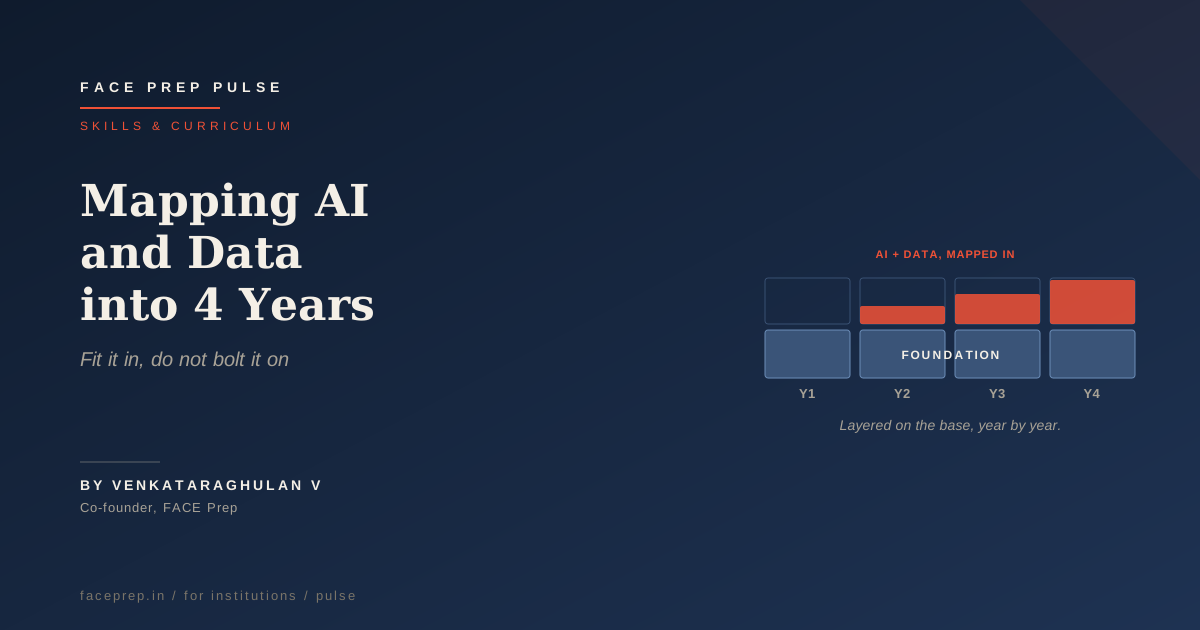
With that flexibility, a college can lay out where each element belongs across the four years. The map below is a guide rather than a rule; the principle is that every layer rests on the one beneath it.
| Years | Foundation being built | AI and data, mapped in |
|---|---|---|
| Years 1 to 2 | Mathematics, programming, data structures | Statistics and data handling as core; AI seen, not yet central |
| Years 2 to 3 | Solid coding, core engineering subjects | Applied data and introductory AI as credits and electives, on the coding base |
| Year 3 | Comfortable with applied work | AI and data minor or focused electives, matched to branch and interest |
| Year 4 | Strong foundation, project experience | Specialisation electives plus a capstone using real AI or data work |
The shape carries the message. The early years stay anchored in the foundations that everything else depends on, with data introduced as core because it underpins AI and is useful everywhere. The middle years add applied AI and data as credits and electives, built on the coding base instead of sitting apart from it. The final year is where depth diverges, through specialisation electives, a minor, and a capstone matched to where the student is heading. Nothing here is bolted on; each piece is placed where the foundation to support it already exists.
Mapping it for non-CS branches
A fair worry is that this is a computer-science plan being pushed onto every branch. It is not, and the mapping should look genuinely different outside CS.
For a mechanical, civil, electrical, or chemical student, AI and data are not a second major; they are a literacy and a set of applied tools relevant to that discipline. The clean way to deliver this is as a minor or a small set of applied electives: data handling and analysis, and AI tools as they apply to that field’s design, simulation, or analysis work. A mechanical student gains from AI in simulation and design workflows; a civil student from data in structural and environmental analysis; an electrical student from data-driven control and signal work. The foundation-first principle holds, but the AI and data content is matched to the branch’s own work rather than imported wholesale from a software syllabus. Mapped this way, it strengthens the student’s core discipline instead of distracting from it.
This branch-matching is also where a college most often goes wrong by copying. It is tempting to take the computer-science department’s AI plan and apply it everywhere, because it already exists. But a mechanical student does not need the same AI as a software student, and forcing the CS plan onto them produces content that feels irrelevant and is quietly ignored. The discipline is to design the AI and data thread for each branch around that branch’s real work, which takes more thought up front and produces far better engagement and outcomes.
What to avoid: the bolt-on trap
It is worth being explicit about the failure mode, because it is the most common one and the most expensive. The bolt-on is a standalone AI course, or a cluster of them, added on top of a full degree, disconnected from the core subjects and from the student’s programming work, and taught in isolation.
The bolt-on fails in three ways at once. It overloads students, who now have more to carry without anything taken away. It connects to nothing, so the AI learning never reinforces or is reinforced by the rest of the degree. And it is fragile, depending on a single course that can be dropped or weakened without the curriculum noticing. A mapped curriculum has none of these problems: the AI and data content sits inside the credit structure, builds on the foundations, and is woven through enough of the degree that it cannot quietly disappear. The difference between mapping and bolting on is the difference between AI that becomes part of how a college teaches engineering and AI that remains a fashionable appendage.
How to begin, without a wholesale rewrite
A Dean looking at all this can reasonably worry that it means tearing up the curriculum and rebuilding it, which is daunting and risky. It does not, and attempting a single dramatic overhaul is itself a common mistake. Mapping is best done incrementally, over a couple of admission cycles, so faculty and students are never overwhelmed at once.
A workable first move is small. Take one existing course and add a data or AI element to it, rather than creating a new course, so the addition rides on something already timetabled. Introduce one well-designed elective in the middle years. Use the credit flexibility NEP provides to make these count within the degree rather than as extra hours. That alone begins the shift, and it is reversible and low-risk, which makes it easy to start.
From there the map fills in over time. The next cycle adds the minor for students who want depth; the one after sequences the foundations earlier so the later AI content has something to rest on. Faculty are brought along in step, trained on each element before they teach it rather than all at once, which is the difference between a map that holds and one that collapses on the people expected to deliver it. A college that adds one well-placed element each cycle arrives, within two or three years, at a fully mapped curriculum, having never once subjected its students or its faculty to a disruptive overhaul. The incremental path is slower on paper and far more durable in practice.
A university in Assam that re-mapped instead of adding
A university in Assam had responded to the AI moment the way many do: it added a set of AI electives across its engineering programmes. Two years on, students were overstretched, the electives sat disconnected from the core teaching, and the placement improvement the university had expected had not arrived.
The problem was the bolt-on, not the intent. The electives had been stacked onto already-full programmes without using the structural room NEP provided, so they competed with the core rather than building on it. We worked with the university to re-map rather than add more. Data handling moved into the early years as core content, applied AI became credit-bearing electives in the middle years built on the coding base, and a structured AI and data minor replaced the scatter of disconnected electives for the students who wanted depth. Crucially, the total load on students went down, not up, because the AI and data content now lived inside the credit structure rather than on top of it.
The outcomes followed once the overload eased and the content connected. Students were learning AI and data in a way that reinforced their core engineering, rather than as a separate burden, and the recruiter conversations reflected graduates who could apply these skills in their discipline. The university had not added more; it had placed what it already had where it belonged.
The detail the Registrar valued most was that the re-mapping fit inside the credit framework the university already ran under NEP, so it did not require special approvals or a confrontation with the academic council over extra hours. The change was, on paper, a reallocation of credits rather than an expansion of the degree, which made it far easier to pass and to sustain. That is the quiet advantage of mapping over adding: it works with the structure the institution already has, rather than asking it to grow.
For an HOD, a Dean, or a Registrar, the reassuring conclusion is that mapping AI and data into the degree is a structural problem with a structural solution, and the structure to solve it now exists. It does not require overloading students or a dramatic rewrite, only the discipline to place each element where its foundation already sits. If it would help to map AI and data into your own programmes using the flexibility NEP provides, the For Colleges / Universities page describes the way we approach that with an institution.
Primary sources
- NEP 2020 enables multidisciplinary education, a credit-based Academic Bank of Credits, multiple entry and exit options, and flexible curricular structures (Ministry of Education, National Education Policy 2020)
- AICTE is integrating AI and machine learning across B.Tech programmes under NEP, with multidisciplinary minors and core-faculty training (AICTE, reported by Careers360)
Frequently asked questions
How do you fit AI and data into an already-full engineering degree?
By mapping it into the existing structure rather than adding it on top. NEP 2020's flexibility, multidisciplinary minors, credit-based electives, and the Academic Bank of Credits, lets a college weave AI and data through the four years: foundations of maths and programming early, data and applied AI in the middle, and specialisation late. Done this way, AI and data reinforce the core subjects instead of competing with them for a student's time.
Does every engineering branch need the same amount of AI?
No. The depth and form should match the branch. A computer science student may take AI and data as core and electives; a mechanical or civil student is better served by AI and data literacy delivered as a minor or as applied electives relevant to their field. The mapping principle holds across branches, foundations first, then applied AI matched to the discipline, but the specific allocation differs.
What does NEP 2020 change for curriculum design?
It gives colleges structural room they did not have before. Multidisciplinary study, a credit-based Academic Bank of Credits, multiple entry and exit options, and minors mean AI and data can be added as credits and electives within the degree rather than as extra hours bolted onto a fixed timetable. NEP turns AI and data from an overload problem into a mapping problem, which is far more solvable.
What is the most common mistake colleges make adding AI?
The bolt-on: a standalone AI course stacked on top of an already-full schedule, disconnected from the core subjects and the student's programming work. It overloads students, connects to nothing they are already learning, and rarely changes outcomes. The fix is to map AI and data into the existing courses and credit structure so they build on the foundations rather than compete with them.
When in the four years should AI actually be taught?
After the foundations are in place. The early years carry mathematical and programming foundations and data structures, with AI present but not central. The middle years introduce data handling and applied AI on that base. The final year is for specialisation, electives, and a capstone, with depth set by where the student is headed. Putting applied AI before the foundations is the surest way to teach it badly.
Can a college do this without rewriting its whole curriculum?
Yes, and it should not attempt a wholesale rewrite. Mapping is incremental: introduce a data or AI element into an existing course, add an elective or minor, use the credit flexibility NEP provides, and sequence it across the years. A staged map, built over a couple of admission cycles, is more robust than a single dramatic overhaul that strains faculty and students at once.
How does FACE Prep help with curriculum mapping?
We help colleges map AI and data into the degree using credit-bearing subjects delivered inside the programme, sequenced across the years and matched to each branch, alongside faculty enablement so the teaching is sustainable. The aim is integration that fits the existing structure, not an overload added on top. We have done this across institutions and degree programmes over 18 years.
Wondering how this applies to your college or university?
Message the FACE Prep team on WhatsApp. We work with 2,000+ institutions on placement training, academic integration, and upskilling programs. Tell us where your placements stand today, and we will share what has worked for institutions like yours.
WhatsApp the FACE Prep teamAbout the author
Venkataraghulan V
Co-founder, FACE Prep
Venkataraghulan V is a co-founder of FACE Prep. Previously at Deloitte, he has built and scaled technology products used by 5M+ learners, and leads FACE Prep's work on AI-era employability and the H.E.R.O.S. and DOJO platforms.