The 2026 Fresher Salary Landscape: Packages You Can Realistically Target
Fresher packages at the same recruiter now span Rs 3.4 lakh to Rs 21 lakh. What decides which band a student lands in, and how a cell sets targets it can defend.
 Karthik Raja 8 min read
 A screenshot of a Rs 21 lakh Infosys offer letter went around a placement WhatsApp group in July, and by evening half the batch believed that was the number to expect. Forty minutes after the first screenshot, a second one landed from the same recruiter, same campus, same week: Rs 6.25 lakh, Digital Specialist Engineer track. Both offers were real. Neither was the batch’s median.
I get some version of this question from a TPO or a Principal most weeks now: why does one recruiter’s offer letter say one thing and another student’s, from the very same company, say something else entirely. The answer is not complicated, but it does require a placement cell to stop quoting one number and start quoting a band, and to be able to say why a given student sits where they do in it.
What TCS and Infosys are paying in 2026
Start with the two recruiters most Indian engineering colleges see every season, because their published bands are the clearest evidence of how far the spread has widened.
| Track | Company | Reported CTC (UG) |
|---|---|---|
| Ninja | TCS | From Rs 3.4 lakh |
| Digital | TCS | Rs 7.09 to 7.30 lakh |
| Prime | TCS | Rs 9.09 to 9.30 lakh |
| Digital Specialist Engineer | Infosys | Rs 6.25 lakh + Rs 75,000 joining bonus |
| Specialist Programmer L1 | Infosys | Rs 10 lakh + Rs 1 lakh joining bonus |
| Specialist Programmer L2 | Infosys | Rs 16 lakh |
| Specialist Programmer L3 | Infosys | Rs 21 lakh |
TCS’s official NQT hiring page lists Ninja, Digital, and Prime as its three fresher tracks for the 2024 to 2026 batches, with Prime pay rising further for postgraduate candidates and for one to two years of relevant experience. Infosys, in a tiered pay structure reported by The Hindu BusinessLine in December 2025, built its Specialist Programmer ladder specifically for stronger programming proficiency, with the top L3 tier aimed at candidates ready for AI-first specialist work.
Two companies, four to five distinct pay points each, and a gap between the lowest and highest that has never been this wide in the mass-recruiter segment. That gap is the entire subject of this article, because a placement cell that does not understand it will keep setting the wrong expectation with its batch.
Why the spread between bands has widened
The short version: companies are pricing for what a fresher can build, not for the degree that got them into the room, and AI has made that distinction sharper than it used to be.
Philip Praveen, COO of Rajalakshmi Engineering College in Chennai, put a number on it from his own campus’s TCS results this season, quoted in The Hindu BusinessLine: “At TCS, for instance, nearly 65 per cent of the offers have been at the Digital and Prime levels, with packages ranging from Rs 7 lakh to Rs 12 lakh per annum.” That is not a college with an unusually strong batch reporting a fluke. It is a signal that the higher bands are no longer a rare outcome at a well-prepared campus, they are becoming the more common one.
K Butchi Raju, Dean of Training and Placement Operations at GRIET Hyderabad, frames the mechanism plainly: “AI is doing the bulk of the code generation work. Those entry-level jobs will not be there. You need to have skills to meet the new demands of IT firms. They are looking for ‘smart’ freshers who can chip in.” The routine coding tasks that used to justify a large Ninja-equivalent intake are exactly the tasks AI now assists with. Companies still need that base layer of talent, and Ninja-level hiring has not disappeared, but they pay a real premium for the layer above it: candidates who can use AI as a tool inside a harder problem rather than needing to be taught the basics from scratch.
Nasscom and Indeed’s 2026 industry study puts a market-wide figure on the same pattern: AI-skilled professionals in India command a 30 to 40 percent salary premium over peers without comparable skills, and the premium holds across large employers and smaller ones, not only at the handful of companies that make headlines. A 30 to 40 percent premium on a Rs 7 lakh base explains most of the gap to Rs 9 to 10 lakh on its own. It does not, by itself, explain a jump to Rs 21 lakh, which is a narrower, more selective tier again on top of the premium.
This is also why the same company can run three or four bands instead of collapsing everyone into one raised number. If AI closed the gap for every fresher equally, companies would simply pay one higher entry wage. Instead they are paying for a specific, verifiable capability, and structuring the hiring process to find out who actually has it before deciding which band applies. A placement cell that reads this only as “salaries went up” will miss the part that actually matters: the bar for the higher bands is a skill bar, not a general market adjustment that lifts every offer by the same amount.
Three bands, and what separates them
It helps a placement cell to stop thinking in company names and start thinking in three bands, because the same three bands repeat across most large recruiters even where the company-specific labels differ.
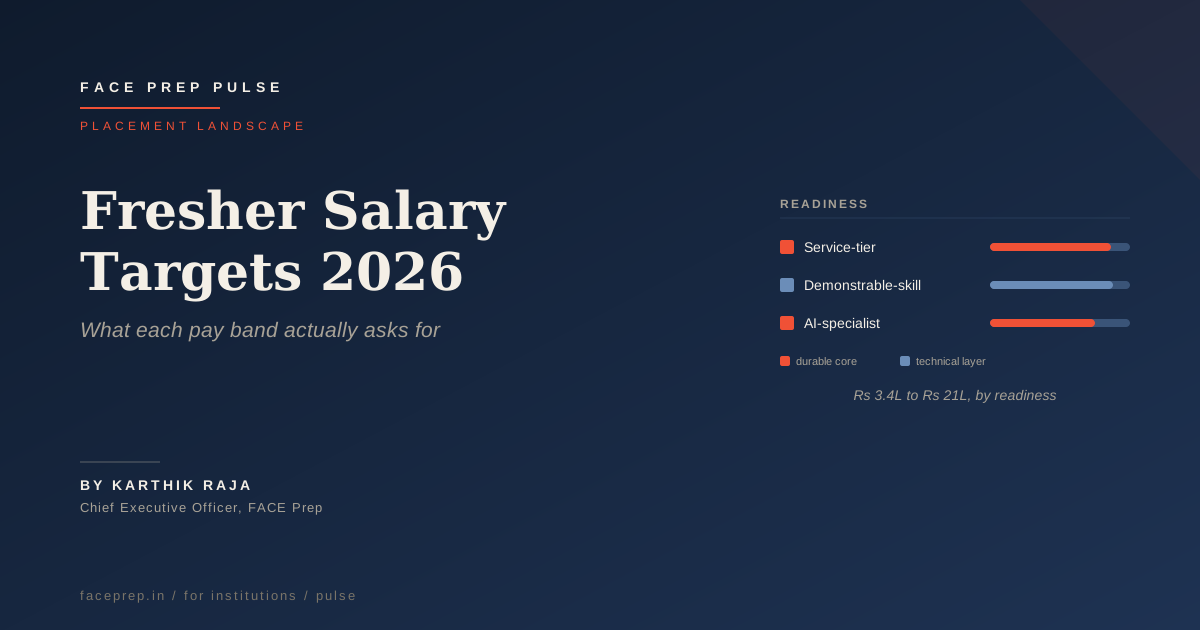
The service-tier band, roughly Rs 3.4 to 4.5 lakh. This is TCS Ninja and its equivalents elsewhere. The screen is aptitude, communication, and correct, if not especially advanced, coding. Most of a batch, in most colleges, lands here or does not get an offer from this recruiter type at all. It remains a legitimate, honourable first job for a large number of students, and the fundamentals it tests, quantitative reasoning, clean logic, working code, are the base every higher band assumes as well.
The demonstrable-skill band, roughly Rs 7 to 12 lakh. TCS Digital and Prime, Infosys’s Digital Specialist Engineer and Specialist Programmer L1, sit here. The screen adds a harder technical round and, increasingly, a task that checks whether a candidate can apply AI usefully rather than merely mention it. Students reach this band with real project work behind them, not a certificate alone, which is why the gap between a student who has built something and one who has only studied for the test shows up here first.
The AI-specialist band, upward of Rs 16 lakh. Infosys’s Specialist Programmer L2 and L3 are the clearest public example. This band is narrow by design. It rewards depth in a specific area, often AI or systems work, evaluated over a harder, more selective process than the other two bands. It is real, it should be named honestly to students who are close to it, and it should not be the number a placement cell circulates as the batch’s expectation.
A university in Himachal Pradesh that stopped promising one number
A university we work with in Himachal Pradesh, around 2,600 engineering students across the usual branch spread, had a habit going into the 2025 season that its own placement head later described as well-intentioned but wrong: every orientation talk to a new batch opened with the previous year’s highest package.
The number was real. It came from a single Specialist Programmer offer the year before. It was also true that fewer than half a percent of the batch had a realistic shot at anything close to it, and most students spent the year measuring themselves against a figure that had almost nothing to do with their own preparation path.
The change was not complicated. The cell built three target bands for the incoming batch, based on where the previous two years’ students had actually landed, and told each student honestly which band their current readiness put them closest to. Students in the service-tier band trained on aptitude, communication, and clean coding, the fundamentals that would carry them into any of the three bands later. Students already close to the demonstrable-skill band added project work and an AI-application module on top of that base. A small group with strong existing coding depth was told, honestly, that the top band was a real stretch goal, not a guaranteed outcome, and trained accordingly.
By the following season, the batch’s offers had not shifted dramatically in their overall distribution, most students still landed in the service-tier or demonstrable-skill bands, exactly as the honest baseline predicted. What changed was how the batch experienced the season. Fewer students treated a solid Rs 7 lakh offer as a disappointment. More of the middle band moved up a level than in the year the cell had trained everyone toward the same headline number. The placement head’s own read on it: students who know which race they are actually running tend to run it better.
Setting targets a placement cell can defend
A target-setting cycle for an incoming batch works best run over the first ninety days of the academic year, before the season’s own momentum takes over.
Days 1 to 30: build the baseline. Pull the last two years of offers by recruiter, band, and branch, not just a single average package. If a college does not have this broken down by band already, this is the first gap to close, because a single blended average hides exactly the spread this article is about.
Days 31 to 60: map students to bands honestly. Run a readiness check against the demonstrable-skill band specifically, not a generic aptitude score, since that is the band where the largest number of additional students can realistically move with focused preparation. Share the result with each student in plain terms: which band their current readiness supports, and what specifically would move them up one.
Days 61 to 90: brief every stakeholder on the same bands. Take the same three-band framing to the batch, to faculty advisors, and to the management committee reviewing the placement plan. A committee that expects one number and gets a distribution feels blindsided later in the season. A committee briefed on bands up front reads a genuinely good season correctly, even when the headline average looks unspectacular next to a screenshot from another college.
Where this does not apply
Not every student needs the AI-specialist track, and a placement cell that pushes every student toward it wastes training time that could close a real gap elsewhere. Service-tier roles continue to hire in large numbers, continue to pay a legitimate entry wage, and continue to reward the same aptitude and coding fundamentals they always have. For a student who needs a stable first job and a clear path into experience, that is not a lesser outcome, it is the right one for where they are.
The bands also compress or shift by recruiter type and by branch. A core-engineering employer in manufacturing or energy prices a mechanical or electrical fresher differently from how an IT-services firm prices a CSE fresher, and forcing every branch into the same three-band language built around software recruiters will mislead a placement cell about its own core-branch students. Build the bands from the recruiters that actually visit a given branch, not from the IT-services numbers alone.
And a single season is a noisy sample to build bands from. One strong Specialist Programmer offer or one unusually generous Prime batch can make a band look wider or narrower than it really is. Build the baseline from at least two years of offers before treating the distribution as stable, and revisit it every season rather than assuming last year’s split still holds. The point of the exercise is not a permanent number. It is a habit of checking before promising.
What this means for the season ahead
The batch WhatsApp group will keep circulating the highest number it sees, because that is what a screenshot does. A placement cell’s job is not to compete with that screenshot. It is to give every student an honest, specific answer to the question the screenshot raises: given what I can actually do right now, which of these is realistically mine, and what would move me up. That answer is more useful to a nervous final-year student than any single projected package, and it is the conversation we keep having with placement cells across the country. If it would help to map your own batch’s readiness against these bands before the season opens, that is a conversation worth having early, not in December.
Primary sources
- TCS All India NQT Hiring 2024-2026: official Ninja, Digital, and Prime CTC bands (TCS Careers)
- Infosys raises fresher pay bar with 21 lakh packages for niche tech roles (The Hindu BusinessLine, Dec 2025)
- India's AI Talent Inflection Point: AI-skilled professionals command a 30-40% salary premium (Nasscom-Indeed, May 2026)
- Demand for AI skills boosts campus placement salaries: named quotes from Rajalakshmi Engineering College and GRIET Hyderabad (The Hindu BusinessLine, Aug 2026)
Frequently asked questions
What is a realistic starting salary for a fresher engineer from a smaller-city or regional engineering college in 2026?
For most students in a service-tier role, Rs 3.4 to 4.5 lakh a year is the honest entry band, matching what TCS pays at its Ninja level and what most mass-recruiter offers still look like. Students who build demonstrable coding or AI-adjacent skill on top of solid fundamentals reach the Rs 7 to 12 lakh band at the same companies, through TCS Digital or Infosys's Digital Specialist Engineer and lower Specialist Programmer tiers. The top tier, upward of Rs 16 to 21 lakh, is real but narrow, and setting it as the default expectation for a batch does more harm than good.
Why do fresher packages at the same company now range from Rs 3.4 lakh to Rs 21 lakh?
Companies have split what used to be one entry-level role into several tracks, screened differently and paid differently. TCS runs Ninja, Digital, and Prime; Infosys runs Digital Specialist Engineer and a three-level Specialist Programmer ladder. The split tracks how much of the work AI can now do on its own. Routine coding and testing pay less because AI assists with much of it. Roles that require designing systems, reasoning about ambiguous problems, or applying AI well pay a real premium, and that premium is what widened the range.
What actually separates a Rs 3.5 lakh offer from a Rs 9 to 21 lakh offer at the same recruiter?
Mostly the depth of the coding and problem-solving assessment, and increasingly a practical AI component. Ninja-level and equivalent hiring still tests aptitude, communication, and basic coding correctness. The higher bands add harder technical rounds, sometimes a machine-coding or system-design exercise, and evidence the candidate can use AI tools to build something real rather than only knowing they exist. A student who has done real project work clears this bar more often than one who has only completed a certificate.
Do core-branch students, mechanical, EEE, and civil, get lower packages than CSE and IT?
In pure IT-services hiring, yes, because those tracks are built around software roles. But core-branch students are not limited to IT-services drives. Manufacturing, electric-vehicle, energy, and semiconductor employers hire mechanical, electrical, and electronics engineers directly, often at packages that compare well with mid-band IT offers, and those roles rarely show up on a software-only recruiter list. A placement cell that tracks only IT-services packages is undercounting what its core branches can actually reach.
How should a placement cell set salary targets for an incoming batch instead of quoting one number?
Set three bands and be specific about what moves a student between them. State the entry band most of the batch will land in, the demonstrable-skill band that a well-prepared minority will reach, and the narrow top band that exists but should not be the planning assumption. Then map training to the middle band, since that is where the largest number of students can realistically move with focused preparation, rather than training everyone as though the top band were the median outcome.
Is a headline figure like Rs 21 lakh a realistic target to set for most of a batch?
No, and setting it as one does a batch a disservice. That figure sits at the top of a single company's most selective fresher track, reached by a small share of hires with strong, demonstrable AI and programming ability. Circulating it as the expected outcome sets students up to be disappointed by a genuinely good offer, or to walk into an interview prepared for the wrong bar. Cite it as the ceiling of what is possible, not the target for the batch.
What does FACE Prep bring to a college that is trying to set salary targets its placement cell can defend to management?
We work from what a given batch's readiness actually supports, not from the number a management committee would like to hear. Across 18 years and 2,000-plus college and university partners, the pattern holds: a cell that trains to a realistic band, and can show management why that band is realistic, keeps its credibility through a season where headline packages are noisy. That is a more useful conversation than any single projected number, and it is the one we have with placement cells most often.
Wondering how this applies to your college or university?
Message the FACE Prep team on WhatsApp. We work with 2,000+ institutions on placement training, academic integration, and upskilling programs. Tell us where your placements stand today, and we will share what has worked for institutions like yours.
WhatsApp the FACE Prep teamAbout the author
Karthik Raja
Chief Executive Officer, FACE Prep
Karthik Raja is the CEO of FACE Prep, with 15+ years in education and skilling. He works with colleges and universities across India on placement strategy and outcome-based training that moves real placement numbers.