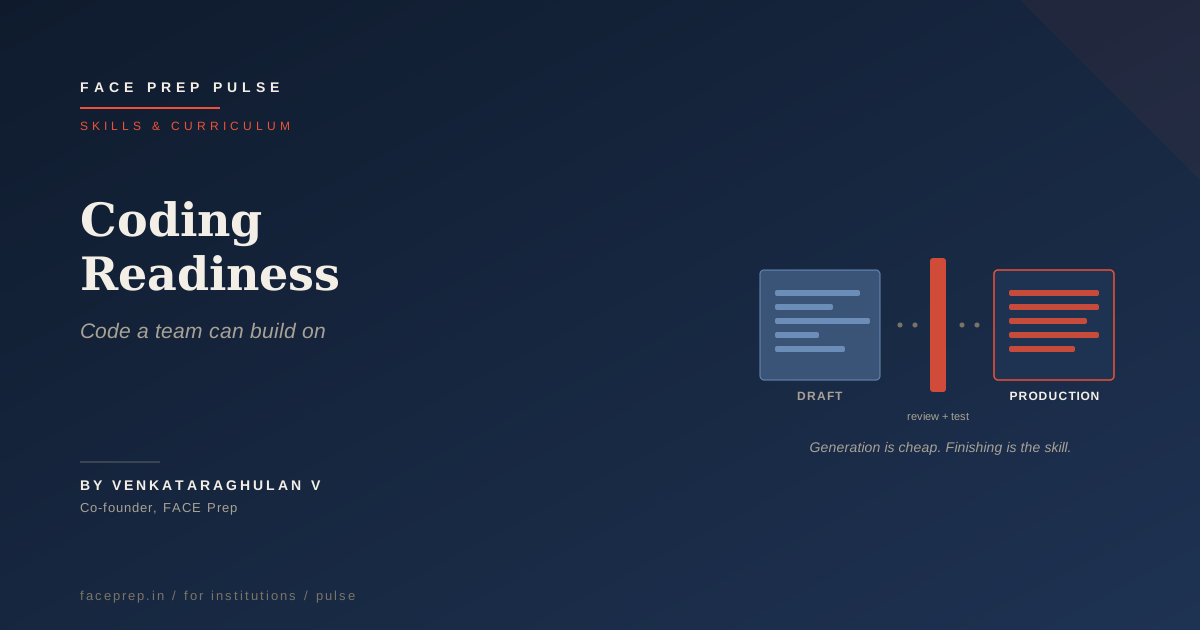
Coding Readiness: Helping More Students Write Production-Ready Code
Production-ready code is correct, readable, tested, and maintainable, not just code that runs once. How to help more students, not only the toppers, reach that bar.
 Venkataraghulan V 8 min read
 There is a gap between code that runs once on a student’s laptop and code that a team can actually build on. Most engineering students learn to write the first kind. Recruiters hire for the second. Closing that gap, for more students than just the toppers, is one of the most underrated levers a placement cell has, and it has become more valuable in the AI era, not less than it was before.
I want to make the case plainly, because there is a lot of noise suggesting AI has made coding skills optional for freshers. It has done the reverse for the skills that actually decide placements, and a college that reads the moment correctly can turn that into an advantage while others draw the wrong lesson and quietly let their coding training slide.
What production-ready means
Start with the bar itself, because vague goals produce vague training. Production-ready code is not a mystery; it has four recognisable properties.
It is correct, not just on the happy path but across the cases that matter, including the awkward ones a student is tempted to ignore. It is readable, written so another person can understand it without the author standing over their shoulder, because real code is read far more often than it is written. It is tested, so the author and the team can trust it and change it without fear. And it is maintainable, structured so it can be extended later rather than rewritten. A fresher does not need mastery of all four, but they should understand the difference between a one-off solution that works in a demo and code that meets these properties, and be able to move toward the second.
Most academic coding stops at the first property and a weak version of it: does it run, once, on the expected input. The distance between that and production-ready is the distance a great many freshers fall short by, and it is entirely teachable.
It helps to see why this gap forms, because the cause points at the cure. College assignments are usually graded on whether the output matches an expected answer, so a student optimises for exactly that and never learns the other three properties, which are never assessed. Nobody reads their code for clarity, nobody asks them to test it, nobody makes them maintain it across a term. They are not failing to learn production-readiness; they are succeeding at a narrower target that the grading set for them. Change what is asked of the code, and the same students rise to the wider bar, because the limitation was in the assignment, not in them.
Why this matters more in the AI era, not less
The common assumption is that AI has made this kind of coding skill less necessary, since a model can generate code on demand. The evidence from people who do this for a living points the other way.
When Stack Overflow surveyed developers in 2025, 84 percent reported using or planning to use AI tools, and 51 percent use them daily, so AI is now woven through professional coding. But the same developers report that 45 percent of them find debugging AI-generated code more time-consuming than writing it themselves. Sit with what that means. AI readily produces code that looks right and is subtly wrong, and turning that draft into something correct, tested, and maintainable takes a developer who genuinely understands code. The generation is cheap and getting cheaper; the judgment and the finishing are where the work, and the value, now sit, and that is unlikely to reverse.
So the bar has moved up, not down. A student who can only prompt a model for code and accept what it returns is less employable than before, because that is exactly the part a company can now do without them. A student who understands code well enough to take an AI draft and make it production-ready is more employable than ever. Comprehension, not generation, is the skill that the AI era rewards, and it is the skill production-readiness is built on.
Helping more students, not just the top
Here is the part that matters most for a placement rate. The top students in any cohort will write good code and place well no matter what a college does. The lever is not them; it is the larger group sitting just below, who can code but have never been pushed to production quality.
That group is where the offers are won or lost. With the right practice they cross the bar and convert; without it they stall, writing code that runs in a demo and falls apart under an interviewer’s follow-up questions. A college that aims its coding effort at moving this middle band, rather than polishing students who were already going to be fine, lifts far more offers for the same effort. The goal is not a handful of excellent coders; it is many more students who clear the production-ready bar, which is a different and more valuable target.
This reframing also changes how a college should feel about its results. A placement cell that celebrates its three star coders placing at top firms is measuring the wrong success; those three were never the question. The real measure is how many students from the middle band, those who could have gone either way, crossed the bar this year that they would not have crossed last year. That number is harder to see and far more important, because it is the number the overall placement rate is made of. A college that learns to track and grow it, rather than the achievements of its strongest few, is measuring the thing that actually decides its season, and managing coding readiness as the cohort-wide capability it really is.
How to know who is at the bar
Moving the middle band requires knowing who is in it, which means measuring coding readiness in a way that reflects the production bar rather than a single pass-or-fail score. A useful assessment reads four things, matching the four properties of production-ready code.
The first is correctness beyond the happy path: does the student’s code handle the awkward inputs and edge cases, or only the obvious one. The second is readability: could another student follow the code without help, which is best tested by actually having a peer read it. The third is whether the student tests their own work and can say how they know it is right. The fourth is debugging: give the student broken code, including AI-generated code, and see whether they can find and fix the fault. A student who is sound on the happy path but weak on the other three is exactly the middle-band student a college can move, and this kind of assessment finds them before the season does.
The value of measuring this way is that it turns a vague sense of who can code into a specific, addressable list. Instead of knowing only that a third of the cohort struggles in coding rounds, a college learns that a particular group is fine on correctness but never learned to test or to read code, which is a problem with a clear training answer. The assessment and the training are two halves of the same loop.
What to teach to build production-readiness
Production-readiness is a craft, and crafts are built by repetition and feedback, not by a single course delivered before the season. Four practices build it.
The first is writing code often, in volume, because fluency comes from reps. The second is reading and reviewing other people’s code, which is how students learn what readable and maintainable actually look like, and which almost no curriculum includes. The third is testing, making students responsible for proving their code works rather than assuming it does. The fourth is debugging real failures, including the failures in AI-generated code, since fixing an almost-right draft is now a core part of the job. We built our DOJO daily coding platform around exactly this kind of sustained, daily practice with feedback, because production-quality coding is a habit formed over months, not a topic covered in a week. The platform is incidental; the principle is that reps and feedback, not a one-time bootcamp, are what move a student to production-ready.
A college in Jharkhand that moved its middle band
A college in Jharkhand had a familiar shape: a strong top tier of coders who placed well, and a large middle that could write basic code but kept failing the coding rounds at good companies. The college had been running an intensive coding bootcamp before the season and was frustrated it had not helped the middle.
The bootcamp was the wrong instrument. A few weeks of intensive sessions cannot build a craft that is made of habit; the strong students did not need it and the middle could not absorb it that fast. We replaced the model with consistent daily practice through the pre-final and final years, with feedback on every submission, code review built in so students learned to read as well as write, and debugging exercises that included fixing AI-generated drafts. Nothing about it was intensive; it was steady.
The middle band moved, which is what mattered. Over two cycles the share of students clearing coding rounds at the better companies rose substantially, almost entirely from the group that had been stuck just below the bar. The toppers were unaffected, as expected, since they were always going to be fine without any of it. The placement rate moved because the middle did, and the middle moved because the practice was daily and fed back rather than crammed.
The role of AI, and its limits
A fair question is how AI tools should figure in all this, given that students will use them regardless. The answer is to use AI to learn faster, never to avoid learning.
Used well, an AI assistant is a tutor that is always available: a student can ask why a piece of code is wrong, explore an approach, or get a draft to critique. Used badly, it is a way to produce code the student does not understand and cannot defend, which is the opposite of production-readiness. The line between the two is whether the student remains responsible for understanding and finishing the result. A college should teach students to use AI on the right side of that line, generating drafts they then make correct, tested, and maintainable themselves, because that is precisely the skill the survey data shows the market now pays for, and the one a student cannot fake in an interview.
There is a teaching trap worth flagging here. Banning AI tools outright, which some departments try, does not prepare students for a workplace where the tools are everywhere; it just sends them to use the tools without guidance, learning the bad habits a course could have corrected. The better path is to bring AI into the coding training openly, with the rule that the student owns the final result and must be able to explain and defend every line, whether they or a model wrote it first. That mirrors how a good engineering team actually works with these tools, and it builds the ownership that separates a production-ready coder from a prompt-and-paste one.
For an HOD, a TPO, or a Dean, the encouraging part is that coding readiness is buildable for far more than the top tier, and the AI era has made the underlying comprehension more valuable rather than redundant. The effort is steady rather than heroic, and it pays out exactly where the placement rate is decided. Spread daily across the years and aimed at the middle band, it is also one of the most reliable investments a college can make, because the skill it builds does not date the way a tool does. You can read how that kind of practice is built with a college on the For Colleges / Universities page.
Primary sources
- 84% of developers use or plan to use AI tools and 51% use them daily, yet 45% say debugging AI-generated code is more time-consuming (Stack Overflow Developer Survey 2025, Jul 2025)
- On the gap between learning to pass coding exams and writing code that works in real systems in Indian engineering education (The Hindu, 2025)
Frequently asked questions
What does production-ready code mean for a fresher?
It means code that does more than run once on the student's own machine. Production-ready code is correct across the cases that matter, readable by someone else, tested, and written so it can be maintained and extended. A fresher does not need to be an expert at this, but they should understand the difference and be able to write code a team could actually build on, rather than a one-off solution that works only in the demo.
Has AI made coding skills less important for freshers?
The opposite, for the skills that matter most. AI can produce a draft quickly, but turning that draft into production-ready code, judging it, fixing it, and making it maintainable, requires real understanding. Among developers surveyed by Stack Overflow in 2025, 45 percent said debugging AI-generated code takes longer, which tells you comprehension is now more valuable, not less. A student who only generates code without understanding it is less employable than before, not more.
Why focus on the middle of the cohort rather than the top students?
Because that is where the placement rate actually moves. The top students will write good code and place well regardless. The students sitting just below them, who can code but have never been pushed to production quality, are the ones who convert with the right practice and get left behind without it. Helping that group cross the production-ready bar lifts more offers than perfecting the students who were already going to be fine.
How is production-readiness best taught?
By repetition and feedback, not a single course. Students need to write code often, read and review other people's code, test their own work, and debug real failures, including failures in AI-generated code. The habit is built through consistent daily practice with feedback, the way any skill of craft is built, rather than through one intensive block before the season.
Do non-CS branches need production-ready coding skills?
To a level appropriate to their field, yes. A mechanical or electrical student writing code for analysis or control benefits from the same habits of correctness, readability, and testing, even if they will not work in a pure software role. The depth differs by branch, but the principle that code should be correct and maintainable rather than just working once is universal wherever code is written.
Can students rely on AI to write production-ready code for them?
Not reliably, which is the whole point. AI produces drafts that are often almost right, and making them genuinely production-ready, correct, tested, and maintainable, requires a student who understands the code well enough to finish the job. A student who can do that is more valuable in the AI era; a student who cannot is stuck with output they cannot trust. The skill to aim for is using AI to go faster while owning the quality of the result.
How does FACE Prep build coding readiness across a cohort?
We build it as a daily habit rather than a one-off course, with consistent practice and feedback so production-quality coding becomes routine, and we focus the effort on moving the middle of the cohort, not just the strongest coders. The point is sustained, feedback-driven reps over months rather than an intensive block before the season. It is the evidence-led approach we have run across institutions over 18 years.
Wondering how this applies to your college or university?
Message the FACE Prep team on WhatsApp. We work with 2,000+ institutions on placement training, academic integration, and upskilling programs. Tell us where your placements stand today, and we will share what has worked for institutions like yours.
WhatsApp the FACE Prep teamAbout the author
Venkataraghulan V
Co-founder, FACE Prep
Venkataraghulan V is a co-founder of FACE Prep. Previously at Deloitte, he has built and scaled technology products used by 5M+ learners, and leads FACE Prep's work on AI-era employability and the H.E.R.O.S. and DOJO platforms.