Campus Placements in 2026: What's Changed for Colleges & Universities
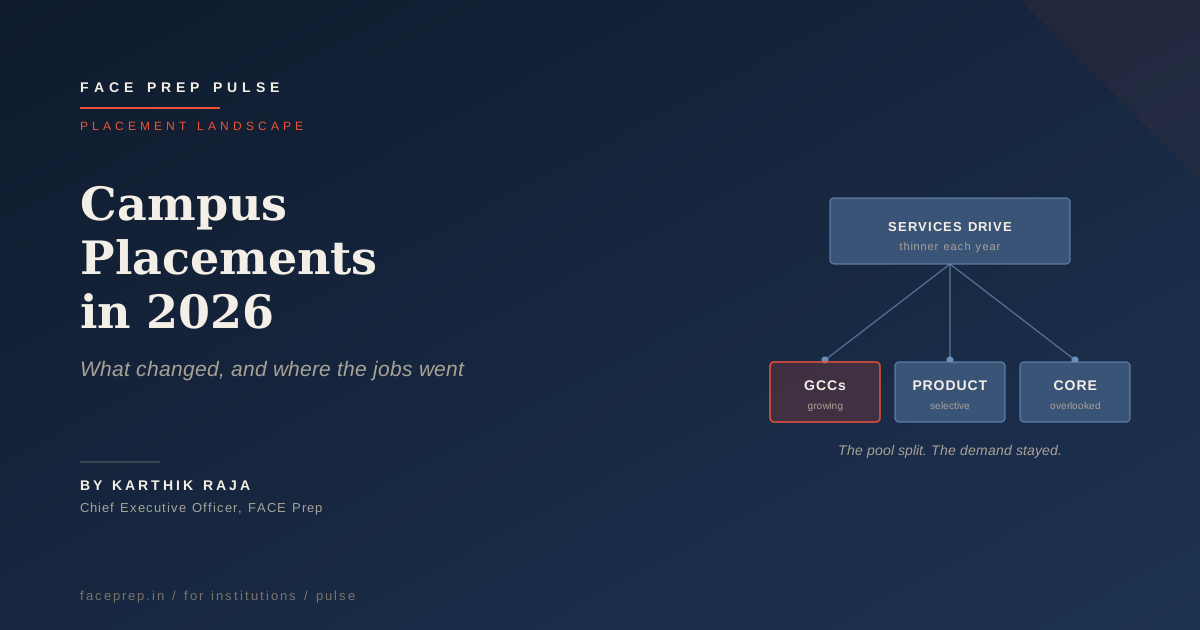
Campus hiring in 2026 did not shrink so much as redistribute. The colleges that adapt re-aim at where the jobs went: GCCs, product firms, and selective drives.
 Karthik Raja 8 min read
 Every December I get the same call from principals and placement heads, and in 2026 it had a sharper edge. The services drives that used to fill a campus in a week were thinner, and the worry on the line was that campus placements were collapsing.
I do not read it that way. The hiring did not vanish. It moved, and it changed shape, and a college that still measures placement by the size of the old IT-services drive is counting a pool that is draining while three others fill up. The job in 2026 is not to mourn the old drive. It is to see where the demand went and aim at it.
The jobs did not vanish, they moved
Hold two facts next to each other. On one side, the largest IT-services recruiters are taking fewer freshers in bulk than they did a few years ago, and they are choosier about whom they take. On the other side, the in-house technology centres that global firms run in India kept growing straight through the slowdown.
India now hosts about 2,117 of these Global Capability Centres, spread across some 3,728 units and employing roughly 2.36 million professionals, according to NASSCOM and Zinnov’s 2026 reading of the sector. The ecosystem has grown by close to a third since 2021, generates revenue on the order of 98 billion dollars, and NASSCOM projects it will pass 2,400 centres and 4.5 million jobs by 2030. These are not back-office shops. They build the product, the platform, and the data systems for their parent companies, and they hire engineers straight onto those teams.
So the picture is not an empty market. It is a market that pays for something different from what the bulk services drive used to reward, and that hires through a different door.
Where the hiring went
When a placement head tells me the drives are thinner, my first question is where they have looked. For most colleges the demand has redistributed into three streams, and only one of them resembles the old model.
The first stream is the captive centres above. They recruit freshers directly, often outside the mass-aptitude funnel, and they screen on whether a student can actually build something. A centre hiring for a data or platform team is reading a candidate’s projects and problem-solving, not only a percentile on a timed test.
The second stream is product companies and funded startups. These hire in smaller batches than a services major ever did, with a higher bar and, usually, a higher package. One such offer is worth several of the entry-level ones in a student’s first salary, which is why the better-prepared students now chase them.
The third stream is the quiet one that placement cells often forget: core and non-IT roles inside the student’s own branch. Manufacturing, electric vehicles, semiconductors, and energy are hiring electronics, electrical, and mechanical engineers in ways that never showed up in an IT-services drive at all. For a college with strong core branches, this stream is real placement that a software-only target list misses entirely.
The scale of the first two streams is easy to underestimate from inside a single campus. Cognizant alone said it would hire about 25,000 freshers in 2026, even as it reworks how it ties headcount to revenue, so the demand at the large firms is real but routed through a higher bar. The centres are a structural shift, not a passing one: their growth has held for years across the whole sector, which is why a college can build a multi-year placement strategy around them rather than treating them as a lucky one-off.
How each destination screens differently
The reason re-aiming takes real work, and not just a new phone list, is that the three streams read a candidate in genuinely different ways. A placement cell that prepares students for one screen and sends them to another is the most common reason good students fail interviews they should pass.
The old services drive screens for throughput. A large aptitude paper filters the cohort, a coding round confirms the basics, and an interview checks communication and fit. It rewards a student who is quick, accurate, and steady under a timed test, and a college that has run these drives for years knows the pattern well.
A captive centre screens for proof of work. The aptitude filter is often lighter or absent, and the weight moves to whether a student has actually built something: a project that runs, code that survives questions, and the ability to reason about a real problem rather than a textbook one. A student with a thin resume but a strong project clears this screen more often than a high scorer with nothing to show.
A product firm or startup screens for depth in a narrow area. The batch is small, the interview is harder, and the questions go further into data structures, system thinking, or a specific stack. This is where the better-prepared students win the higher packages, and where a generic four-week crash course rarely takes a student far enough.
Why the headline number can feel worse than the market
Here is the part that confuses a lot of good placement cells. The market for engineers is not collapsing, yet the college’s own number looks worse. Both things are true at once, and the reason is mechanical.
A placement engine wired to the old services drive is very good at one thing: moving a large cohort through aptitude rounds toward a few big recruiters. When those recruiters take fewer students, that engine has nothing else to feed. The centres and product firms are hiring, but they ask for demonstrable skill and AI awareness that the old engine was never built to produce, so students do not convert there even though the seats exist. The college experiences a demand problem. What it actually has is a readiness-and-aim problem, which is far more fixable.
This is also why two colleges in the same city can report very different seasons. The one that re-aimed early is placing students into centres and product teams. The one still waiting for the old drive to return is watching a shrinking pool and calling it a market collapse.
A university in Gujarat that stopped counting only the services drive
A university we have worked with in Gujarat, around 4,000 engineering students across the usual branch mix, came into a season convinced its placements were failing. The headline count was down by a third year on year, and the management was alarmed.
When we looked with them, the count was down for one reason: two large services recruiters that used to take big numbers had cut their intake sharply. Every other signal was healthier than the leadership believed. Two captive centres in the region had been hiring from comparable colleges, and a cluster of product firms and core-engineering employers had open fresher roles that this university had simply never targeted, because its placement calendar was built around the services drives and nothing else.
The work over the next year was less about new training than about new aim. The placement cell built a target list of centres, product firms, and core employers, mapped which branches each one hired, and prepared those students for the way each screened, which leaned far more on projects and applied skill than on a timed aptitude paper.
The hardest part was not the training. It was the conversation with the centres, who had never thought of this university as a source of talent and needed a reason to spend a recruiter’s day there. The cell gave them one: a shortlist of students with real projects, screened against the skills the centre actually hired for, so the first visit was low-risk for the recruiter. Two centres came, hired a small group, and came back the next season for a larger one, which is how these relationships compound once they start.
By the following season the headline count had recovered past its old level, but the more useful change was underneath it: offers were spread across four kinds of employer instead of depending on two, and the share of higher-paid roles had grown. The market had not come back. The university had gone to where the market already was.
What has not changed
I want to be careful not to oversell the shift, because a placement cell that overcorrects does as much harm as one that ignores the change. Plenty has stayed exactly the same.
The high-volume service roles continue to recruit, continue to take large numbers, and still test aptitude, communication, and the ability to write correct code. For a great many students that is the right first job, and the fundamentals behind it are the same fundamentals every other destination assumes underneath the newer skills. A student who cannot reason through a quantitative problem or write a correct loop is not ready for a captive centre either. So the base of the work does not change. We build it first, the way we always have. The redistribution adds destinations and raises the bar on top of that base; it does not remove the base.
There is no need for fear in any of this. The students are no less capable than last year’s. The demand for engineers in India is, if anything, larger and more varied than it was. What the season asks of a college is attention to where that demand now sits, not panic that it has gone.
What this asks of leadership now
For a Principal, a VC, or a management committee reading the 2026 numbers, four moves turn the redistribution from a threat into an opening.
First, widen the recruiter target list deliberately. Map the captive centres, product firms, and core employers within reach of your campus and your branches, and treat them as named targets rather than hoping the old drives return. The list is the strategy.
Second, build the readiness the new destinations screen on. That means real projects, applied problem-solving, and AI awareness layered on top of solid fundamentals, so a student can clear a skills-led screen and not only a timed test.
Third, change what you measure. Track offers by destination type, by branch, and by package band, not as one headline figure. The single number hides exactly the redistribution that explains the year, and it is the breakdown that tells leadership whether the college is reaching the growing pools or still leaning on the shrinking one. The same breakdown also lets leadership separate a genuine demand problem from a readiness one, which are fixed in completely different ways and are routinely mistaken for each other.
Fourth, keep the recruiter relationships warm through the year rather than calling only in season, because the centres and product firms that hire selectively return to campuses that have stayed in touch and delivered before. A centre that made two good hires from your campus last year is the easiest recruiter to bring back, and the most expensive to win from scratch.
There is one more thing worth saying to a management committee. The redistribution does not land evenly across branches or regions. A campus near a metro with a dense cluster of centres has more on its doorstep than one in a smaller town, and a college strong in electronics or mechanical has core-engineering demand that a software-heavy peer does not. The point is not that every college has the same opening, but that almost every college has more openings than its current target list reflects. The work is to find the ones within reach and prepare students to clear them, which is a question of effort and aim rather than of luck or location.
Reaching these pools does not turn on a larger budget or a more famous name. It turns on leadership accepting that the old drive is not returning at its former size, and pointing the placement engine at the streams that are genuinely growing. The colleges that have done this are having good seasons in a market everyone else is calling difficult. If it would help to map where your own offers are concentrated today and which growing destinations you have not yet targeted, the For Colleges / Universities page is where that conversation starts.
Primary sources
- India hosts 2,117 GCCs employing ~2.36 million professionals; projected 2,400+ GCCs and 4.5M+ jobs by 2030 (NASSCOM, GCC ecosystem page, 2026)
- India's GCC revenue projected at USD 98.4 billion in FY26; ecosystem grew 32% since FY21 (NASSCOM-Zinnov, GCC Value Orbit, Economic Times, May 2026)
- Cognizant to hire about 25,000 freshers in 2026 even as the headcount model changes (Economic Times, Feb 2026)
Frequently asked questions
Did campus hiring actually fall in 2026, or just change shape?
Both, in different places. Mass IT-services intake at the largest recruiters thinned, which is the part a college feels first because those drives used to fill the calendar. At the same time, captive global centres and product firms kept hiring engineers in large numbers, through a more selective process. The net for a given college depends entirely on which doors its students are prepared to walk through.
What is a GCC, and why does it matter for placements?
A Global Capability Centre is the in-house technology and operations centre that a multinational runs in India, building its own products and platforms rather than serving external clients. They matter because they now employ roughly 2.36 million professionals here and are still growing, and they hire freshers directly onto engineering teams. They usually screen on demonstrable skill rather than a pure aptitude funnel, so they reward colleges that build real readiness.
Our students used to get placed easily through the big services drives. Why is that harder now?
The largest service recruiters now take fewer freshers in a single batch and are choosier about whom they pick, so the same campus that once saw a hundred offers from one company may now see a fraction of that. The demand has partly moved to centres and product firms that screen differently. The students who adapt to that screening keep getting placed; the gap shows up where preparation still assumes the old drive.
Does this shift hurt Tier-2 and Tier-3 colleges more?
It can, because Tier-2 and Tier-3 colleges often relied most heavily on the high-volume services drives, and have fewer captive centres recruiting on campus by default. But the same colleges can reach the new destinations by building readiness and going to the recruiter rather than waiting to be visited. Location is less of a constraint than readiness, since centres hire from wherever the prepared candidates are.
Should we stop preparing students for IT-services roles?
No. Those roles still hire in real numbers and remain the right first job for many students, and the aptitude and coding fundamentals they screen for are the same fundamentals every other destination assumes. Keep that base. The change is to add the skills the newer destinations want on top, rather than treating the services drive as the whole game.
How should a college measure placements now that hiring is spread across more destinations?
Widen the definition beyond the headline count from a few large drives. Track offers by destination type, by branch, and by package band, so leadership can see whether the college is reaching centres and product firms or still depending on a shrinking services pool. A single number hides the redistribution that is the whole story of 2026.
How is FACE Prep reading this shift across the colleges it works with?
We see the same pattern on most campuses: the services pool is thinner, the centre and product demand is real but needs different preparation, and the colleges that move first re-aim both their recruiter list and the readiness behind it. We have worked through earlier hiring shifts with institutions over 18 years, and the through-line is always preparation matched to where the jobs actually are.
Wondering how this applies to your college or university?
Message the FACE Prep team on WhatsApp. We work with 2,000+ institutions on placement training, academic integration, and upskilling programs. Tell us where your placements stand today, and we will share what has worked for institutions like yours.
WhatsApp the FACE Prep teamAbout the author
Karthik Raja
Chief Executive Officer, FACE Prep
Karthik Raja is the CEO of FACE Prep, with 15+ years in education and skilling. He works with colleges and universities across India on placement strategy and outcome-based training that moves real placement numbers.