Building a High-Performing Training & Placement Cell: A Playbook
The placement cells that perform run a system, not a season-long scramble. Four moves that separate the strong ones, drawn from work across 2,000+ institutions.
 Karthik Raja 8 min read
 After eighteen years of working with placement cells across more than two thousand institutions, the pattern is clear to me. The cells that place students consistently do not have more staff, a more famous campus, or better luck with the economy. They run a system. The cells that struggle tend to run on effort, a few committed people working very hard for the three or four months of placement season, and then starting again from scratch the next year.
A system beats effort because placements are not a season. They are the output of decisions made all year. This is the playbook we have seen work.
What a placement cell is accountable for
Most job descriptions undersell the role. A placement cell is accountable for four things at once, and they pull in different directions if you let them.
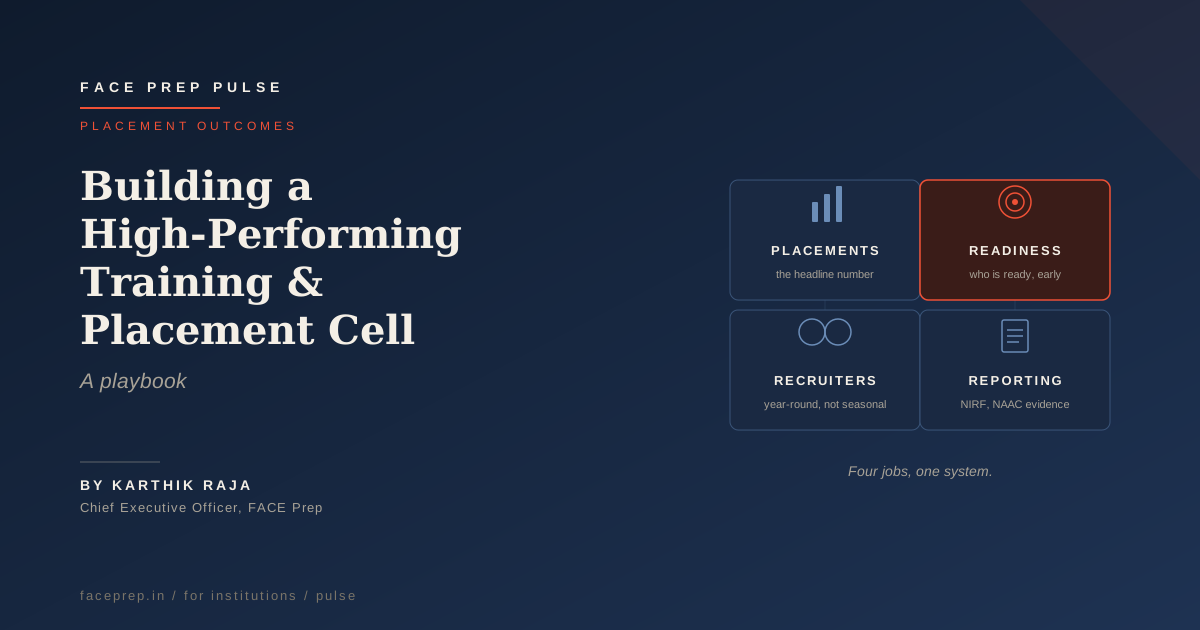
The first is the headline placement number. The second is student readiness, which is what produces that number. The third is the relationship with recruiters, which decides how many companies turn up and how many slots they bring. The fourth, and the one cells often discover late, is the institution’s own reporting. The cell’s placement records feed straight into NIRF, the government’s ranking framework, and into NAAC accreditation, so they are not just an internal scorecard. They shape how the institution is ranked and accredited, which is why a sloppy placement sheet quietly costs the institution twice.
A cell that treats these four as one system, rather than four separate fire drills, is already ahead.
Why many cells underperform
The common failure is not laziness. It is structure. Many cells activate only once a drive is announced, then try to prepare students in the short window before it. The ones who are not ready interview anyway and are rejected, the recruiter leaves unconvinced, and the next year brings fewer slots or no visit at all. The loop is self-reinforcing, which is how a hard-working cell can still watch its number stay flat.
The second structural problem is visibility. When readiness lives in a spreadsheet that is updated once a season, the cell only learns a student was unready once the rejection letter lands. By then it is too late to help.
There is now a third pressure on the cell that did not exist in earlier years: verification. After a series of recruitment scams in 2025, including the Thynk Tech incident that left around five hundred IT engineers and interns without pay, placement cells across the country have had to add a vigilance layer to their workflow. Prof. Sanjay S. Jadhav, the secretary of the Maharashtra Association of Training and Placement Officers (MaTPO), which links over five hundred TPOs across Maharashtra, told the Times of India that the body now asks members to check a new recruiter’s registration on the Ministry of Corporate Affairs portal, verify client credentials, and look at employee reviews before allowing the company on campus. The cell’s job has quietly grown by one whole responsibility, even as the placement number has not got any easier.
The playbook: four moves
1. Make readiness visible before the season
Score every student on the five dimensions that decide outcomes: aptitude, coding, communication, interview readiness, and AI fluency. Then keep scoring through the year. The point is not the assessment, it is the visibility: knowing by October which students are ready, which are nearly there, and which need the most work, while there is still time to act. Our H.E.R.O.S. platform was built for this, but the principle matters more than the tool. A cell that can see readiness early can fix it early.
2. Keep recruiter relationships warm all year
Recruiters are not a list you call in September. They are relationships you maintain. The cells that keep companies coming back stay in contact between seasons, share how last year’s hires are performing, host them for guest sessions and pre-final-year internships, and make the campus easy to recruit from. A recruiter who has made good hires on your campus and been treated as a partner has every reason to return with more slots.
The shape of those touchpoints matters too. The cells that get repeat visits keep the conversation about outcomes, not about asks. They send a short update on the previous batch in February, a hosted-session offer in July, and a hiring-window check-in in early August. None of it is a request. By the time the recruiter is planning their campus list for the year, your name is already on it. The asks happen later, from a position of established trust, and they convert.
3. Train every batch, not just the final-year top tier
It is tempting to pour effort into the students at the top who will place regardless. The number climbs when the middle band of the cohort improves, and that band is built over years, not in a final-year push. Spread structured preparation across the pre-final and final years so the season opens with a cohort that is already prepared.
The operational version of this is simpler than it sounds. You set a readiness target by branch, say a six out of ten on each of the five dimensions, and you track the share of the cohort that has crossed it. Every training hour and every mock session is aimed at moving more students above the line. The thirty students who are already at nine do not need another aptitude class. The hundred who are at five and a half do, and that is where the placement rate is won.
4. Build AI readiness in, and report outcomes cleanly
The market has moved. AI now runs through company assessments, including the TCS National Qualifier Test, and recruiters increasingly hire freshers for demonstrable AI skill rather than the degree alone. Fold AI fluency into readiness as a layer on top of solid coding, not as a standalone workshop. And as you do all of this, keep the records clean, because the same data that tells you who is ready becomes your NIRF and NAAC evidence at the end of the year.
A two-person cell that stopped scrambling
The first time I sat with the placement team at a Tier-3 engineering college in Madhya Pradesh, the entire operation was two people and a shared spreadsheet. Twelve hundred students, a season that ran from August to December and swallowed every other priority for those five months, and a placement number that had sat near 38 percent for three years. Their working theory was that more recruiters would fix it.
The redesign did not start with recruiters. It started with measurement. We ran a baseline of the pre-final year over two weeks, scored every student across the five readiness dimensions, and showed the Principal a cohort view rather than a brochure. The conversation moved from “do we have enough companies” to “do we have enough ready students for the companies we already have.” That single shift unlocked the rest.
The cell’s two staff stopped doing the training themselves. We split their time so one owned recruiter relationships year-round, in touch with about thirty companies through the year rather than scrambling against a list of eighty in August. The other owned the cohort: who was on track, who was slipping, who needed which mock format. The training was routed by gap, not by batch, and the AI layer was woven in for the CSE-heavy students who could already write a clean loop.
The first cycle moved the headline number by about eight percentage points, and the share of mid-tier company offers climbed faster than that. By the second cycle, recruiter conversations had changed character. Two of the original eighty had stopped responding, but four mid-sized analytics and consulting firms that had never visited had a panel on campus, because the placement cell could send them a screened shortlist before they asked.
The cell, again, did not get bigger. What changed was the system around it, which took on the work the two of them had been trying to do by hand.
Why we stopped chasing logos
Early on, we measured a cell’s success by the logos on its placement brochure. We chased big-brand recruiters and treated the arrival of a famous company as the goal. It made for a good photograph and a thin placement rate, because a single marquee recruiter taking five students does less for your number than ten steady mid-tier companies taking thirty.
The other mistake was treating the cell as a season-only operation. When the work starts in September, the year is already lost. The cells that improved moved the work earlier and kept it running all year, so by the time the season opened, they were converting students they already knew were ready, not finding out in the interview room who was not.
A 30-60-90 day plan for the cell itself
For a Principal or VC reading this who wants a practical starting point, the first ninety days of a cell rebuild look like this. It assumes you are not adding headcount, only redirecting attention.
| Phase | What the cell does | What the Principal or VC sees |
|---|---|---|
| First 30 days | Baseline the pre-final year on the five dimensions. Pull last three years of placement records into one place. Audit the active recruiter list and mark which fifteen relationships matter most. | A one-page cohort readiness report and a 15-company recruiter map, instead of a brochure. |
| Days 31 to 60 | Route training by gap, not by batch. Re-establish contact with the fifteen priority recruiters, offering them last year’s outcomes and a guest-session slot. Add a verification step for any new recruiter approach. | Weekly readiness deltas and the first “we are back in touch” responses from past recruiters. |
| Days 61 to 90 | First mock drives in real company formats, scored. Re-measure the cohort. Share the half-cycle picture with management. | Concrete evidence of who is converting and who needs the next push, in time to act. |
None of this requires a new product or a new team. It requires the cell to act on data the institution has always had, and to treat recruiter trust as a year-round asset rather than a seasonal ask.
How this feeds NIRF and NAAC reporting, without extra work
This is the quiet upside many cells miss. The same readiness and outcome records the playbook produces are exactly what NIRF and NAAC want to see at the end of the year. NIRF’s Graduation Outcomes parameter asks for placement and higher-studies data with documentary evidence; NAAC’s student-progression criterion asks the same in a different vocabulary. A cell that has been keeping clean records as it goes is sitting on accreditation evidence, not facing a March data hunt.
The practical move is to align the cell’s own internal sheet with the NIRF and NAAC field names from the start of the year. Same student, same offer, same date, captured once and reusable everywhere. When the accreditation team comes asking, the cell hands them a file rather than a deadline. The placement work and the reporting work stop being two different jobs.
Where to start
If you are rebuilding a cell, start with visibility. Run a baseline this term, get an honest readiness picture of the current pre-final year, and decide where the training hours go based on data rather than instinct. Then put one person in charge of recruiter relationships as a year-round responsibility, not a seasonal one. Those two moves, made early, change the season that follows.
A placement cell is not judged on how hard it works in season. It is judged on the share of students who walk out with an offer, and that is settled long before the first company arrives. If you are rebuilding yours and want a second pair of eyes on the system, the For Colleges / Universities page shows how we work with cells like yours.
Primary sources
- NIRF: Graduation Outcomes is one of five ranking parameters (Ministry of Education, India Rankings)
- NAAC reform: placements sit under student progression; binary and maturity-based accreditation (NAAC/NBA chair Anil Sahasrabudhe, Careers360, 2025)
- India's AI Talent Inflection Point: 40% of employers prefer demonstrable AI skills over degrees (NASSCOM-Indeed, May 2026)
- Placements dip at Tier-2/3 engineering colleges; principals report about 40% placement (Times of India, Aug 2025)
- MaTPO secretary Prof. Sanjay S. Jadhav on tightened recruiter verification by Maharashtra placement officers (Times of India, May 2025)
Frequently asked questions
What does a high-performing placement cell do differently?
It runs as a year-round system rather than a placement-season operation. The strongest cells know who is ready before drives begin, keep in touch with recruiters between seasons, prepare every batch and not just final-year toppers, and keep their placement data clean enough to use for NIRF and NAAC reporting.
How many people does a placement cell need?
Fewer than most expect, if the work is systematised. The constraint is rarely headcount. It is whether readiness is visible early and whether recruiter relationships are maintained through the year. A small cell with a clear system outperforms a larger one that only activates in season.
How does the placement cell affect our NIRF or NAAC scores?
Directly. NIRF counts graduation outcomes, which include placements and higher studies, among the handful of parameters it ranks on, and NAAC weighs student progression too. A cell that records outcomes accurately through the year turns placement work into accreditation evidence rather than a last-minute data hunt.
Do we need to teach AI to run a good placement cell now?
Increasingly, yes, as a layer on top of fundamentals. Employer demand has shifted toward demonstrable AI skill, and AI now sits inside the company assessments students face, so readiness tracking should include AI fluency alongside aptitude, coding, and communication. The cell does not have to deliver this alone.
How do we protect students from fraudulent recruiters approaching the cell?
This is a real risk now. After the 2025 Maharashtra IT job-scam incidents, MaTPO and its TPO members tightened verification, checking MCA registration, asking for client credentials, scanning forums for employee reviews before allowing a new recruiter on campus. A useful rule: a new company gets a verified background check, a known partner's referral, or a small first-pilot drive, before the cell offers the full batch.
What does a year-round recruiter relationship actually look like?
Three or four touchpoints a year per active recruiter. A short update on how last season's hires are performing on the floor, an invitation to a guest session or a panel, a pre-final-year internship pipeline if your batch quality supports it, and a quiet pre-season conversation about hiring expectations. None of it is a sales call. It is the ordinary grammar of a working partnership, and it is the difference between fifteen visits a year and eight.
How is FACE Prep involved with placement cells?
We work alongside the cell, not in place of it. We bring the readiness baseline, training routed to where each student's gaps actually are, including AI, company-aligned mock drives, and a live read on who is ready and who is not, while the cell keeps control of the relationships and the calendar. It is the same approach we have refined with 2,000+ colleges and universities over 18 years.
Wondering how this applies to your college or university?
Message the FACE Prep team on WhatsApp. We work with 2,000+ institutions on placement training, academic integration, and upskilling programs. Tell us where your placements stand today, and we will share what has worked for institutions like yours.
WhatsApp the FACE Prep teamAbout the author
Karthik Raja
Chief Executive Officer, FACE Prep
Karthik Raja is the CEO of FACE Prep, with 15+ years in education and skilling. He works with colleges and universities across India on placement strategy and outcome-based training that moves real placement numbers.