AI Skills for Engineering Students: What to Teach, and When
The useful question about teaching AI is not only what, but when. A year-by-year sequence that puts fundamentals first and treats judgment as the real AI skill.
 Venkataraghulan V 8 min read
 The most common question I get from HODs and Deans about AI is what to teach. It is a reasonable question, and I usually redirect it, because the more useful one is when. Get the timing right and the content largely takes care of itself; get the timing wrong, and even the best content in the world will not stick.
I have watched a lot of well-meant AI teaching fail for exactly one reason: it arrived before the foundation that makes it useful. So this piece is organised around the sequence first, and the content second, which is the order that actually works.
Start with the question of when
AI skills sit on top of other skills. They are not a foundation; they are a layer, and a layer needs something underneath it. The thing underneath is the ability to read and write correct code and to reason about a problem. Without that, AI teaching has nothing to attach to.
This is why timing decides everything. A student who is taught to lean on an AI assistant before they can write a clean program themselves does not learn faster; they learn to depend on something they cannot evaluate. When the assistant is confidently wrong, and it often is, the student has no way to know. So the first principle of teaching AI is patience: build the base, then add the layer, in that order, across the years rather than in a single rushed course.
The skill that matters most is judgment
If a college teaches only one AI skill, it should be judgment: the ability to look at what a model produces and tell whether it is right, and to fix it when it is not. This is the skill recruiters now value most, and it is the one most AI teaching skips in favour of generation.
The reason judgment matters so much is visible in how working developers actually relate to these tools. The 2025 Stack Overflow Developer Survey found that 46 percent of developers distrust the accuracy of AI output, against only a third who trust it, and that 66 percent are frustrated by AI solutions that are almost right but not quite. Notice what that describes: professionals who use AI constantly and have learned, through experience, that its output needs checking. The almost-right answer is the dangerous one, because it passes a casual glance and fails in production. A student who can catch the almost-right answer is doing the highest-value work in the whole AI workflow. A student who cannot is a liability with a tool, not an asset.
So the spine of any AI teaching should be verification, woven through everything else. Generate, then check; produce, then defend. That habit is worth more than any amount of prompt fluency.
A year-by-year sequence
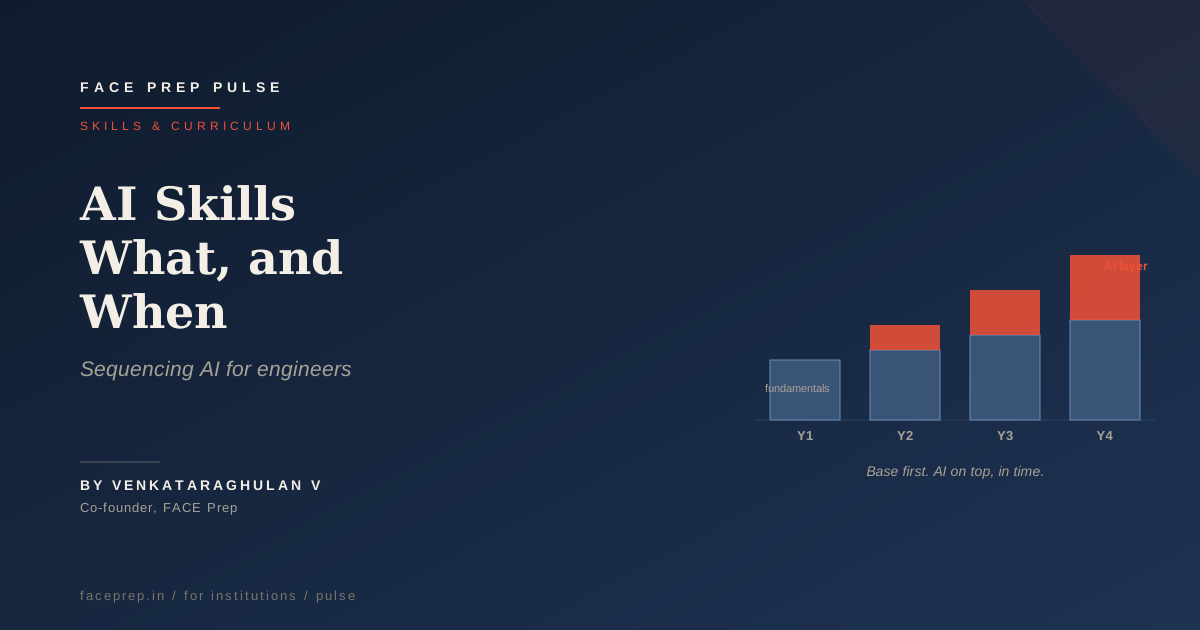
Here is a sequence that works across a four-year programme. The years are a guide, not a rule; the principle is that each stage rests on the one before it.
| Year | Foundation in place | What to add |
|---|---|---|
| Year 1 | Reasoning, programming basics, correct simple code | No AI dependence; build the base. AI seen, not leaned on |
| Year 2 | Can read and write code, understands data structures | AI introduced as a tool, used and then checked on real tasks |
| Year 3 | Comfortable coder, some projects | AI inside real workflows; verification and debugging AI output as a habit |
| Year 4 | Solid base, project experience | Role-specific depth matched to the student’s target, plus model limits and ethics |
The shape is the message. The early years are mostly about the foundation, with AI present but not depended on. The middle years add AI as a tool, always paired with checking. The final year matches depth to where the student is heading, since a student aiming at an AI-specific role needs more than one aiming at a core-engineering job. A college that compresses this into one final-year course is trying to build the top of the layer cake without the layers beneath it.
Two transitions in this sequence deserve the most care, because they are where colleges slip. The first is the move from Year 1 to Year 2, where AI enters. The temptation is to let it in early to look modern, but a student who meets the assistant before they can write a clean program learns dependence instead of skill. Hold the line in the first year; the patience pays back for three. The second is the move from Year 3 to Year 4, where depth diverges by destination. Up to Year 3 the sequence is broadly common to every student. In the final year it should fork: the minority heading into AI-specific roles go deeper into models and systems, while the majority consolidate fluency and judgment on top of their core discipline. Treating every final-year student as a future AI specialist wastes the time of the many to over-serve the few, and treating none of them as one fails the students who are headed exactly there. The skill is to read where each student is going and set the final-year depth accordingly.
Where colleges get the sequence wrong
The most common mistake is teaching generation first and judgment never. A college, wanting to look current, runs a course that teaches students to produce code and text from prompts, and stops there. The students come away able to generate output quickly and unable to tell whether it is any good, which is precisely the profile recruiters have learned to screen out. The complaint I now hear from hiring teams is about graduates who can prompt but cannot reason about what comes back, and it traces directly to this inverted sequence.
The second mistake is teaching AI in isolation from coding, as a separate subject with its own silo. AI skill is not separate from coding skill; it is a way of working with code and data. Taught in a silo, it never connects to the student’s actual programming practice, and the connection is the entire point. The fix in both cases is the same: teach AI on top of, and woven into, real coding work, with verification as the constant thread.
There is a third, quieter mistake worth naming: chasing the newest tool every term. Because the tools move fast, a college can spend its whole effort keeping its AI course current and still leave students unable to evaluate any of them, since the underlying judgment was never built. The tools will keep changing long after a student graduates. What does not change is the habit of checking output and the fundamentals it rests on, so that is where the teaching effort should concentrate. A student who has those can pick up next year’s tool in a weekend; a student who only knows this year’s tool is back to the start when it is replaced.
What to teach, concretely
With the sequence in place, the content is straightforward. Four capabilities cover most of what an engineering student needs.
The first is using AI usefully on a real task, which is more than prompting; it is knowing when an AI step helps and when it is faster to do the work directly. The second, and the most important, is verification: reading AI output critically, testing it, and correcting it, the judgment skill above. The third is integration: folding an AI step into a working solution, with the student responsible for the whole result rather than just the generated fragment. The fourth is understanding limits and ethics: knowing where models fail, where their data comes from, and where it would be wrong or unsafe to rely on them. Prompt technique is worth a session, not a semester; these four are the durable content.
How verification is taught in practice
Because judgment is the skill that matters and the one colleges find hardest to teach, it is worth being concrete about how it is built. It is not a lecture topic; it is a habit formed through repetition on real tasks.
The core exercise is simple and endlessly reusable. Give a student a coding problem they understand, have them solve part of it with an AI assistant, and then make the assignment about what the assistant got wrong. The student has to find the flaw the model introduced, explain why it is a flaw, and correct it. Marks go to the catch and the fix, not to the speed of generation. Run that exercise weekly across a term and students stop trusting output at a glance, which is exactly the instinct working developers have learned the hard way.
Two refinements make it sharper. First, vary the failure: sometimes the AI’s code is subtly wrong, sometimes it is correct but inefficient, sometimes it solves a slightly different problem than the one asked. A student who learns to distinguish these is doing real engineering judgment. Second, ask the student to defend the final solution aloud, as they would to a reviewer or an interviewer, because being able to say clearly why the corrected version holds up is what turns a private catch into a hireable skill. None of this needs special tooling; it runs on the coding setup a college already has, and it builds the one capability the market is now screening for.
A college in Uttarakhand that fixed the order
A college in Uttarakhand had done what it thought was the responsible thing and added an AI course to its final year. A year on, the placement team was puzzled that it had not helped, and some faculty had concluded that AI teaching simply did not move outcomes.
The problem was the order, not the intent. The AI course taught generation to final-year students whose coding base was uneven, in isolation from their regular programming work, and in a single concentrated block. Students learned to produce output they could not evaluate, which is exactly the profile interviews were rejecting. Nothing about the sequence gave judgment a chance to form.
The college re-sequenced rather than abandoned. It moved the foundation work earlier and lighter, introduced AI as a tool from the second year on top of regular coding, and made verification the recurring exercise: here is a task, use the assistant, now find what it got wrong. By the time students reached interviews, working with and checking AI was a habit rather than a topic. The outcomes followed, and the faculty stopped concluding that AI teaching did not work; it had simply been taught in the wrong order. The content had barely changed. The timing had.
A note on what not to over-teach
It is worth saying what not to do, because over-teaching AI is now as common a mistake as ignoring it. A college does not need every student building large models, and it should not turn a general engineering programme into an AI specialisation for everyone. Most students need fluency and judgment with AI tools on top of strong fundamentals, not deep model-building expertise, which belongs to the minority heading into AI-specific roles. The World Economic Forum found that 85 percent of employers plan to prioritise upskilling their people, which tells you the market expects to keep teaching specialised skills on the job; a college’s task is to send students who can learn that depth quickly, grounded in fundamentals and judgment, not to attempt all of it in four years.
For an HOD or a Dean, the freeing part of this is that the sequence matters more than the syllabus, and the sequence is within your control. Get the order right, make verification the constant thread, and match depth to the year, and the content falls into place. To see how an AI sequence like this could be layered onto your existing programme without crowding it, the For Colleges / Universities page sets out the approach we use with an institution.
Primary sources
- 46% of developers distrust AI output and 66% are frustrated by AI answers that are almost right but not quite; positive sentiment toward AI tools fell to 60% (Stack Overflow Developer Survey 2025, Jul 2025)
- 85% of employers plan to prioritise workforce upskilling through 2030 (World Economic Forum, Future of Jobs Report 2025)
Frequently asked questions
When should a college start teaching AI skills?
After the coding base is sound, not before. In the first year the priority is fundamentals: reasoning, programming basics, and the skill to write code that is correct. AI as a tool is best introduced once a student can already write and read code, usually from the second year, because a student who cannot judge whether code is correct cannot judge whether an AI's code is correct either. Sequencing it this way is the difference between AI skills that stick and a workshop that fades.
What is the single most important AI skill to teach?
Judgment: the ability to check what a model produces and catch where it is wrong. This matters because AI output is often plausible but flawed. The 2025 Stack Overflow Developer Survey found 46 percent of developers distrust AI output and 66 percent are frustrated by answers that are almost right but not quite. A student who can spot and fix that gap is far more employable than one who can only generate text from a prompt.
Should first-year students use AI tools?
Sparingly, and not as a substitute for learning the basics. A first-year student leaning on AI to write code they cannot yet write themselves skips the very learning that makes them useful later. The safer approach is to build the fundamentals first, with AI introduced as a tool once the student has enough grounding to judge its output. The goal is a student who uses AI to go faster, not one who depends on it to function.
Is teaching prompt engineering enough?
No. Prompting is the easiest and least durable part of working with AI, and it changes with every tool. The durable skills are verification, folding an AI step into a working solution, and understanding a model's limits. A course that stops at prompting teaches students to generate output they cannot evaluate, which is the opposite of what recruiters now screen for.
How do we teach AI skills without specialised infrastructure?
Most of it needs no special infrastructure. The core practice is giving students real coding tasks and having them use, then critically check, an AI assistant on those tasks: extend a program, find the bug the AI introduced, explain why the fix works. That runs on the same coding environment a college already uses, and it builds judgment, which is the skill that matters, rather than tool familiarity that dates quickly.
Do non-CS engineering students need AI skills too?
Yes, but a different depth and flavour. A mechanical or civil student does not need to build models, but does benefit from AI literacy relevant to their field: using AI tools in their design or analysis workflow and judging the results. The sequencing principle is the same across branches, fundamentals first, then AI on top, with the specific AI skills matched to what that discipline actually uses.
How does FACE Prep approach teaching AI skills to students?
We sequence it: the base comes first, then AI work is layered onto students whose coding is already sound, focused on judgment and real tasks rather than prompting alone. The work is woven through the existing coding training rather than run as a separate event, and the depth is matched to each student's year and target role. We have built this evidence-led method with institutions over 18 years, and adapted it to the AI era.
Wondering how this applies to your college or university?
Message the FACE Prep team on WhatsApp. We work with 2,000+ institutions on placement training, academic integration, and upskilling programs. Tell us where your placements stand today, and we will share what has worked for institutions like yours.
WhatsApp the FACE Prep teamAbout the author
Venkataraghulan V
Co-founder, FACE Prep
Venkataraghulan V is a co-founder of FACE Prep. Previously at Deloitte, he has built and scaled technology products used by 5M+ learners, and leads FACE Prep's work on AI-era employability and the H.E.R.O.S. and DOJO platforms.