AI and Fresher Hiring: What the Shift Means for Your Placement Cell
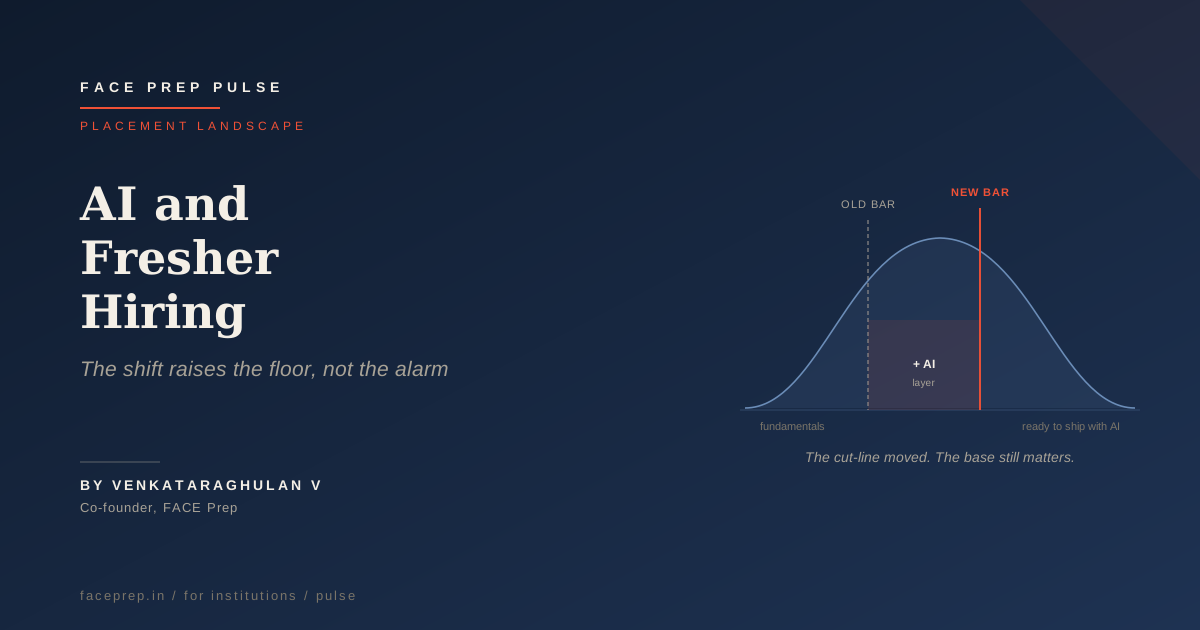
AI is not removing entry-level engineering roles. It is raising the floor of what they assume. Here is what that asks of a college placement cell, in practical terms.
 Venkataraghulan V 8 min read
 A fresher who joins an engineering team in 2026 is handed an AI assistant on the first day and expected to be quicker because of it. That one fact has quietly reshaped what recruiters look for, and most placement cells have not caught up to it.
I want to be careful here, because this is a topic that attracts more noise than almost any other in our work. The fear version says AI is wiping out entry-level jobs and students are finished. The hype version says every student must become an AI engineer by next semester. Both are wrong, and a placement cell that acts on either does real harm. What is actually happening is narrower and more manageable, and it is worth seeing clearly.
What an entry-level job assumes now
The work a fresher joins has changed, even where the job title has not. The teams hiring them are already built around AI in a way they were not three years ago.
Look at the scale of it inside one recruiter. In its FY2025 reporting, Accenture described around 77,000 AI and data professionals and more than 550,000 staff trained in generative AI, on the way to a target of 80,000 specialists. That is not a research lab off to one side; it is the shape of the teams a new hire is placed onto. When the surrounding team works with AI by default, the assumption about what a junior member can do shifts with it.
The demand behind this is not a blip either. NASSCOM has projected the Indian AI market growing at 25 to 35 percent a year through 2027, with demand for AI-capable talent running ahead of supply. A market growing at that rate, inside firms already restructuring their work around AI, is what sits behind the change a placement cell feels as tougher interviews.
So the entry-level job still exists. What it assumes on day one is different.
The screen moved from can you code to can you ship with AI
For years, the core question a technical screen answered was simple: can this student write correct code under some pressure. That question has not gone away, but a second one now sits next to it, and it carries growing weight: can this student build and ship something workable with AI in the loop, and reason about what the AI hands back.
This is a real shift in what is being read, and it shows up in the interview. A candidate who can produce a function from memory but freezes when asked to use an assistant to extend it, debug its output, or judge whether it is correct, now looks less ready than a candidate who is fluent at that collaboration. The first student has the older skill. The second has the one the team actually needs from day one.
Cognizant put the graduate side of this well in a piece on generative AI and the new workforce. Its argument was that the path for a graduate has moved from a fixed academic model toward continuous, self-directed learning, and that the graduates who thrive treat AI as a tool that raises their value rather than a threat to it. Tellingly, the same company built a self-paced course in generative AI, Python, and prompt engineering specifically for new graduates. When recruiters are training incoming graduates in AI before they start, the signal to a college is hard to miss: this is now part of the baseline, not an advanced elective.
It helps to make the shift concrete. A few seasons ago, a typical technical interview asked a student to reverse a linked list or find a duplicate in an array, and a clean solution from memory was a strong signal. A growing number of interviews now hand the student a half-built feature and an assistant, and watch how they work: do they prompt it usefully, do they spot the bug it introduces, can they explain why the corrected version is right. The underlying computer science is the same. What is being read is whether the student can drive the tool rather than be driven by it. A student drilled only on memorised solutions can look surprisingly weak in that format, which is why the older preparation alone now leaves marks on the table.
What AI-aware questions look like in a company test
It is worth being specific about how this reaches the screening round, because a placement cell can only prepare students for a format it can describe. Three patterns are showing up across company assessments, and none of them is exotic.
The first is the assisted-coding task: the student is given a problem and access to an AI tool, and is judged not on whether they can write every line unaided but on the quality of the final, working solution and their judgement along the way. The second is the correction task: the student is shown AI-generated code that looks plausible but contains a flaw, and asked to find and fix it. This tests the single most important habit of working with AI, which is not trusting the output blindly. The third is the reasoning task, where the question itself is framed around an AI system, and the student has to reason about what it would and would not do well.
A college does not need special technology to prepare students for any of this. It needs to put these formats in front of them repeatedly, as part of normal coding practice, so the real assessment is not the first time a student has seen the shape of the question.
Why the one-off AI workshop does not work
The instinct, once a placement cell accepts the shift, is to schedule an AI workshop. A day, maybe two, an external speaker, a certificate at the end. I understand the appeal, and I have watched it fail enough times to be blunt about it.
AI fluency is not a topic you can cover in a sitting. It rests on coding fundamentals, and it is built through repeated practice on real tasks. A workshop dropped onto students who are still unsure of loops and data structures produces a photograph of progress and very little of the substance. Worse, it can mislead a college into believing the gap is closed when it has barely been touched.
There is an order to this that matters more than the intensity. A student who cannot yet write a clean, correct program cannot use an AI assistant well, because they cannot tell when its output is wrong, and a confident wrong answer from a model is more dangerous than no answer at all. Fundamentals first, then AI practice layered on the students ready for it, repeated across two years until the habit holds. That sequence is unglamorous and it is what works.
What the placement cell can do about it
The practical response is smaller than the anxiety around it. Four moves cover most of it.
First, fold AI into the readiness picture you already build, rather than treating it as a separate initiative. If your cell baselines students on aptitude, coding, and communication, add a measure of whether they can work with AI on a real task, and track it the same way.
Second, sequence it correctly. Keep building the coding and aptitude base for everyone, and start AI practice with the students whose fundamentals are solid enough to benefit. Pushing AI onto a student who cannot yet code is effort spent in the wrong place.
Third, make the practice resemble the work. The useful exercise is not generating code from a prompt; it is using AI to extend or debug a real piece of work, then checking and correcting what it returns. That mirrors what a team will ask of a new hire, and it is also closer to the AI-laced questions now turning up inside company assessments.
Fourth, aim it. The students targeting captive centres and product firms need this layer most, because those are the destinations screening for it. The students heading for high-volume service roles need a lighter version, since those roles still hire largely on the older fundamentals. Matching the depth of AI work to the destination keeps the effort honest.
A placement cell in Uttar Pradesh that made AI ordinary
A university in Uttar Pradesh we have worked with had done the responsible thing a year earlier: it ran a well-attended AI workshop for its pre-final year. When the season came, it made no difference to outcomes, and the placement head was understandably disillusioned with the whole subject.
The problem was not the students or the appetite. It was the shape. The workshop had been a single event, disconnected from the coding training, delivered to a cohort whose coding base was uneven. Students left with slides and no changed habit.
We rebuilt it as a thread rather than an event. The coding training stayed the spine, and once a student’s fundamentals were sound, a short weekly AI task was added on top: extend this small program with an assistant, find the bug it introduced, explain why the fix works. Nothing dramatic, just steady practice tied to real code. By the next season the students who reached the centre and product interviews were no longer thrown by the AI-collaboration questions, because they had been doing exactly that, in small doses, for two terms. The change was not a bigger event. It was the same content made ordinary and continuous, which is how a skill becomes real.
The placement head noticed a second, quieter change. The faculty had been wary of AI, half-expecting it to expose gaps in their own knowledge, and the weekly-task format defused that. Because the AI work was tied to ordinary coding exercises they already taught, the staff could run it without becoming AI experts overnight. The students learned a habit, and the faculty learned that the shift asked less of them than they had feared. Both of those mattered more to the outcome than any single piece of content.
Where AI is not the answer
A note of caution, because the danger now runs in both directions. A college that ignores AI leaves the better offers on the table. A college that overcorrects, chasing AI at the expense of the fundamentals, does just as much harm, and it is the more fashionable mistake.
The aptitude and coding base is still what gets most students placed, and it is still the foundation every AI-augmented role stands on. There is no version of this where a student weak on the basics is rescued by AI tools, and a programme that promises that is selling a shortcut that does not exist. There are also whole categories of roles, in the service tier and in core engineering, where deep AI skill is simply not what the recruiter is screening for, and time spent forcing it there would be better spent elsewhere. The skill is to add AI where the destination rewards it, and to protect the fundamentals everywhere. Calm sequencing beats enthusiasm here, every time.
What this means for the next two years
For a Principal or VC, this is a manageable shift, not an emergency. The students are as capable as ever, and the demand for engineers across the country has widened rather than shrunk. What has changed is the baseline a fresher is hired against, and the response is to build the coding base you always have, then weave AI through it for the students ready to use it.
The colleges that treat AI as one more layer of the readiness work, sequenced and measured like the rest, will quietly do well over the next two seasons while others either ignore the shift or thrash against it. If it would be useful to look at how AI readiness could sit on top of your existing placement training rather than alongside it, you can see how we approach that work on the For Colleges / Universities page.
Primary sources
- Accenture FY2025: ~77,000 AI and data professionals, on track to 80,000 by FY2026; 550,000+ staff trained in generative AI (Accenture 360 Value Report 2025)
- Gen AI: A gamechanger for graduates entering the workforce (Cognizant insights blog, 2024)
- Cognizant Launch: a self-paced generative AI, Python and prompt-engineering course for new graduates (Cognizant Careers)
- India's AI market projected to grow 25-35% CAGR through 2027; AI talent demand outpacing supply (NASSCOM, Advancing India's AI Skills)
Frequently asked questions
Is AI taking away entry-level jobs for engineers?
Not in the way the headlines suggest. The roles are changing rather than disappearing. A fresher now joins a team that already uses AI, and is expected to be productive with it sooner. Some routine first-year tasks are automated, which raises the bar on what a new hire contributes, but it does not remove the role. The students who learn to work with AI on top of their fundamentals are more valuable, not less needed.
What does it mean that AI raises the floor for fresher hiring?
It means the baseline expectation of a new hire has gone up. Where a fresher once proved themselves over months, a recruiter now assumes they can use AI tools to be useful faster. The screen has shifted accordingly, from whether a student can write code in isolation to whether they can build and ship something workable with AI assistance, and reason about what the AI produces.
Should our college run an AI workshop to prepare students?
A one-off workshop rarely moves anything. AI fluency is not a topic you cover in a day; it sits on coding fundamentals and is built through practice over months. A workshop bolted onto a cohort whose coding base is still uneven produces a certificate and little real capability. Weave AI through the existing training instead, on top of a solid coding base.
Do all recruiters now expect AI skills from freshers?
No, and it is important not to overcorrect. The high-volume service roles still hire largely on aptitude, communication, and correct code, and for plenty of students that is the right place to start a career. AI matters most for the captive centres and product firms that are raising their share of hiring. The safe strategy is a strong base for everyone, with AI built on top for the students aiming at the destinations that screen for it.
How early should AI readiness start?
After the coding base is in place, not before. A student who cannot yet write a correct, clean program will not get far with an AI assistant, because they cannot tell when its output is wrong. Build coding fundamentals first, usually through the pre-final year, then layer AI practice on the students who are ready for it. The order is the whole point.
What is the risk of ignoring this shift?
The risk is not that your students become unemployable overnight. It is quieter than that. Over a couple of seasons, the better-paid offers at centres and product firms go to students from colleges that prepared for the new screen, while a college that trained only for the old one keeps its students in the shrinking, lower-paid pool. The cost is opportunity, not collapse, which is exactly why it is worth fixing calmly rather than in a panic.
How does FACE Prep approach AI readiness for placements?
We treat it as a layer on the existing readiness work, not a separate product. Students build coding and aptitude fundamentals first, then practise using AI in real workflows, reading and correcting what a model produces, and handling the AI-laced questions now appearing in company tests. It is the same evidence-led approach we have used across institutions for 18 years, with AI added where the market now pays for it.
Wondering how this applies to your college or university?
Message the FACE Prep team on WhatsApp. We work with 2,000+ institutions on placement training, academic integration, and upskilling programs. Tell us where your placements stand today, and we will share what has worked for institutions like yours.
WhatsApp the FACE Prep teamAbout the author
Venkataraghulan V
Co-founder, FACE Prep
Venkataraghulan V is a co-founder of FACE Prep. Previously at Deloitte, he has built and scaled technology products used by 5M+ learners, and leads FACE Prep's work on AI-era employability and the H.E.R.O.S. and DOJO platforms.